
Apple Patents Invisible Light Technology That Keeps AR Headsets Tracking Hands in the Dark
Hand tracking on AR headsets falls apart in dim rooms because the cameras can't see your hands. Apple's new patent describes an invisible infrared light system that illuminates the space in front of you so the headset never loses track of where your fingers are.
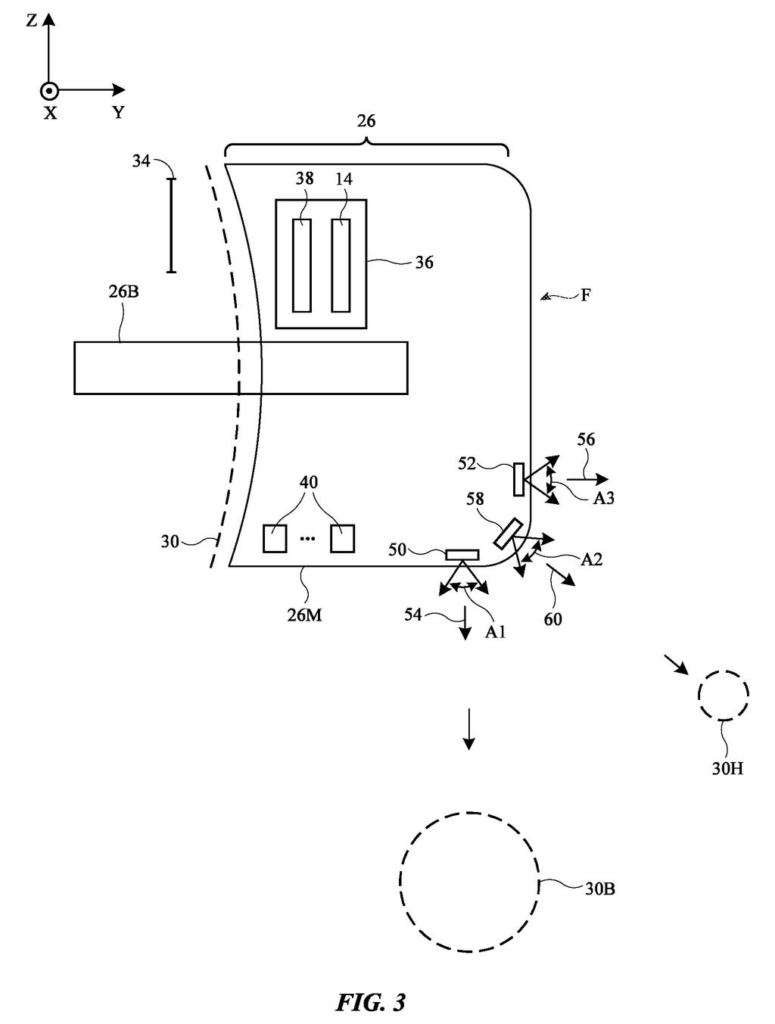
How Apple wants to fix hand tracking when the lights go out
Cameras need light to see, and that's a real problem for AR headsets that rely on cameras to follow your hand gestures. In a dark room, those cameras go blind, and the headset loses your hands entirely.
Apple's patent describes a fix: an infrared light source built into the headset that floods the area in front of you with light that's invisible to human eyes but perfectly visible to the tracking cameras. When the room is bright, the system stays off. When it gets dim, it kicks in automatically.
The system has two modes. It can cast a wide infrared beam across the full coverage area at once, or it can use a narrower, more focused beam that sweeps across the space. The focused approach uses less power, which matters a lot for a device you wear on your face.
… an infrared light source configured to emit infrared light across an illumination angle to illuminate a first area; and a camera configured to capture infrared images of a second area that overlaps the first area …
Translation: The headset uses invisible infrared light and a camera to see what you are doing in the dark.
How infrared beams cover the space in front of the headset
The patent covers a head-mounted device with a dedicated supplemental illumination system designed to maintain hand and object tracking in low-light environments.
At the core is an infrared light source, which can be an infrared LED or an infrared laser, paired with one or more tracking cameras sensitive to infrared wavelengths. The key design detail in the independent claim is that the camera's field of view is wider than the illumination angle of the light source. This means the light doesn't need to cover the entire camera view at once; the system can steer or scan a tighter beam across the broader area instead.
Apple describes two illumination strategies:
- Wide-beam mode: a single infrared beam covers the full tracking area simultaneously, simpler but more power-hungry.
- Steered-beam mode: a narrower beam is directed across different parts of the coverage area over time, reducing power draw by illuminating only where the camera is actively looking.
The system activates based on ambient lighting conditions, meaning it only runs when the environment is too dark for the cameras to work without help. The infrared light is invisible to the wearer, so there's no visible flash or glow disrupting the experience.
In dim ambient lighting conditions, a supplemental illumination system may be activated to provide supplemental illumination for the tracking cameras.
Translation: When the room gets dark, built in lights turn on so the headset can keep tracking your hands.
What this means for Vision Pro and hands-free AR control
For AR headsets like Apple Vision Pro, hand tracking isn't a nice-to-have extra. It's the primary way you interact with everything. If tracking fails in a dim living room or a darkened movie theater, the whole interface breaks down. A built-in infrared fill light solves that at the hardware level, which is a more reliable fix than trying to compensate in software.
Apple's interest in robust hand-tracking hardware shows up here in a practical way. The steered-beam approach is the detail worth watching: by sending a focused beam only where the camera needs it, Apple could significantly cut the power cost of always-on tracking. On a face-worn device where battery life and heat are constant concerns, that tradeoff has real product implications.
Apple's 59th in our AR glasses work tracking since May builds on scanning your head for fit and frame lights up by gaze.
All the physical pieces this patent describes already exist as off-the-shelf components: infrared lights, cameras that see infrared, and small motors or mirrors that can redirect a beam. The gap between this patent and a shipping product is mostly about control software and the decision to assemble these parts in a specific way on a headset.
The most revealing detail is the steered-beam option, where a narrow beam sweeps around instead of flooding the whole area with light. That choice only matters if you're worried about battery life and heat on something worn on your face, which suggests Apple is designing around real constraints a product team would actually face.
The shortest path to shipping this is an update to existing headset hardware, swapping in smarter infrared emitters and adding the software logic to dim or redirect them based on how dark the room is. Nothing here requires inventing new technology first.
There are more where this came from
We read every patent application Big Tech publishes and send you the ones worth knowing. Plain English, free, every week.
The drawings
8 drawing sheets from US 2026/0276997 A1 · click any drawing to enlarge


Want this weekly breakdown for a company we don't cover? Patentlyze Pro →