
Apple Patents a System for Deciding Which App Controls Your Mixed-Reality World
When you're running several apps at once inside a mixed-reality headset, which one gets to change the sky, the lighting, or the background? Apple's new patent describes a system for answering that question automatically and securely.
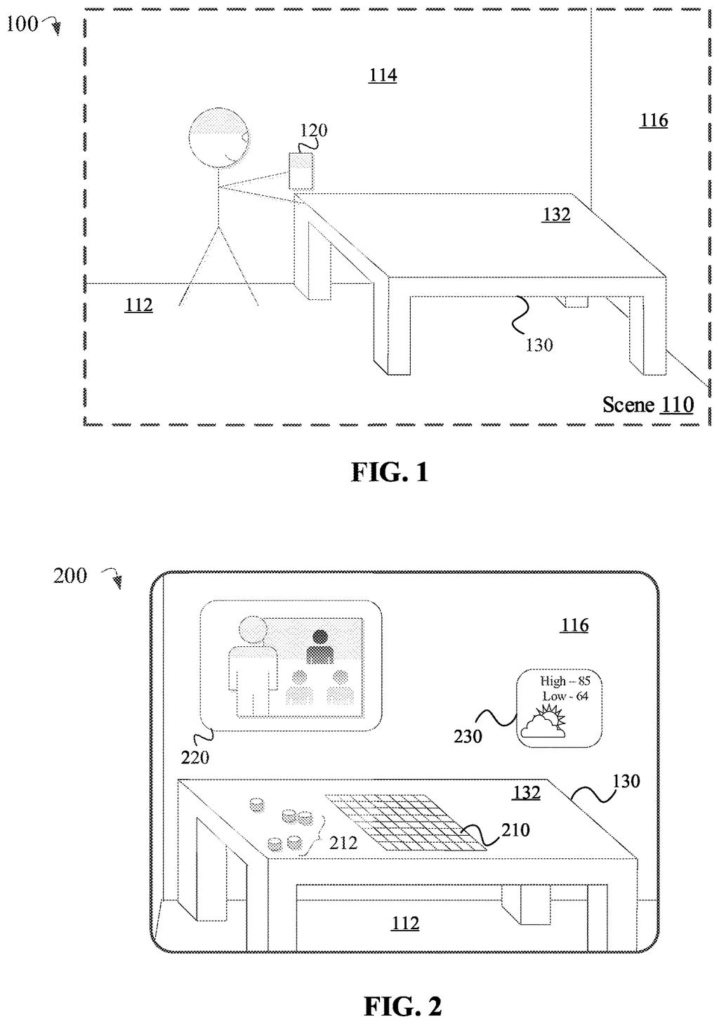
What Apple's XR environment gatekeeper actually does
Every time an app tries to redecorate your mixed-reality space, every other running app is potentially trying to do the same thing at the same time. Without a referee, the result is visual chaos.
Apple's patent describes a gatekeeper system for headsets like Vision Pro. Your device watches what you're doing, figures out which app deserves the wheel, and hands that app a special key called a control parameter. That key lets the chosen app reshape the environment beyond its own window, adjusting things like the background or ambient space that all your apps share.
The critical part: once one app holds that key, every other app is locked out. They can still display their own content inside their own windows, but they can't touch the shared environment. When you shift focus, the device can reassign the key. You never have to manage any of this yourself.
… providing the first application with access to a control parameter based on the first application satisfying at least one of the one or more criteria, wherein the control parameter enables the first application to modify the view of the XR environment outside of a visual representation of content provided by the first application.
Translation: The system gives one app permission to change your entire virtual view rather than just its own window.
How the device picks and locks in the controlling app
The patent describes a method for extended reality (XR) environments where multiple apps run simultaneously, each displayed as a visual panel or window floating in your space.
The device collects sensor data about the user, such as where they're looking or which app they're interacting with, and uses that to identify a single "winning" app based on defined criteria. That winning app is granted access to a control parameter, a setting that lets the app modify the XR environment outside its own visual panel. Think of it as permission to paint the walls, not just hang your own picture.
The key technical detail is the access restriction. Once one app holds the control parameter, all other apps are explicitly blocked from using it. This prevents conflicts where two apps try to change the same shared space at the same time.
The system is dynamic. As sensor data changes (say, you look at a different app or switch tasks), the device can re-evaluate which app should hold the parameter and transfer it accordingly. The patent covers the full cycle:
- Capturing sensor input from the user
- Evaluating which app meets the qualifying criteria
- Granting that app the environment-modification key
- Blocking all other apps from the same access
… restricting access to the control parameter by other applications which prevents the other applications from modifying the at least the portion of the view of the environment via the control parameter.
Translation: It blocks all other apps from hijacking the rest of the display at the same time.
What this means for mixed-reality multitasking on Vision Pro
Mixed-reality operating systems face a problem that phone and desktop systems never had to solve: multiple apps sharing a single continuous space rather than separate screens. If Apple gives every app the ability to change that space freely, the result is unpredictable conflicts. This patent is Apple's answer to that coordination problem at the OS level, handled automatically based on where your attention is.
For Vision Pro users, this could mean richer, more immersive experiences where the right app can transform your surroundings contextually, like a media player darkening the room when a video starts, without other apps fighting it. Apple's run of XR environment-management filings suggests the company is building out a full operating-system framework for spatial computing, not just individual features.
Apple's 47th filing we've tracked in our AR glasses watchlist since May builds on ideas like stretching screens into air and sliding displays for your eyes.
When multiple apps share the space around your head simultaneously, each one can try to redecorate that shared space in ways that fight each other. For someone wearing a headset, that fight does not register as a software glitch. It registers as a world that has stopped making sense, and people respond by taking the headset off.
The problem scales in a way that makes early decisions matter enormously. Every additional app is another candidate for conflict, and the discomfort compounds faster than the app count does.
Apple's answer is to give only one app at a time the authority to change what surrounds you, with the device deciding who holds that authority based on what you are actually doing. That is a tight constraint, and it leaves some situations unresolved, but the size of the constraint roughly matches the size of the problem: coherence in shared spaces is fragile, and fragile things need clear rules before they break.
There are more where this came from
We read every patent application Big Tech publishes and send you the ones worth knowing. Plain English, free, every week.
The drawings
6 drawing sheets from US 2026/0278963 A1 · click any drawing to enlarge


Want this weekly breakdown for a company we don't cover? Patentlyze Pro →