
Samsung Patents a Fix to Stop Colors Washing Into Each Other on OLED Screens
A precise ratio buried in a display patent could be the difference between crisp colors and a muddy mess in tiny OLED screens. Samsung has filed a patent describing the exact proportions that keep light from one pixel from contaminating its neighbors.
What Samsung's color-bleeding fix actually does
Imagine looking through an AR headset and noticing that the red text on your screen has a faint orange halo, or that white icons look slightly off. That kind of color muddiness often comes from light leaking between pixels inside the display itself.
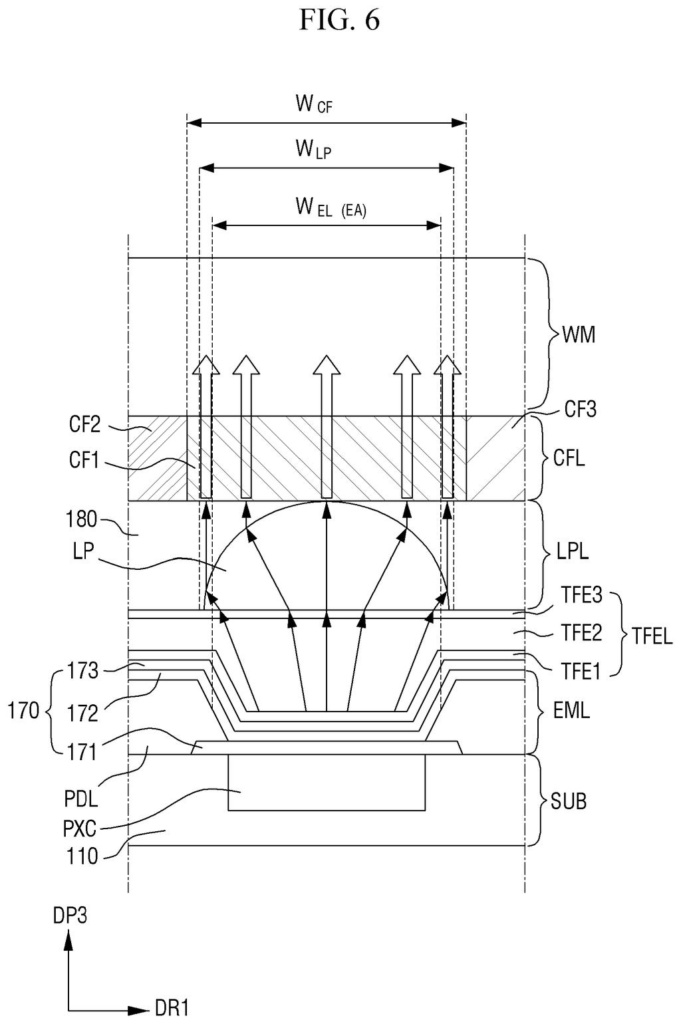
Samsung's patent tackles this by specifying exact proportions for the layers stacked inside an OLED display. Think of it like fitting lids onto a row of boxes: if the lid is the wrong size relative to the box walls, light spills over the edges. The patent defines a precise height-to-width ratio (about 1:0.5-2:2-5) between the protective encapsulation layer, the walls dividing each pixel, and the color filters sitting on top.
The goal is to make sure the light from each tiny pixel travels straight up and lands only on its own color filter, not a neighbor's. For a screen that sits centimeters from your eyes inside a headset, that kind of precision matters more than it does on a phone or TV.
… a ratio of the height of the encapsulation layer, a width of the pixel defining layer, and a width of each color filter is about 1:0.5 to 2:2 to 5.
Translation: Samsung specifies exact mathematical proportions for the screen layers to prevent color bleeding.
How the encapsulation-to-filter ratio controls light paths
The patent describes a multi-layer OLED display built on a substrate. At the base, an organic light emitting element layer generates light between two electrodes. A pixel defining layer acts as a physical wall separating individual sub-pixels, keeping each color in its lane.
Above that, an encapsulation layer seals and protects the organic materials from moisture and air, which would otherwise degrade them quickly. On top of that sits a light control pattern layer (an intermediate structure that shapes or redirects light before it reaches the final color filters), and above that, a color filter layer containing red, green, and blue filters.
The core invention is a specific geometric relationship:
- The height of the encapsulation layer
- The width of the pixel defining wall
- The width of each color filter
Are tuned to a ratio of approximately 1: 0.5-2: 2-5. When these dimensions are in proportion, light traveling at an angle from one pixel is more likely to be absorbed by the pixel wall or the light control pattern rather than reaching an adjacent color filter. The result is less color mixing between neighboring pixels, which engineers call reduced color crosstalk.
… a light control pattern layer disposed between the encapsulation layer and the color filter layer and including a light control pattern disposed on a light path of the organic light emitting layer.
Translation: An extra layer is placed right in the path of the light to control how colors travel through the screen.
What this means for OLED screens in AR headsets
Color crosstalk is a real and expensive problem for any display manufacturer trying to pack more pixels into a smaller area, which is exactly what near-eye displays for AR and VR headsets demand. When pixels are tiny and close together, even a slight angle of light emission can send a photon to the wrong color filter, washing out contrast and muddying hues. The closer the screen is to your eye, the more obvious those flaws become.
For Samsung, Samsung's track record in display-component patents shows this is a long-running engineering priority. A structural fix baked into the layer proportions is more reliable than a software correction applied afterward, because it attacks the problem at the source rather than masking it. If this geometry holds up in manufacturing, it could mean sharper, more accurate colors in screens designed for headsets where every millimeter of the stack matters.
Samsung's 108th filing we've tracked since May in our display technology work adds to a run that includes pixel temperature dimming and glasses-free 3D stacking.
Color bleeding between pixels is one of those problems that sounds minor until you strap a screen two inches from your face. At that distance, a washed-out image or muddy colors are not background noise; they are the entire experience, and they cause people to take the headset off and not put it back on.
The core of what Samsung describes here is a precisely sized layer inserted between the light source and the color filter, steering each pixel's glow along a controlled path before it reaches your eye. The specific proportions written into the filing signal a real manufacturing commitment, because vague ratios do not survive a production line.
The scale of the fix looks proportionate to the scale of the problem. Visual fidelity in a headset is not a feature among many; it is the threshold condition for the product working at all, and a structural approach to color bleed addresses that threshold directly.
There are more where this came from
We read every patent application Big Tech publishes and send you the ones worth knowing. Plain English, free, every week.
The drawings
20 drawing sheets from US 2026/0305141 A1 · click any drawing to enlarge


Want this weekly breakdown for a company we don't cover? Patentlyze Pro →
Be the first to weigh in