
Samsung Patents a Glasses-Free 3D Display Built From Stacked Lens Sheets
Samsung is working on a display that creates the illusion of depth without any special glasses, using stacked sheets of lenses that each bend light in opposite directions to fool your eyes into seeing three dimensions.
How Samsung's stacked lenses create depth without glasses
Most 3D displays today either require you to wear glasses or deliver a headache-inducing experience that only works from one narrow angle. Samsung is trying to change that with a new approach to how the screen itself is built.
Instead of relying on software tricks or bulky optics in front of the screen, Samsung's idea puts two thin sheets of lenses directly on top of the display panel. Each sheet contains lenses that alternate between curving inward and curving outward. When you stack two of these sheets together at a specific offset, the combined effect steers light from different pixels toward your left and right eyes separately, which is exactly what your brain needs to perceive depth.
The result is a screen that can show you a genuine 3D image without asking you to put anything on your face. The display still functions as a normal flat-screen when it isn't showing 3D content, since the lens effect is tied to the image being sent to the panel.
… a plurality of lens sheets comprising a plurality of gradient-index (GRIN) lenses, respectively, the plurality of GRIN lenses being configured to operate as a convex lens or a concave lens based on different refractive indices based on a position in each lens …
Translation: The screen uses special internal lenses that change how they bend light depending on the exact spot the light hits them.
How the GRIN lens sheets bend light into a 3D image
The patent describes a display made of two main components: a standard light-emitting panel (the kind that drives pixels in modern screens) and a pair of gradient-index (GRIN) lens sheets placed in front of it.
Gradient-index lenses are unusual because their refractive index (how strongly they bend light) varies across the lens itself, rather than depending on a curved surface. That means a flat piece of material can act like a curved lens, just by having its internal structure vary from center to edge. Each lens sheet in the patent contains alternating lenses: some act as convex lenses (which spread light outward) and some act as concave lenses (which pull light inward), arranged in a repeating pattern.
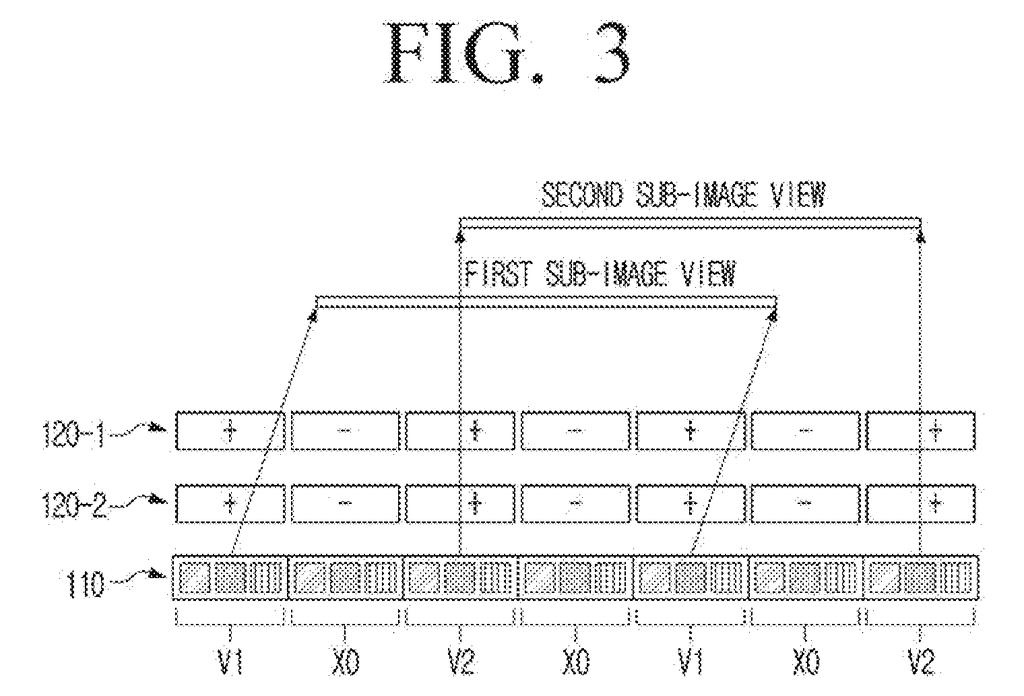
The key claim covers the offset alignment between the two sheets. When 3D content is playing, the convex lenses in the first sheet sit directly above the convex lenses in the second sheet. This stacked, aligned configuration causes light from certain pixels to be directed toward one eye and light from neighboring pixels to go toward the other eye, creating the left-eye and right-eye views that produce a sense of depth.
- Light emitting panel drives individual pixels with image data
- First GRIN lens sheet alternates convex and concave lenses in a grid
- Second GRIN lens sheet mirrors that pattern, aligned so convex lenses stack above convex lenses during 3D mode
- The combined bending effect separates the light path for each eye
… first lenses operating as a convex lens and second lenses operating as a concave lens, respectively, wherein the first lenses and the second lenses are alternately disposed within the lens sheets …
Translation: Different types of lenses that either magnify or shrink images are mixed together in alternating patterns across the layers.
What this means for glasses-free 3D screens on your devices
Glasses-free 3D has been a target for display makers for decades, and it keeps running into the same problem: the optics needed to separate the two eye-views tend to reduce brightness, cut the effective resolution in half, or only work in a narrow sweet spot. Samsung's GRIN approach is interesting because flat lens sheets can potentially be made thin and cheap enough to sit inside a phone or tablet display stack, not just on a large standalone screen.
For you as a consumer, this is the kind of patent that, if it makes it into a product, would let 3D video or depth-based interfaces appear on a device you already own, with no accessory required. It also signals that Samsung is investing engineering effort in the display layer itself, not just in software processing or camera-based eye-tracking workarounds.
Samsung's 106th filing in display technology we've tracked since May follows work like the privacy viewing angle patent and the waterproof curved frame patent.
Claim 1 is fairly specific. It requires two distinct lens sheets, each containing alternating convex and concave GRIN lenses, with the convex lenses in the first sheet positioned directly above those in the second sheet during 3D output. That is a narrow enough construction that it describes a particular physical arrangement rather than the broad idea of glasses-free 3D displays, which gives it a reasonable chance of surviving an examiner's prior-art search.
The narrowness cuts both ways, though. A competitor could potentially sidestep the claim by using a different alignment rule between the sheets, or by using only one lens sheet with a more complex pattern. Samsung is protecting a specific solution, not the category.
What makes this more than routine is that GRIN lenses inside a consumer display stack are a real engineering challenge. Making them thin enough, uniform enough, and cheap enough to manufacture at scale is where patents like this either become products or become shelf items. The claim doesn't speak to any of that, but it does suggest Samsung has a working enough model to describe the geometry precisely.
There are more where this came from
We read every patent application Big Tech publishes and send you the ones worth knowing. Plain English, free, every week.
The drawings
9 drawing sheets from US 2026/0277017 A1 · click any drawing to enlarge


Want this weekly breakdown for a company we don't cover? Patentlyze Pro →
Be the first to weigh in