
Apple Patents a Multi-Light Camera System for More Accurate 3D Scanning
Apple's Face ID system already uses invisible light to map your face in 3D. A newly filed patent suggests Apple is working on a projector that fires two different wavelengths of light simultaneously, blending them into a single, wide beam, potentially unlocking sensors that work better in more conditions.
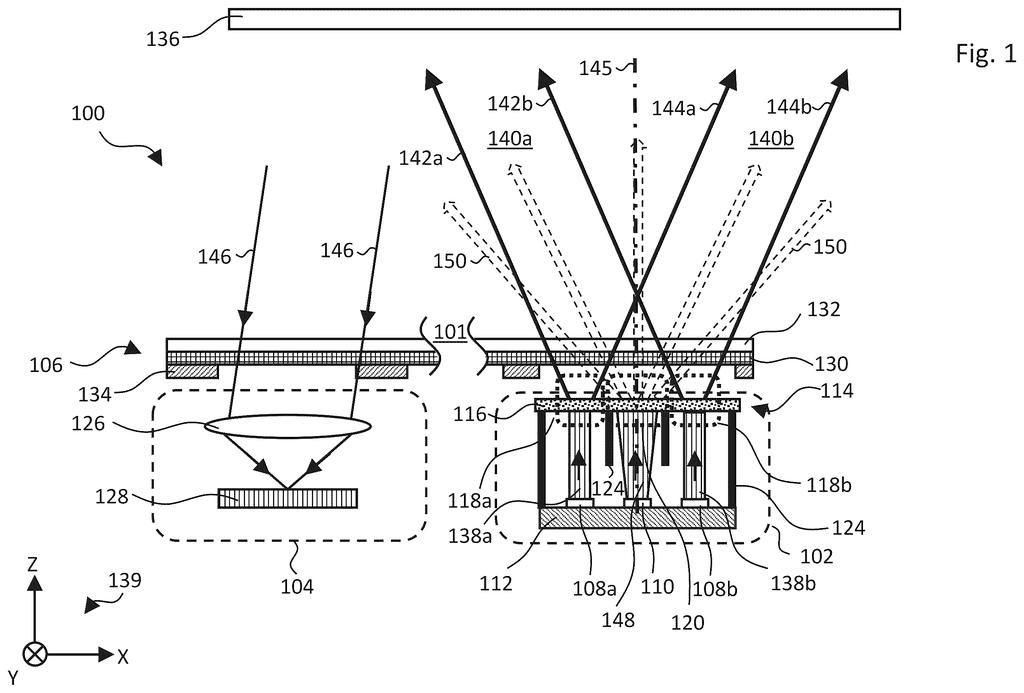
What Apple's two-color flood projector actually does
Ever wondered why your phone can unlock in the dark but sometimes struggles in direct sunlight? The answer comes down to the quality of the invisible light your phone projects onto your face.
Apple's patent covers a projector module that holds at least two laser emitters, each operating at a different wavelength (think of wavelength as the color of the light, even if it's invisible infrared). Special optics above the emitters combine both beams into one wide cone of illumination covering at least 30 degrees, enough to bathe your whole face or a wide scene in light from a short distance.
Using two wavelengths instead of one gives the sensor more information to work with. Different wavelengths bounce off surfaces differently, so a device can cross-check the two signals to get a sharper, more reliable depth map, even when lighting conditions are tricky.
at least first and second emitters configured to emit respective first and second beams of coherent optical radiation at different, respective first and second wavelengths …
Translation: Multiple laser sources produce beams at different specific wavelengths.
How the optics merge two laser beams into one wide cone
The core of the invention is a flood illumination projector, a module that bathes a scene with invisible (typically infrared) light so a camera can measure depth or detect faces.
What makes this filing distinct is the use of at least two emitters operating at different wavelengths. Each emitter produces its own beam of coherent optical radiation (laser or laser-like light, meaning all the light waves travel in step with each other, unlike a flashlight). Conventional flood projectors typically use a single wavelength.
Projection optics (lenses or diffractive elements mounted directly over the emitters) then merge the two beams into a single cone covering a minimum angular spread of 30 degrees. That wide angle means the projector can illuminate an entire face or a broad scene from close range without needing to move or sweep.
The claim is written at a high level of generality:
- At least two emitters (the patent says "at least first and second," leaving room for three or more)
- Any two different wavelengths (no specific infrared bands are locked in)
- Any projection optics that achieve the 30-degree-plus cone
That breadth means the patent, if granted, could cover a wide range of physical implementations.
… combine the first and second beams into a cone of flood illumination having an angular extent of at least 30° …
Translation: Special lenses merge the beams into a wide lighting cone spanning at least thirty degrees.
What this means for Face ID and future Apple sensors
For everyday users, the practical payoff would be more reliable face unlock and depth sensing. A two-wavelength flood can potentially distinguish real faces from photos, cut through interference from sunlight (which is rich in certain infrared bands), or give the depth camera more data points to work with, all without making the hardware noticeably larger.
The claim as written is broad: it covers any projector with two emitters at different wavelengths combined into a 30-degree-plus cone, regardless of the specific wavelengths or optics used. If granted in that form, the pattern in Apple's depth-sensing filings would extend into territory that could make it harder for rivals to build similar dual-wavelength flood systems without designing around this claim.
Apple's 19th filing in our Camera patents we cover since June follows work like the prism-tilting zoom system and the dot-pattern light projector.
Claim 1 covers any device that takes two beams of laser light at different colors, combines them through any optics at all, and spreads the result into a cone at least 30 degrees wide. No specific colors, no particular lens design, no required technology beyond those three things. That is a very wide fence.
If granted, the claim would block anyone from building a flood light that mixes two coherent light sources at different wavelengths into a broad beam, full stop. A 30-degree spread is roughly what you get pointing a flashlight at a wall from close range, so the threshold is not demanding.
Whether the patent office sees this as a genuine invention or an obvious next step for engineers already working with laser arrays will decide how much it matters. That examination is where the real story gets written.
There are more where this came from
We read every patent application Big Tech publishes and send you the ones worth knowing. Plain English, free, every week.
The drawings
4 drawing sheets from US 2026/0303941 A1 · click any drawing to enlarge


Want this weekly breakdown for a company we don't cover? Patentlyze Pro →
Be the first to weigh in