
Samsung Patents a Projector That Grows Its Image as the Lens Cover Opens
Most projectors just blast a full image the moment they turn on, cover or not. Samsung's new patent describes a device that watches its own cover open and scales the picture to match, frame by frame.
What Samsung's opening-cover projector actually does
Projectors typically have a cover or shutter that protects the lens when the device isn't in use. When you turn one on, there's often an awkward moment where the image appears before everything is properly open, or you get a jarring flash of full-brightness light hitting the room.
Samsung's patent describes a projector that solves this by tying the image size directly to how open the cover is. As the cover slides or swings open, the projected picture grows in real time to match. By the time the cover is fully open, the image has smoothly expanded to whatever size you set in the device's settings.
Think of it like a curtain rising at a theater: instead of the whole scene appearing at once, the picture reveals itself gradually as the opening widens. It's a small quality-of-life detail, but one that makes the startup experience feel intentional rather than abrupt.
… control, while the cover is being moved, the projector to project an image having a size corresponding to a degree of exposure of the space …
Translation: The projected picture grows bigger in real time as the lens cover slides open.
How the cover position controls the projected image size
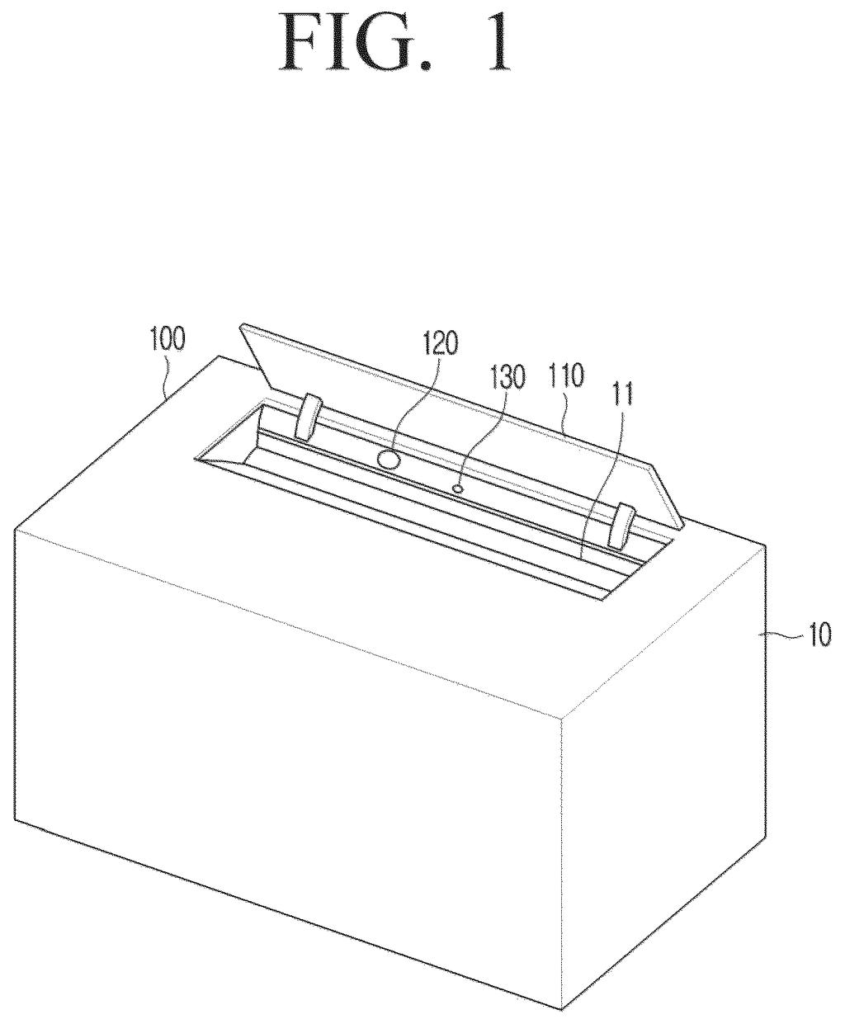
The patent describes a projection device with a motorized cover that physically opens to expose the projector lens and any sensors housed in the same internal compartment.
Inside the device, at least one sensor monitors conditions in that compartment. A processor tracks the cover's position as a motor drives it open. While the cover is moving, the processor instructs the projector to display an image whose size is proportional to how much of the space has been uncovered. So at 50% open, you get roughly half the intended image size; at 75% open, you get three-quarters; and so on.
Once the cover reaches the fully open position, the projector switches to projecting the full-size image based on a setting stored in memory, such as a specific screen width or zoom level the user configured previously. The whole sequence is automatic and coordinated by the device's internal logic.
The patent doesn't specify a single form factor, so this could apply to a compact portable projector, a built-in display device, or any projector where a motorized cover is part of the design.
… based on the cover being fully open, control the projector to project a full-size image corresponding to a setting value pre-stored in the memory …
Translation: Once the cover is completely out of the way, the projector displays the final saved image size.
What this means for compact and portable projectors
For people who use projectors in living rooms, bedrooms, or presentations, the startup moment matters more than it might seem. A sudden blast of full-brightness projection onto a wall, before the lens is even properly exposed, can be disorienting or visually jarring. Tying image size to cover position is a low-cost fix that makes the experience feel polished.
Samsung's bet on home projector hardware has grown as the company pushes products like its portable Freestyle projector. A patent like this fits that direction: small software and motor-coordination improvements that distinguish a premium device from a basic one. Whether this specific feature reaches a shipping product is another question, but the problem it targets is real.
Samsung's 74th filing in the camera patents we've tracked since May follows work like a thinner zoom lens and a five-lens stack.
A projector that blazes to full brightness before its cover is fully open will startle anyone in the room and may slam the image against the partially open lid. It is a small annoyance, but in a device that sits at the center of a room and anchors a social moment, the startup experience carries real weight. People remember bad first impressions from their devices.
The problem is real enough that it erodes trust, even if it never makes a review's headline. A projector that hiccups on the way to doing its one job plants doubt about everything else.
The approach here matches the scale of the problem well. Using the motor that already moves the cover to smoothly scale the image as it opens is a lightweight fix to a lightweight irritant, and that proportionality is a point in its favor.
There are more where this came from
We read every patent application Big Tech publishes and send you the ones worth knowing. Plain English, free, every week.
The drawings
11 drawing sheets from US 2026/0287988 A1 · click any drawing to enlarge


Want this weekly breakdown for a company we don't cover? Patentlyze Pro →
Be the first to weigh in