
Apple Patents a Prism-Tilting Camera System for Thinner Optical Zoom
Apple's latest patent describes a compact camera that bends light around a corner using a prism, then tilts that prism to keep images stable. It's a peek at how the company keeps squeezing better zoom into phones that don't get thicker.
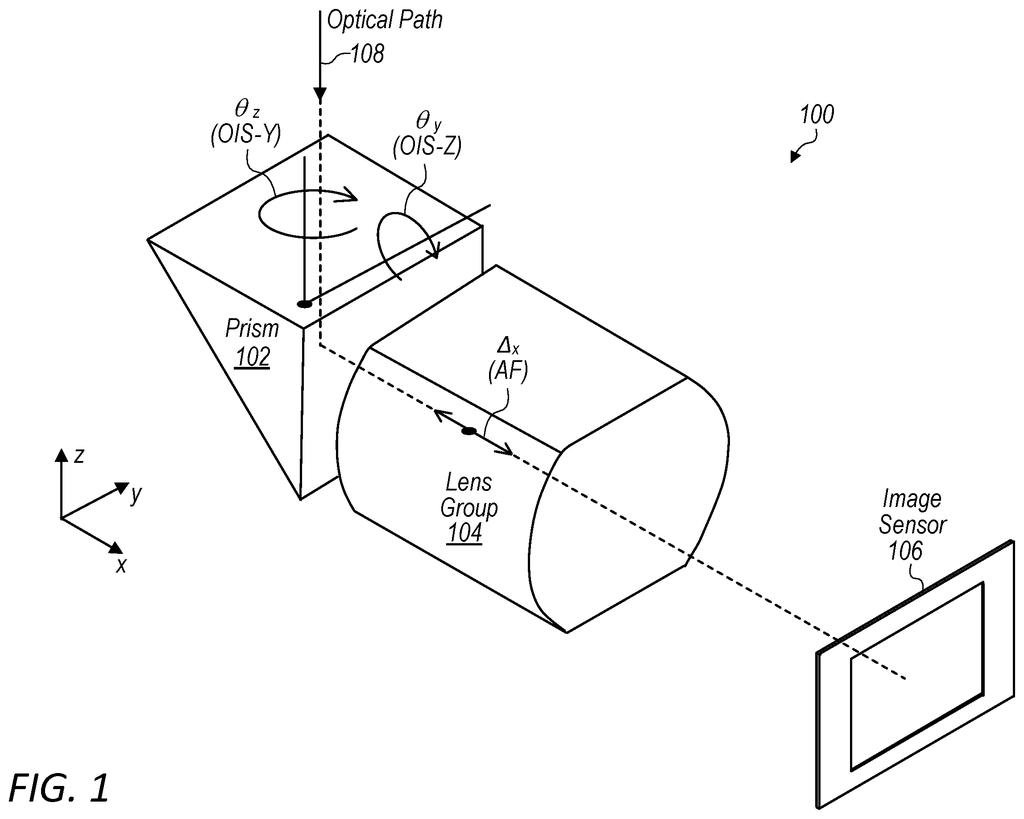
What Apple's folded-optics tilt camera actually does
A smartphone tries to take a sharp photo while you're walking, and the camera has to fight every tiny shake your hand makes. On top of that, it has to do this inside a device only a few millimeters thick.
Apple's patent describes a camera design that solves both problems at once. Instead of pointing a long lens straight out the back of a phone, it uses a prism to bend the light sideways, so the optical path can run along the length of the phone rather than poking out of it. This is what engineers call folded optics. Apple adds a motor system that can tilt the prism in two directions, allowing the camera to correct for shake the same way your eye moves to hold a steady gaze.
The patent also describes a second set of motors that slide the main lens group back and forth to adjust focus or zoom. Together, these moving parts sit on a bearing suspension system designed to keep everything controlled and precise.
… an actuator arrangement of the camera may include one or more actuators for tilting the prism about multiple axes. Furthermore, the actuator arrangement may include one or more actuators for translating the lens group along an axis.
Translation: Tiny motors tilt the prism and slide the lenses to achieve zoom.
How the prism tilts and the lens shifts together
Folded-optics cameras are already inside iPhones with telephoto lenses. The standard design uses a prism to redirect incoming light 90 degrees, letting a longer focal-length lens sit horizontally inside a thin chassis. What this patent adds is a much more capable motion system on top of that baseline design.
The prism tilt actuator can rotate the prism around multiple axes simultaneously. In a conventional camera, optical image stabilization works by shifting a lens element sideways. Here, tilting the prism achieves a similar result but potentially over a wider range of correction, because the prism sits at the very start of the optical path where small angular changes have a large downstream effect on where the image lands on the sensor.
The lens group actuator works along a single linear axis, translating (sliding) the lenses back and forth. This handles focus and potentially zoom magnification.
Holding all of this together is a bearing suspension arrangement, a physical support structure that constrains unwanted movement while still allowing the specific motions the actuators are designed to create. Think of it like a track that lets a drawer slide smoothly but won't let it wobble sideways. The combination of tilt control at the prism and linear control at the lens gives the system two independent correction axes working in parallel.
What this means for future iPhone zoom cameras
For you as a phone buyer, better prism-tilt stabilization could mean sharper photos at longer zoom ranges without needing a physically larger camera bump. Folded-optics designs are already what separate Apple's best telephoto cameras from the basic ones, and finer control over prism angle is a direct path to improving both image stabilization and overall photo quality at telephoto distances.
a growing pile of Apple folded-optics filings suggests the company is treating this camera architecture as a long-term platform rather than a one-generation feature. More precise actuator control could also feed into video stabilization, which is increasingly a reason people choose a phone camera over a dedicated camera.
Apple's 49th filing in our cell phone patent coverage since May follows applications like a sharper display frame grab and a self-flattening foldable hinge in the cases we've tracked.
Tilting a prism across two directions while sliding a separate lens group along a third requires multiple motors, a bearing system, and electronics to coordinate all of them inside a space that is already essentially full. Every added moving part is a new way for the camera to fail and a new drain on the battery.
The optical argument for doing it this way is real: correcting for hand shake closer to where light first enters the system is more effective than correcting for it later. But that advantage only pays off if the motors can hold their positions with enough precision, consistently, across millions of units and years of drops and temperature changes.
Apple appears confident that its motor engineering is up to that standard, and this design is the bet on that confidence. Whether it holds is a manufacturing and durability question, and that answer only comes after the product ships.
There are more where this came from
We read every patent application Big Tech publishes and send you the ones worth knowing. Plain English, free, every week.
The drawings
15 drawing sheets from US 2026/0287917 A1 · click any drawing to enlarge


Want this weekly breakdown for a company we don't cover? Patentlyze Pro →
Be the first to weigh in