
Microsoft Patents Mid-Video Color Switching to Reduce File Sizes Without Quality Loss
Most video encoders lock in a single color format for an entire clip. Microsoft's new patent describes a system that can swap color settings shot by shot, squeezing out better quality without blowing up file sizes.
What Microsoft's per-clip color switching actually does
You're watching a movie online and a dark cave scene cuts to a sun-drenched beach. Your TV handles both fine, but behind the scenes the video file had to be compressed using one-size-fits-all color settings that weren't ideal for either shot. That tradeoff costs either quality or storage.
Microsoft's patent covers a video encoder that can flip between different color formats on a segment-by-segment basis within a single video file. Instead of picking one approach for the whole thing, the encoder tests each chunk of video in multiple formats and chooses the one that compresses best. A small flag embedded in the file tells the decoder which format each segment used, so your device knows how to read it.
The key trick is that the encoder doesn't start from scratch with each format test. Work it already did in the first color format, like figuring out how objects moved between frames, gets reused when evaluating the second format. That keeps the extra processing time manageable.
… determining whether or not to switch color spaces for the given unit, including performing the color space conversion operations between the first color space and the second color space, wherein the one or more coding parameters are reused when evaluating the given unit in the second color space; …
Translation: The encoder tests switching color spaces without recalculating motion data.
How the encoder flags and reuses color-space decisions
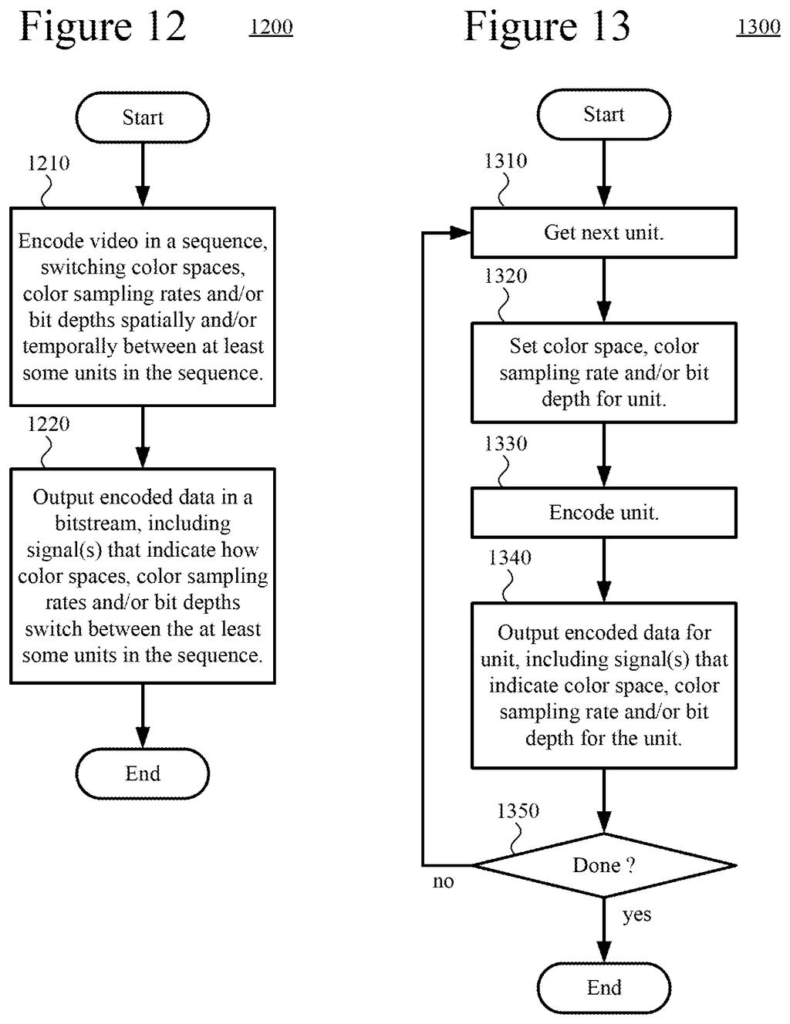
The patent covers three related ideas: switching color spaces (the mathematical system used to represent color), switching color sampling rates (how much color detail is captured per pixel), and switching bit depths (how many shades each color channel can express) between units of a video sequence.
A "unit" here means a chunk of the video, like a frame or a group of frames. The encoder can decide, for each unit independently, which color configuration produces the most efficient compression.
The claim describes a specific workflow:
- The encoder declares upfront (in a parameter set, a header block read before decoding begins) that color-space switching is allowed for this stream.
- For each video unit, it runs motion estimation (figuring out how objects moved, so it only needs to store the difference, not a whole new frame) in the first color space and saves those motion vectors.
- It then tests the same unit in a second color space, reusing the motion vectors rather than recalculating them, which saves compute time.
- It picks the better color space and writes a small flag into the bitstream indicating the choice.
- That flag is compressed using context-adaptive binary arithmetic coding (a lossless compression step that encodes the flag more efficiently by learning patterns from nearby flags).
The result is a bitstream where different segments can legitimately live in different color formats, all tracked by lightweight in-band signaling.
Innovations in adaptive encoding for units of a video sequence can improve coding efficiency. For example, some of the innovations relate to encoding that includes adaptive switching of color spaces between units within a video sequence.
Translation: Switching color spaces during video playback makes file sizes smaller.
What this means for streaming quality and file sizes
For streaming services, video compression efficiency translates directly into bandwidth costs and picture quality. A file that can adapt its color format to each scene type can, in theory, deliver better quality at the same bitrate or the same quality at a smaller file size. That matters on slow connections, for live sports where color accuracy is prized, or for HDR content where bit depth choices are consequential.
Microsoft has been filing around video codec efficiency in ways that align with its Azure video services and Teams infrastructure. Claim 1 of this patent is broad: it covers any encoder that (a) signals permission for color-space switching in a parameter set and (b) reuses motion vectors across color-space evaluations. That scope, if the claim holds up during examination, could touch a wide range of software and hardware encoders that adopt adaptive color switching.
Microsoft's 452nd filing we've logged since May in our Microsoft coverage adds to a run that includes a thermal lens patent and a two-layer cloud AI application.
Claim 1 here is genuinely broad. It doesn't claim a specific algorithm for choosing between color spaces; it claims the general pattern of signaling the option in a header, reusing motion vectors across the test, and flagging the choice per unit. That breadth is the interesting part.
If granted as written, that claim would cover a lot of ground. Any encoder that adaptively switches color spaces and reuses motion data from the first color space when evaluating the second would read on it, which includes approaches other companies might independently develop.
The practical engineering idea is sound: reusing motion vectors across color-space evaluations is a real efficiency gain, not a trivial one. But the claim doesn't describe how the encoder decides which color space wins, or any threshold for making that call. That vagueness is what makes it broad and also what makes it a likely target for prior-art challenges during examination.
There are more where this came from
We read every patent application Big Tech publishes and send you the ones worth knowing. Plain English, free, every week.
The drawings
12 drawing sheets from US 2026/0303860 A1 · click any drawing to enlarge


Want this weekly breakdown for a company we don't cover? Patentlyze Pro →
Be the first to weigh in