
Microsoft Patents a Thermal Camera Lens That Sharpens the Center by Blurring the Edges
Microsoft's new patent describes a thermal camera lens that intentionally warps the edges of the image so the middle gets extra detail. That's a deliberate engineering tradeoff, and it's aimed squarely at head-mounted displays that need to spot people from a distance.
What Microsoft's distortion-on-purpose thermal lens actually does
Imagine you're wearing a mixed-reality headset and it needs to detect a person standing down a long hallway. The thermal camera inside the headset has a fixed number of pixels, and by default those pixels are spread pretty evenly across everything the camera sees. That works fine up close, but at a distance, a person might only fill a handful of pixels, making them hard to pick out.
Microsoft's idea is to intentionally warp the lens so that more pixels are aimed at the center of the frame and fewer at the edges. The edges get a little distorted, but anything you're looking directly at gets much more detail. Think of it like zooming in on the middle of the picture without losing your wide view entirely.
The company says this kind of lens is small enough to fit inside a compact device like a headset, which matters because thermal cameras in wearables don't have room for big, heavy optics.
… a lens arranged to focus IR radiation, emitted by a target within the FOV of the thermal imaging camera system, onto the microbolometer array, wherein the lens is configured with a barrel distortion profile that provides a pixel angular resolution for a central area of the FOV that is greater than or equal to a pixel angular resolution for edge areas of the FOV.
Translation: The lens is intentionally distorted to cram more pixels into the middle of the picture than the sides.
How the barrel distortion profile trades edges for center sharpness
The patent describes a thermal imaging camera built around two main components: a microbolometer array (a grid of tiny sensors that detect heat rather than visible light) and a specially shaped lens that focuses infrared radiation onto that sensor grid.
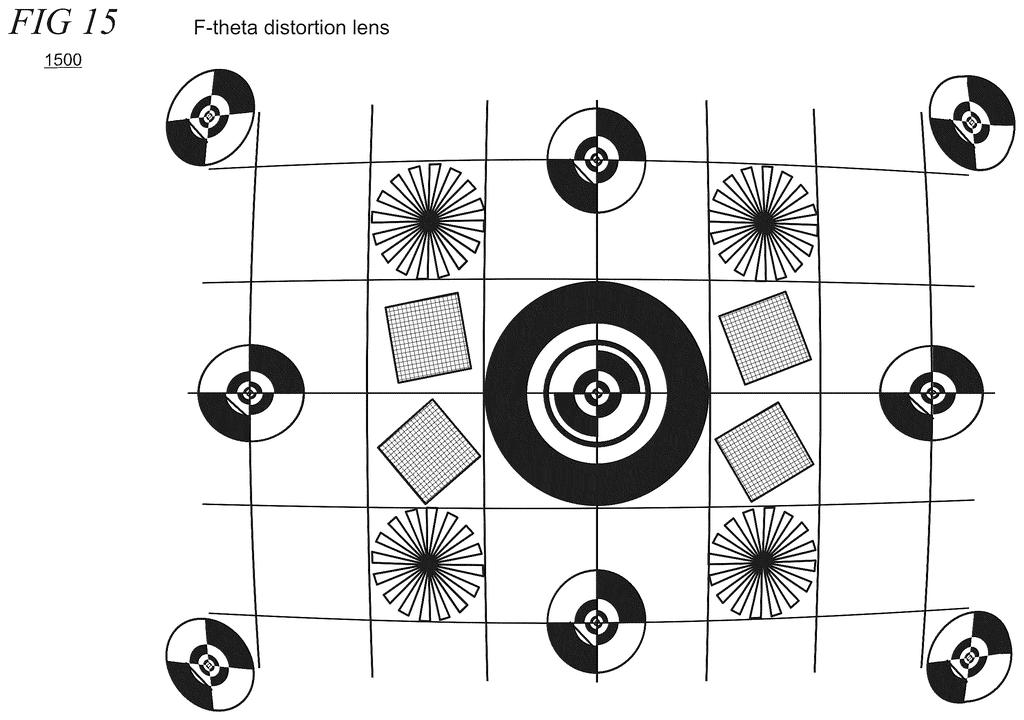
The clever part is how the lens is shaped. A normal camera lens tries to project the world as evenly as possible across the sensor. Microsoft's lens deliberately introduces what's called barrel distortion, where the image is stretched toward the center and compressed at the edges, like the outward bulge you sometimes see in a wide-angle selfie camera. Here, that distortion is used as a feature rather than corrected away.
By packing more of the sensor's pixels onto the center of the field of view, the system gets higher angular resolution (more pixels per degree of angle) in the area straight ahead. The edges of the frame are covered by fewer pixels, so they're less detailed, but the full wide viewing angle is preserved.
The patent specifies that the lens distortion profile uses higher-order mathematical terms to fine-tune exactly how the pixel density shifts from center to edge, letting engineers dial in the tradeoff rather than accepting a blunt, uniform distortion.
The barrel distortion profile provides a corresponding increase in pixel angular resolution (i.e., pixels per angle of FOV) in a central region of the FOV of the camera as compared to that provided by a conventional rectilinear lens having an idealized zero distortion profile.
Translation: This warped design boosts the central detail far beyond what a normal flat lens can manage.
What this means for thermal cameras in mixed-reality headsets
Thermal cameras in headsets are used for things like detecting people in low-light environments or tracking body heat for safety applications. Those use cases depend on catching a clear thermal signature from a distance, and right now the pixel counts in compact thermal sensors are modest, so every pixel has to work harder.
By concentrating detail in the center of the frame, Microsoft's lens lets a small, inexpensive sensor punch above its weight at range, without requiring a bigger sensor or a higher pixel count. The tradeoff is that objects at the far edges of your view get less thermal detail, which could matter in scenarios where something important is in the periphery rather than directly ahead. Whether that tradeoff is acceptable depends entirely on the application.
Microsoft's 13th filing we've tracked since May in the AR glasses race builds on earlier applications including one on matching photos to 3D maps and one on sharpening displays with nanoscale gratings.
Every pixel a camera sends to the center of the frame is a pixel taken away from the edges, and Microsoft is betting that, for a head-mounted thermal camera, the center is where it almost always counts. That's a reasonable bet for detecting people down a corridor, but a shaky one for any scenario where threats or obstacles come from the side.
The engineering cost is real: the edges of the image are distorted, which means software downstream has to either correct for that warp or learn to ignore it. Correcting it would partially undo the sharpness gain. Ignoring it means the edges are misleading about the actual shape of objects in the periphery.
For a narrow application like headset-based people detection in a hallway or office setting, the tradeoff looks reasonable. For a general-purpose thermal sensor that might be pointed anywhere, the center-heavy design feels like it paints the system into a corner.
There are more where this came from
We read every patent application Big Tech publishes and send you the ones worth knowing. Plain English, free, every week.
The drawings
18 drawing sheets from US 2026/0303933 A1 · click any drawing to enlarge


Want this weekly breakdown for a company we don't cover? Patentlyze Pro →
Be the first to weigh in