
Disney Patents a Dual-Laser System for Producing Intense, Eye-Safe Projection Light
Disney has filed a patent for a light source that combines two banks of lasers with a phosphor panel to generate extremely bright, focused light that behaves more like a lamp than a laser, which matters a lot when you're projecting onto a castle.
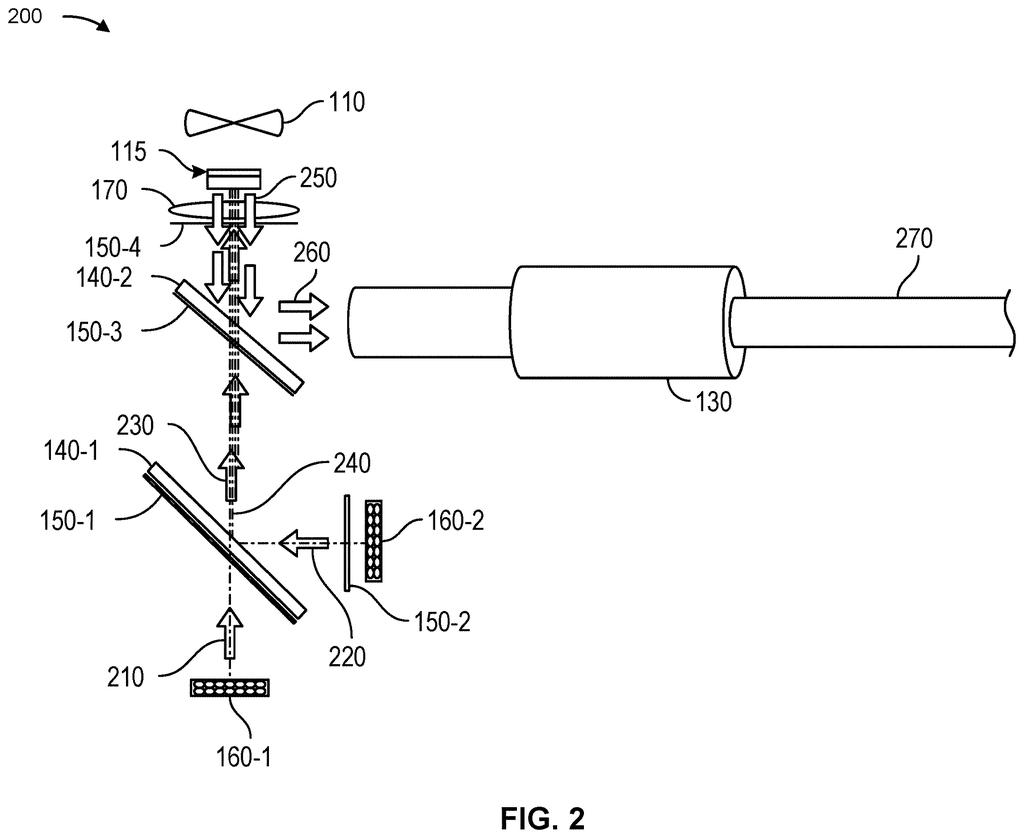
How Disney's two-laser light engine actually works
Imagine standing in a theme park at night watching a projection map an entire building in color. That kind of show needs an enormous amount of very precisely aimed light, and getting that right is harder than it sounds.
Regular lamps are easy on the eyes but hard to aim. Raw lasers are easy to aim but harsh, potentially dangerous, and tricky to color-mix. Disney's patent describes a middle path: two separate banks of lasers feed into a phosphor panel, which absorbs the laser energy and re-emits it as ordinary, non-coherent light. Think of it as using lasers as a pump to power what is effectively a very bright, very focused lamp.
The system also routes the first laser bank through a linear polarizer before the light hits the phosphor. That extra step helps control how the two light sources combine, giving engineers more precise control over brightness, color, and the direction the final beam travels.
… a phosphor assembly positioned to receive the first light from the first array of lasers and the second light from the second array of lasers and to generate a non-coherent light based on a combination of the first light and the second light.
Translation: A special glowing material blends the beams from both laser sets into a single output light.
How the phosphor panel converts laser beams into usable light
The system described in the patent has four main components working in sequence.
- First laser array: emits a beam of light that passes through a linear polarizer, a filter that only lets light waves oriented in one direction pass through. This shapes the light so it can be combined cleanly with the second source.
- Second laser array: emits a separate beam that does not go through a polarizer, giving engineers two independently controllable inputs.
- Phosphor assembly: the key stage. Phosphor is a material that absorbs high-energy light (like laser light) and re-emits it as lower-energy, non-coherent light. Non-coherent means the light waves are out of sync with each other, the same quality that makes sunlight or LED light safe and diffuse rather than the sharp, potentially hazardous beam of a raw laser.
The result is a light source that retains the tight, directable beam shape of a laser system but produces output that is much safer and more manageable optically, which is essential for large-scale projection environments where the audience is in the beam path.
The patent's claim is broad enough to cover the basic architecture of any system combining two laser arrays with a polarizer and a phosphor stage, regardless of laser color or phosphor chemistry.
What this means for Disney's theme park projection shows
For Disney, bright controllable light is a core infrastructure problem. Projection mapping at the scale of Cinderella Castle or the shows at EPCOT demands light sources that are simultaneously intense, precise, and safe for crowds. Laser-pumped phosphor technology is an established approach in professional cinema projectors, and this filing suggests Disney is interested in owning IP around its own implementation of that architecture for entertainment venues.
For everyday visitors, the direct consequence would be sharper, brighter projection shows that hold up even when ambient light is not completely dark. The specific inclusion of a polarizer on one of the two laser arrays also suggests Disney's engineers are thinking carefully about how to mix colors and control glare, two things that determine whether a show looks spectacular or washed out.
Disney's eighth filing in the Display work we cover since June adds to a run that includes one on floating 3D images in open air and one on projecting onto moving surfaces.
Claim 1 is strikingly broad. It covers any system with two laser arrays, a linear polarizer on the first, and a phosphor assembly that combines both beams into non-coherent light. There is no claim to a specific phosphor chemistry, a specific laser wavelength, or a specific optical geometry. That breadth could make the claim hard to get granted without a fight, because laser-pumped phosphor light sources are already common in cinema projectors.
What distinguishes this filing, at least on paper, is the two-array architecture with asymmetric polarization treatment. Using one polarized source and one unpolarized source to drive a single phosphor stage is a specific enough configuration that it might carve out defensible ground if the patent office agrees it is not obvious from existing projector designs.
Disney's interest in projection-system IP means this is less a consumer product announcement and more an attempt to own the engineering layer underneath the spectacle. Whether the claim survives examination in its current form is an open question, but the underlying engineering problem it addresses is real and not trivial.
There are more where this came from
We read every patent application Big Tech publishes and send you the ones worth knowing. Plain English, free, every week.
The drawings
3 drawing sheets from US 2026/0298443 A1 · click any drawing to enlarge


Want this weekly breakdown for a company we don't cover? Patentlyze Pro →
Be the first to weigh in