
Salesforce Patents a System That Warns Users When Tasks Will Take Longer to Complete
Anyone who has asked an AI assistant a question and then waited, silently, for an answer that never came knows the problem. Salesforce just filed a patent for a system that tells you, upfront, when your request is going to take a while.
What Salesforce's long-running task alert actually does
You're talking to an AI assistant at work and you ask it to pull together a full sales report across five regions. Instead of a spinning cursor and silence, the assistant immediately tells you: "This one will take some time, I'll come back to you when it's done." That's the core idea here.
Salesforce is patenting a way for its AI agents to recognize when a task is going to run long, pause, set that task aside in a managed way, and then ping you with the results once they're ready. The agent doesn't just stall out or pretend the work is instant.
For people who use AI tools at the office, this would close one of the most frustrating gaps in current products: the system either takes forever without telling you why, or it gives up. This patent proposes a proper handoff, where the AI stays on the job and keeps you informed.
… determining, at the server, that at least one action of the user-accessible actions is a long-running action to provide the information to the user based on the received query; generating, at the server, a new action based on the determination that the at least one action is the long-running action; …
Translation: The system figures out when a requested task will take extra time and creates a note about it.
How the server detects a slow task and reroutes it
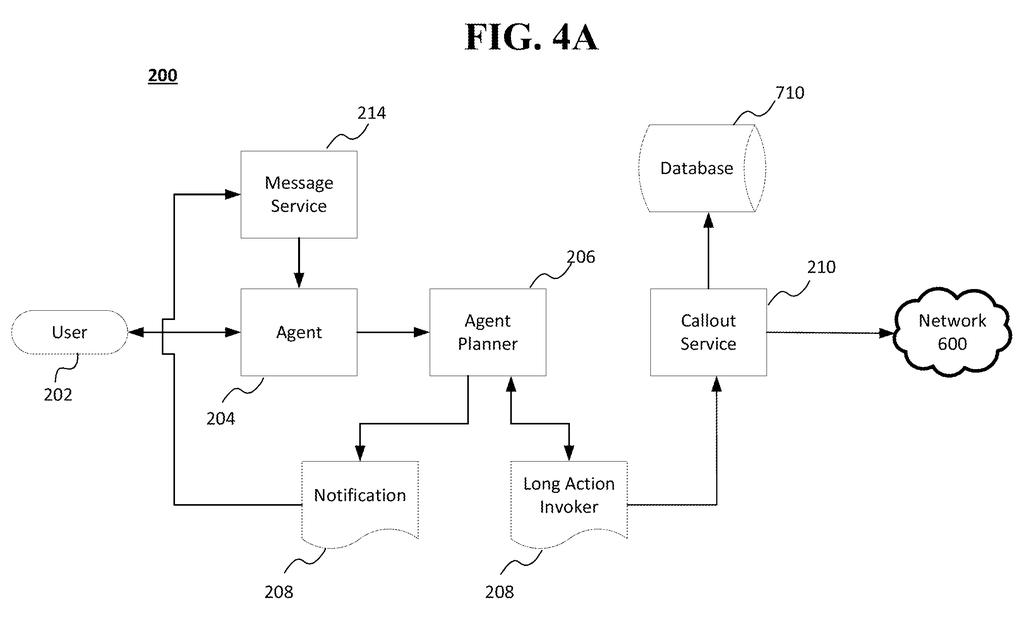
When a user sends a query to a Salesforce AI agent, the agent analyzes that request and assembles a list of possible actions it could take to respond. The server then reviews that list and checks whether any of those actions qualify as a "long-running action" (a task that cannot finish quickly enough to return an immediate answer).
If a slow task is detected, the server generates a new action specifically to handle the situation. That new action triggers a first notification to the user, surfaced through the agent, explaining that the task will take time. The user knows to expect a delay rather than being left in the dark.
Meanwhile, the server continues processing the original request in the background. When the work is done, it sends a second notification back to the agent containing the actual answer, which the agent then delivers to the user.
The mechanism essentially turns what would be a blocking, synchronous exchange (ask and wait) into an asynchronous one, similar to how email works compared to instant messaging. The key steps are:
- Detect that a task is slow before it stalls the conversation
- Tell the user immediately so they can move on
- Process the task separately in the background
- Deliver a follow-up notification with the completed result
The server may transmit a first notification to the agent to be presented to the user that the at least one action is the long-running action based on the generated new action. The server may process the long-running action and provide a second notification that includes the information requested by the user.
Translation: It warns the user in advance that the task is slow and sends the final result when it is done.
What this means for AI agents in the workplace
For anyone using AI tools inside a company's software platform, this is a quality-of-life fix that also changes how much you can trust an AI agent. Right now, if an agent goes quiet, you don't know whether it's working, stuck, or simply failed. A system that separates "I'm on it" from "here's the answer" makes the agent feel more like a reliable colleague and less like a broken search bar.
For Salesforce specifically, this matters because its AI products (sold under the Agentforce brand) are designed to take on complex, multi-step business tasks. Those tasks often touch multiple data sources and can take real time to complete. Salesforce's track record in AI agent patents suggests this is part of a broader push to make autonomous agents trustworthy enough for real enterprise workflows, where a missed reply or a silent failure can mean actual business consequences.
Salesforce's 24th filing we've tracked since May, following work on a self-teaching conversation system and teaching AI to read images, adds another piece to our AI agents acting for you watch.
Adding a detection step, a notification action, and a second delivery path means more places for things to break. The patent is light on what happens if that second notification never arrives.
The trade probably reads as worth it for enterprise software, where an agent that goes silent for three minutes without explanation is worse than no agent at all. Calling out the delay upfront is a small act of honesty that matters a lot when people are trusting software with actual decisions.
The weaker assumption baked into this design is that the server always knows upfront that a task will run long. Tasks go slow for unpredictable reasons mid-process, and a detection step that only fires at the start might miss the slowdowns that actually frustrate users. That gap is the real problem this patent leaves open.
There are more where this came from
We read every patent application Big Tech publishes and send you the ones worth knowing. Plain English, free, every week.
The drawings
6 drawing sheets from US 2026/0300047 A1 · click any drawing to enlarge


Want this weekly breakdown for a company we don't cover? Patentlyze Pro →
Be the first to weigh in