
Google Patents an On-Device AI Assistant That Recommends Actions Before You Ask
Google is patenting an AI assistant that doesn't wait for you to finish asking. It reads the context of your conversation, guesses what system action you probably want next, and asks for your permission before you've even made the request.
What Google's proactive on-device assistant actually does
You're typing out a message asking your phone to set a reminder, and before you even say "set a reminder," your assistant has already queued one up and is asking if you want to go ahead. That's the core idea in this Google patent.
The system is an on-device AI assistant, meaning it runs locally on your phone or tablet rather than sending everything to a cloud server. It reads your natural language input, generates a written response, and also predicts what action you might want the device to take based on what you said. Then it shows you both: the response and a prompt asking, "Do you want me to do this?"
The twist is how the assistant gets trained. A much larger, more capable AI teaches a smaller, leaner one. The big model generates example questions, answers, and recommended actions. The compact model learns from those examples, so it can run efficiently on your device without needing a constant internet connection or a powerful server behind it.
… generating, using the automated assistant, an anticipated system action to be taken by the device based on a context of the user input, wherein the anticipated system action is generated prior to the automated assistant being asked by the user to perform the action …
Translation: The phone predicts what you want to do next before you even ask it.
How a smaller AI learns to anticipate actions from a larger one
The patent describes a two-part output from the on-device assistant. When you say something in natural language, the assistant generates:
- A natural language response answering what you said
- An anticipated system action: a specific device command the assistant predicts you'll want, generated before you ask for it
The assistant then surfaces a proactive recommendation, which packages both the response and a permission prompt. If you approve, the assistant executes the action using a command it has already prepared.
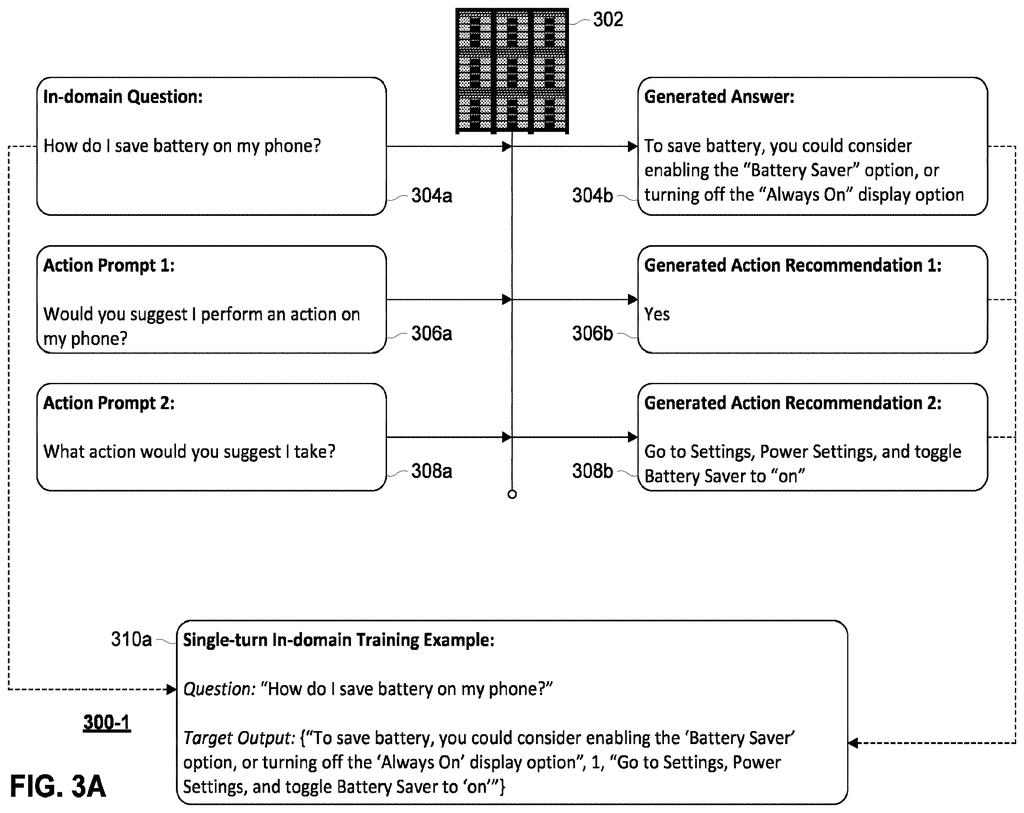
The training pipeline is where it gets interesting. A large conversational language model (think a cloud-scale AI with billions of parameters) acts as a teacher. It generates labeled training data: in-domain questions relevant to a specific product or service, target answers, and target action recommendations. It also generates follow-up questions to simulate multi-turn conversations (back-and-forth dialogue), then answers those too. A separate set of out-of-domain examples teaches the smaller model when not to act.
This process is called knowledge distillation: a compact student model learns to mimic the behavior of a much larger teacher, producing a model small enough to run on-device while still handling nuanced, multi-turn conversations and action prediction.
… a conversational language model is used to generate a target answer and a target action recommendation in response to each of a set of in-domain training questions …
Translation: A massive AI model is used to train the smaller on-device assistant to give answers and suggest actions.
What this means for privacy and on-device AI assistants
For users, the most immediate implication is convenience. An assistant that anticipates the next step in a task and asks permission rather than waiting shaves friction from common workflows, things like setting timers, sending messages, or opening apps, without requiring you to spell out every step.
For privacy, on-device processing matters. A model trained to run locally means your conversation doesn't have to leave your device to get a useful response. Google's run of on-device AI assistant filings suggests the company is treating local inference as a long-term priority, not just a feature footnote. Whether this particular system makes it into a shipping product depends on whether the distilled model is compact enough to run well on consumer hardware without sacrificing accuracy.
Google's 44th filing we've tracked since May in our agents that act for you watchlist follows tool that listens first and an AI that researches from scratch.
The core requirement here is software, not new hardware. A smaller model runs on your phone, a larger cloud model trains it, and a simple permission prompt sits on top. That is a short path to a real product.
The permission-prompt design is the detail that matters most. By asking before acting, the assistant avoids the feeling of something that just does things on your behalf without warning, which is the line between helpful and unsettling.
The harder problem is accuracy. The patent trains the assistant to stay quiet when it is uncertain, but real conversations are messier than training data, and a proactive suggestion that misreads the situation more than occasionally stops feeling like help.
There are more where this came from
We read every patent application Big Tech publishes and send you the ones worth knowing. Plain English, free, every week.
The drawings
24 drawing sheets from US 2026/0288791 A1 · click any drawing to enlarge


Want this weekly breakdown for a company we don't cover? Patentlyze Pro →
Be the first to weigh in