
Intel Patents a Charging Circuit That Backs Off Power When Your Laptop Gets Too Hot
Every laptop owner knows the feeling: the charger is plugged in, the surface is getting uncomfortably warm, and the fan is spinning hard. Intel's new patent describes circuitry that actually negotiates a lower power delivery level with your charger automatically, before that heat becomes a problem.
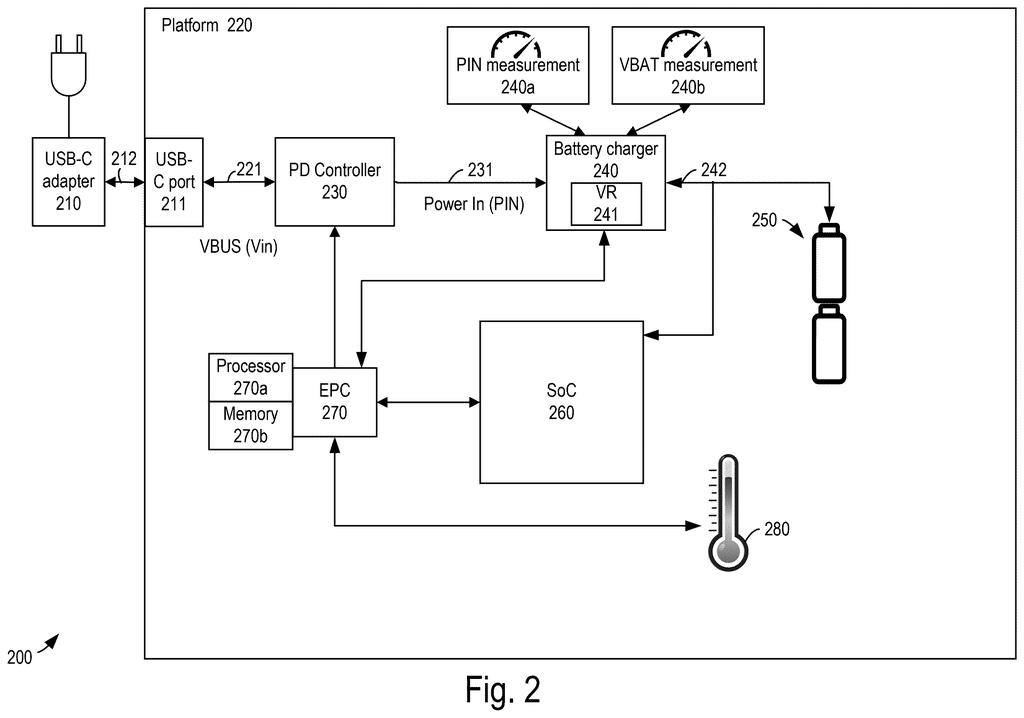
How Intel's heat-aware charger keeps your laptop cool
Every time you plug in a USB-C charger, your laptop and the adapter agree on how much power to transfer. Usually that conversation happens once and stays fixed until you unplug. Intel's patent describes a system that keeps that conversation going throughout your charging session.
The idea is straightforward: a temperature sensor monitors how warm the device's surface gets. If the skin temperature creeps past a set threshold, the laptop asks the USB adapter to send a lower voltage. Less voltage running through the charging circuitry means less heat generated inside the machine, and a cooler surface for you.
The system also watches the battery's current charge level. A battery at 20 percent needs power delivered aggressively; one at 85 percent can afford to take it easy. By combining those two signals, the charger can stay efficient without ever letting the device get uncomfortably warm on your lap.
… reducing its input voltage in response to a sensed skin temperature of the computing device exceeding a threshold …
Translation: The system lowers the incoming power when the outside of the computer gets too warm.
How the circuit renegotiates voltage with your USB adapter
The patent describes a battery charger circuit built around four connected components: the charger itself, a control circuit that acts as the decision-maker, a temperature sensor measuring the device's outer surface, and a charge-level detector reading the battery's current state.
The voltage entering the charger comes from an external USB power adapter. The control circuit watches both the skin temperature and the battery charge level simultaneously. When surface heat exceeds a programmed threshold, the control circuit initiates a USB Power Delivery negotiation (a standardized back-and-forth handshake between device and charger that agrees on voltage and current) to request a lower input voltage from the adapter.
Critically, the patent specifies that required power to the device must be maintained even as input voltage drops. That means the circuit is adjusting the efficiency profile of the internal voltage regulator (a component that steps the incoming voltage down to whatever level the battery actually needs), not simply starving the battery of charge.
The charge-level reading feeds into this calculation too. When the battery is nearly full, it naturally needs less aggressive charging, so a lower input voltage fits naturally. When the battery is low, the system has to balance heat management against the user's need to charge quickly.
What this means for thin laptops that run warm while charging
Thin laptops and tablets are the devices most likely to get warm in your hands while charging, because there's less physical space for heat to escape. A chip that can actively reduce heat at the source rather than just spinning up a fan louder could make a real difference in day-to-day comfort, especially for devices used on a lap or a bed.
This is also a firmware-and-silicon play, not a mechanical one. If the control logic is baked into Intel's platform controller circuitry, laptop makers could get the benefit without adding any new physical cooling hardware. That makes it a low-cost path for thin-and-light designs where thermal budgets are already stretched tight.
Intel's 65th filing in our chip patent coverage since May continues a math-speed thread that includes one on faster AI math handling and one on AI-guided multiplication we've tracked.
The parts this needs already exist in modern laptops: the connector that negotiates charging speed, the sensor that reads surface heat, and the circuit that tracks how full the battery is. Intel is patenting the logic that ties those pieces together in a specific order, which puts a working version closer to a firmware update than a factory redesign.
There are no new physical components required. The shortest path to shipping this is almost entirely software work, running invisibly in the background while the laptop asks its charger for a little less power whenever the surface gets warm.
The real-world result is a laptop that feels slightly cooler on your lap under the right conditions, with no obvious tradeoff. That is a small improvement, and it is close to ready.
There are more where this came from
We read every patent application Big Tech publishes and send you the ones worth knowing. Plain English, free, every week.
The drawings
10 drawing sheets from US 2026/0302798 A1 · click any drawing to enlarge


Want this weekly breakdown for a company we don't cover? Patentlyze Pro →
Be the first to weigh in