
Intel Patents a Faster Path to Sharper Streaming Video Without Burning CPU Time
A filter inside the next-generation AV2 video standard does a great job of improving picture quality, but it's so slow to configure that real-world encoders can barely use it. Intel's new patent offers a way to skip most of that work without hurting the final picture.
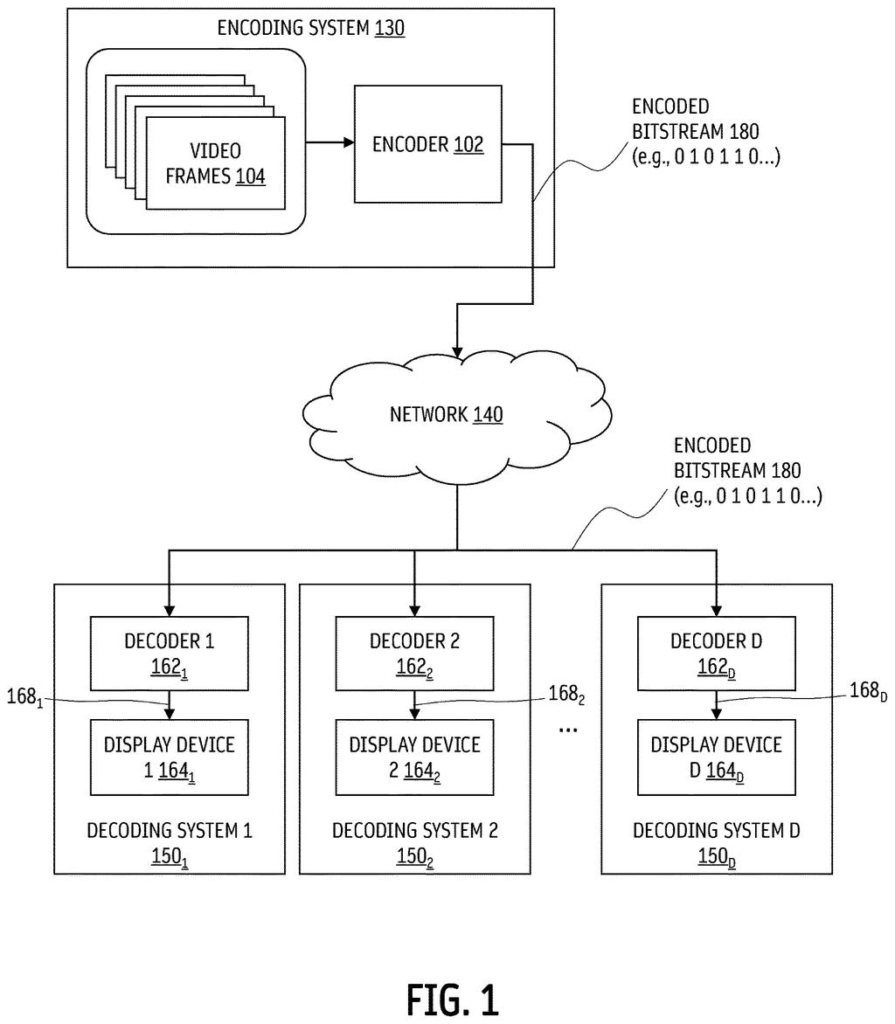
What Intel's AV2 filter speedup actually does
Imagine you're streaming a movie and behind the scenes, a server is compressing that video before it reaches you. Compression software uses many small tools to keep the picture looking sharp, and one of those tools in the new AV2 video standard is a filter that corrects color fringing around edges. The problem is that figuring out the right settings for that filter requires testing thousands of combinations, which takes too long for live video or dedicated chips.
Intel's patent describes a faster decision process. Instead of always running the full search, the encoder quickly checks a few simple things about the current video frame, such as whether it's a key frame or a routine in-between frame, and whether the frame has a lot of sharp edges. Based on those quick checks, it either runs the full search, runs a stripped-down version, or skips the filter entirely.
The result is that the filter can be used in real products, including chips designed for encoding, without grinding the whole process to a halt. You'd still get better-looking video, just without the computing cost that previously made this filter impractical.
How the hierarchical CCSO decision framework cuts search time
The patent targets a specific tool called the Cross-Component Sample Offset (CCSO) filter, introduced in the AV2 video coding standard. CCSO works by looking at one color channel (like brightness) to predict and correct errors in another channel (like color), reducing artifacts around sharp edges in compressed video.
The core problem is that finding the right CCSO parameters for each frame currently requires a brute-force search across a large grid of possible settings, which is computationally prohibitive for real-time encoding hardware.
Intel's solution is a hierarchical decision framework that runs a quick pre-check before committing to any search:
- Intra-frames and anchor frames (frames that other frames depend on) always get a full adaptive search, since quality matters most there.
- Inter-frames (frames predicted from neighboring frames) go through a complexity check: if the frame is complicated enough to benefit from filtering, a full or truncated search runs; if it's simple enough, the filter is disabled entirely and no search is needed.
- A sharp-edge analysis further trims the candidate parameter space before the search starts, so even when searching, far fewer combinations are tested.
The edge analysis acts as a content-aware gate: frames with few sharp edges are unlikely to benefit from CCSO, so the encoder skips the cost of finding out.
What this means for real-time AV2 video encoding hardware
AV2 is the codec that's expected to follow AV1, which already powers a large share of internet video on platforms like YouTube. If AV2's quality tools are too slow to use in practice, encoders will simply disable them, and the standard's picture-quality advantages won't reach viewers. Intel's patent is about making sure a key quality tool is actually usable, not just theoretically available.
For hardware implementers, this is particularly relevant. Dedicated encoding chips have fixed silicon budgets, and a filter search that works on a general-purpose server may be completely unworkable on a chip. By reducing the search to a small fraction of its original size in common cases, this approach makes CCSO viable in real-time encoding hardware, which matters for everything from video conferencing chips to streaming server accelerators.
This is unglamorous but genuinely useful work. The AV2 standard is still maturing, and patents like this one, which make expensive features deployable in actual silicon, are exactly what determines whether a codec's quality improvements reach consumers or stay locked in academic papers. Intel's encoder division has a direct commercial reason to file this: they sell video encoding chips, and a faster CCSO decision directly improves their products.
There are more where this came from
We read every patent application Big Tech publishes and send you the ones worth knowing. Plain English, free, every week.
The drawings
9 drawing sheets from US 2026/0222564 A1 · click any drawing to enlarge


Want this weekly breakdown for a company we don't cover? Patentlyze Pro →