
Intel Patents an AI That Teaches Chips to Multiply Numbers Faster
Matrix multiplication is the workhorse behind almost every AI model, and Intel is filing a patent for a chip that uses AI to optimize the very math AI depends on. It's a self-improvement loop baked into silicon.
What Intel's self-tuning matrix math actually does
You're running an AI tool and it's slower than you'd like. Behind the scenes, your processor is doing an enormous amount of basic arithmetic, adding and multiplying grids of numbers billions of times per second. The way those grids get divided up and processed is one of the biggest factors in how fast the whole thing runs.
Intel's patent describes a system where the chip figures out the best way to split up those number grids on its own, using a technique called reinforcement learning (the same kind of trial-and-error AI that taught computers to beat humans at chess). Instead of engineers hand-coding the optimal approach for each workload, the system tries different arrangements, measures how long each one takes, and keeps the fastest one.
The practical result is that the processor could adapt its behavior automatically depending on the type of math being asked of it, rather than using a one-size-fits-all approach that engineers set in advance.
identify matrices to be multiplied; split the matrices into subgroups; determine an initial tiling state based on the subgroups; determine an action to perform on the matrices; …
Translation: The AI breaks down large math problems into smaller chunks and figures out the best way to tackle them.
How the reinforcement loop picks and scores each split
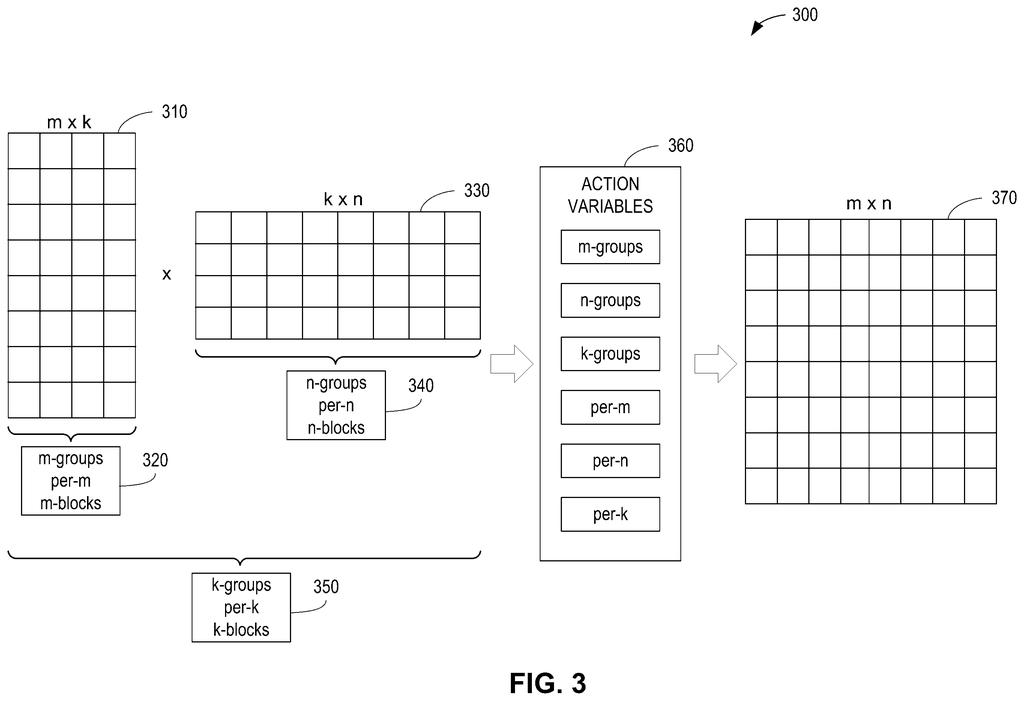
Matrix multiplication is the core operation in AI model training and inference. When a model generates a sentence or classifies an image, it is essentially multiplying huge grids of numbers (matrices) together, repeatedly. How a processor breaks those grids into smaller chunks (called tiling) has a massive effect on speed and memory efficiency.
Intel's patent describes a feedback loop that automates the search for the best tiling strategy. The system:
- Identifies the matrices that need to be multiplied
- Splits them into subgroups and records the current arrangement as an initial tiling state
- Selects an action (a change to how the tiles are arranged or processed)
- Measures the latency (how long the new arrangement takes to execute)
- Updates its state based on whether the new arrangement was faster or slower
This is a classic reinforcement learning loop: try something, get a score, adjust. The score here is raw execution speed. Over time, the system converges on the tiling configuration that runs fastest for a given workload.
The patent is framed around programmable circuitry, meaning this logic could sit in a chip's firmware or a hardware-software layer that governs how computation jobs are dispatched, rather than requiring a completely new chip design from scratch.
What this means for AI chip performance at scale
Tiling configuration is one of those settings that chip and compiler engineers spend enormous effort tuning by hand, and it often has to be re-tuned every time a new AI model architecture comes along. A system that searches this space automatically would cut down on the engineering hours required to get good performance out of new workloads.
For you as an end user, the benefit would show up indirectly: AI tools that respond faster, or that run on less expensive hardware because the chip is extracting more efficiency from the silicon it already has. Intel has been filing around AI-accelerated chip optimization suggests the company sees automated performance tuning as a longer-term architectural direction, not a one-off trick.
This is the 41st Intel filing we've tracked since May in the AI chip wars, building on one on variable data sizes and one on internal math handling.
The idea is teaching a chip's decision-making software how to carve up large math problems into smaller pieces, then learn over time which carving strategy runs fastest. No new physical hardware is described, which means this could theoretically arrive as a software update to chips already in customers' hands.
Getting there requires two things the filing does not address: a reliable way to predict how long any given strategy will take, and enough real training examples to cover unpredictable real-world conditions. Neither is simple.
The most realistic near-term product is probably an offline tuning tool, one that figures out the best strategy before a customer ever runs their workload, rather than a system making live decisions on the fly. That would still spare engineers a lot of tedious manual configuration, and it asks far less of the underlying technology than a fully automatic version would.
There are more where this came from
We read every patent application Big Tech publishes and send you the ones worth knowing. Plain English, free, every week.
The drawings
12 drawing sheets from US 2026/0278037 A1 · click any drawing to enlarge


Want this weekly breakdown for a company we don't cover? Patentlyze Pro →
Be the first to weigh in