
Apple Patents a System That Shifts 3D Photos Between Flat and Depth Views Based on Your Distance
Apple is working on a way to make 3D photos smarter about their own surroundings, automatically presenting them with full spatial depth when you're close enough to appreciate it, and switching to a simpler flat view when you're not.
What Apple's distance-based 3D photo switching actually does
Imagine you're browsing a virtual gallery in Apple Vision Pro, and a photo of a mountain scene is pinned on a wall across the room. At that distance, you can barely make out the details, let alone perceive any sense of depth. Should the headset still spend effort rendering that image in full 3D? Apple says no.
This patent describes a system that watches how far away a media object (like a spatial photo or video) is from your point of view inside a 3D space. If the image is within a certain distance, you get the full experience: foreground subjects that seem to pop out, layered backgrounds, the sense that you could reach in. Stray too far, and the system switches the same image to a flat, ordinary version.
The switch is automatic, driven by context rather than a setting you have to tweak. The photo itself carries depth data from when it was captured, so the system knows exactly which parts of the scene are near and far. It just decides, based on your position, whether to use that data or not.
… determining whether the media object is positioned within a particular distance range of the viewpoint within the 3D environment; based on the whether the media object is positioned within the particular distance range of the viewpoint within the 3D environment, determining a viewing state for viewing the media object …
Translation: The system checks how close you are to the photo to decide how it should be displayed.
How the system reads distance to pick a viewing mode
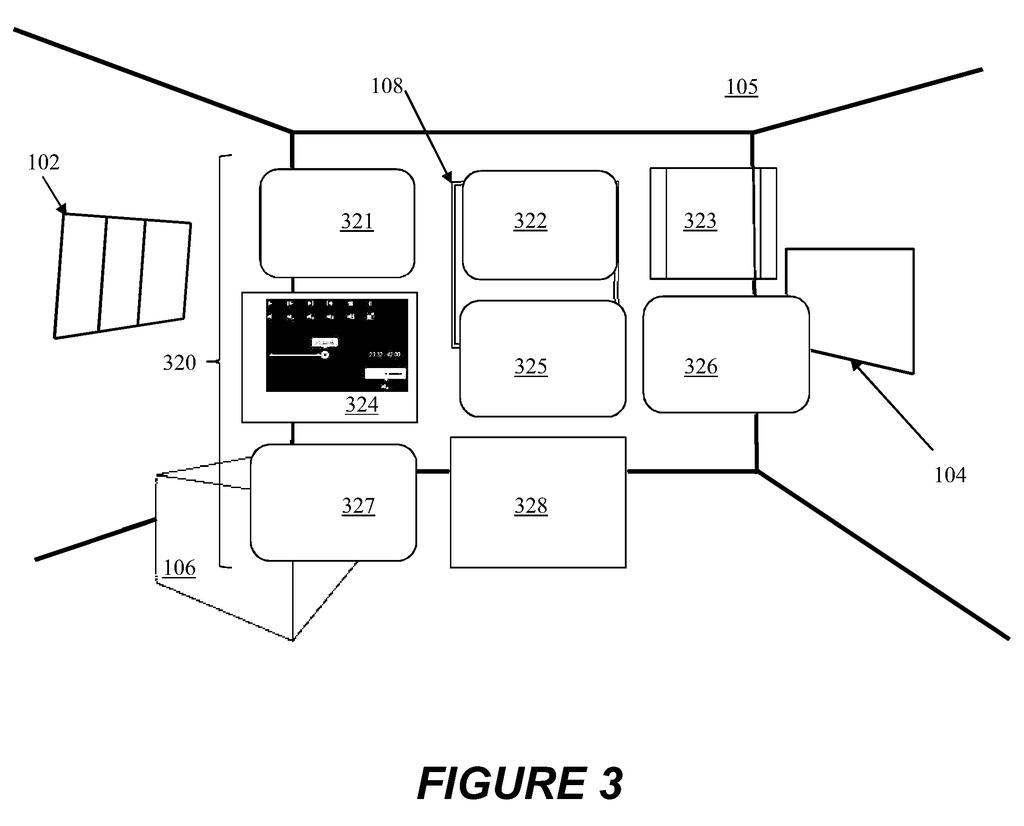
The patent covers a method for managing how spatial media objects (think: photos or videos that contain depth information, like the spatial photos Apple Vision Pro can capture) are displayed inside a 3D environment such as a virtual room or mixed-reality space.
The core mechanism works like this:
- A spatial image is placed somewhere in the 3D scene. When the image was originally captured, the device also recorded depth data, meaning it knows which parts of the scene were near the camera and which were farther away.
- The system continuously evaluates context, with the primary factor being whether the image falls within a specific distance range from the viewer's current position (the viewpoint).
- Based on that evaluation, it assigns a viewing state: either the first state (full depth rendering, using the stored depth map to present the image with apparent three-dimensionality) or a second state (planar rendering, showing the image flat like a regular photo).
The depth data the patent refers to corresponds to actual measured distances of elements within the original capture environment, so the parallax effect or sense of layering is grounded in real spatial information, not an artistic filter. The background 3D environment itself continues to show depth regardless; what changes is whether the photo inside that environment also renders in 3D.
… the viewing state defining whether the media object will be presented as a planar object or with depth within the media object.
Translation: The display mode changes the picture between flat and three dimensional.
What this means for spatial photos on Vision Pro
For anyone using Apple Vision Pro to view spatial photos or mixed-reality spaces, this kind of system addresses a genuinely awkward problem: a 3D image viewed from across a virtual room doesn't look meaningfully different from a flat one, but it still costs the hardware processing power to render it that way. Automatic switching means the experience feels right at every distance without you doing anything.
Apple keeps filing on spatial media and Vision Pro display logic, and this patent fits into that work naturally. The deeper implication is that Apple is thinking about spatial photos less as files you open and more as objects that exist in space, ones that should behave differently depending on where you are relative to them.
Apple's 74th filing we've tracked in our Apple AR glasses work since May adds to a picture that includes a patent on background audio in VR meditation and one on real objects shown around your avatar.
Spatial photos, images that carry depth information to mimic how human eyes see the world, are one of the marquee promises of headset computing. But pinning one of those photos far across a virtual room creates a mess: the depth effect fights for attention, burns processing power, and ultimately makes the experience worse than a flat snapshot would have been.
What this patent addresses is when and how to show depth at all. If a photo is far away, display it flat. If you move closer, let the depth emerge. The distance is already known to the headset, so the decision costs almost nothing extra.
That match between problem size and solution size matters. A sprawling technical fix for a subtle display annoyance would signal poor judgment. A lightweight rule applied at the right moment signals that someone understood the actual friction users were going to hit.
There are more where this came from
We read every patent application Big Tech publishes and send you the ones worth knowing. Plain English, free, every week.
The drawings
7 drawing sheets from US 2026/0301310 A1 · click any drawing to enlarge


Want this weekly breakdown for a company we don't cover? Patentlyze Pro →
Be the first to weigh in