
Apple Patents a Way to Show Real Objects Appearing Around Your Avatar During Video Calls
When you sit down during a video call, a chair could appear under your avatar. Apple has filed a patent describing a system that pulls real-world objects into a 3D virtual meeting space, only when they're needed, and only as much as your privacy allows.
What Apple's physical-context avatar system actually does
A friend's avatar floats in a blank virtual room during your video call. She reaches for something, and there's no context for what she's doing or why. That awkward gap is what this Apple filing tries to fix.
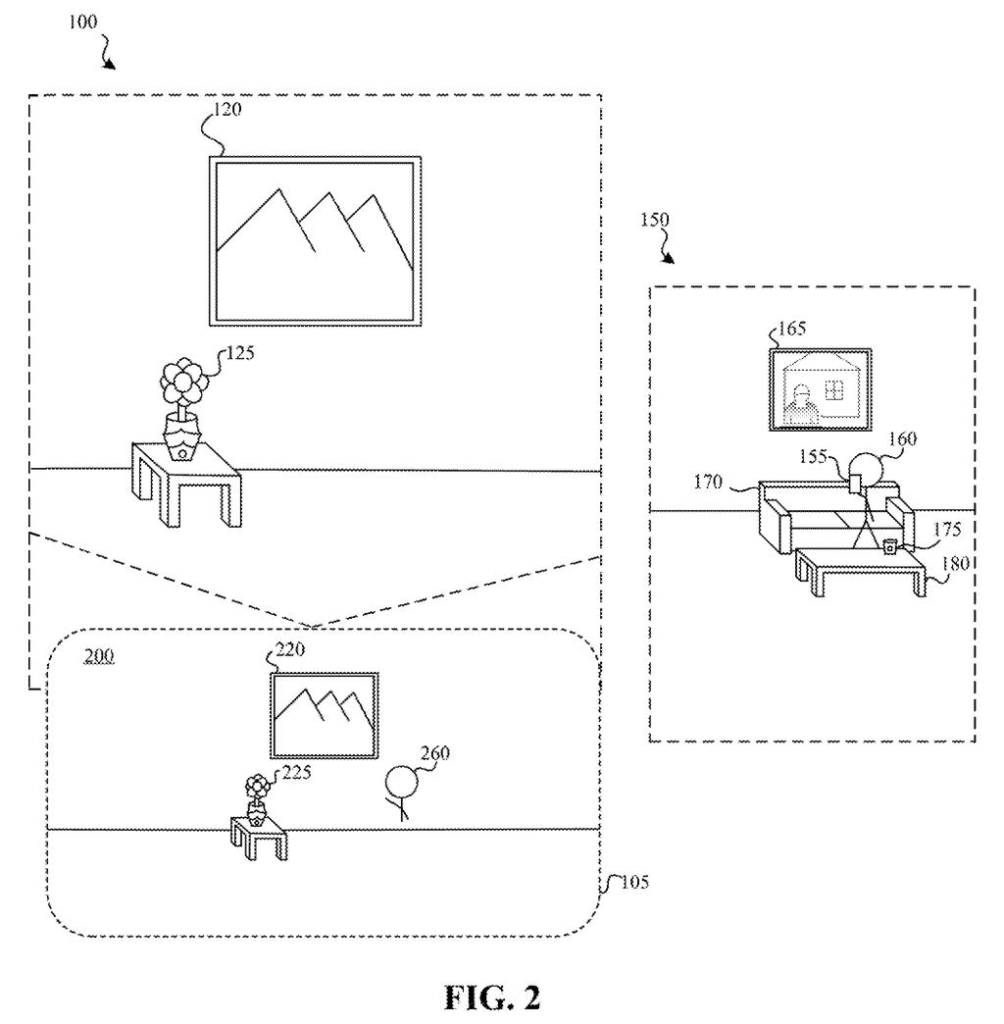
The system watches for specific events in the real world and responds by adding matching objects to the 3D scene. If someone sits down, a chair shape appears beneath them. If they reach toward a table, a table shows up. If a dog barks off-camera, a cartoon dog might pop into view. The idea is that these additions tell the story of what the other person is actually doing, without revealing their entire room.
Privacy is built into the design. The patent is explicit that the information sent about any object must be limited so it doesn't expose private details of the other person's home or surroundings. You see enough to understand what's happening, not a full scan of someone's living room.
… receiving information about characteristics of a context feature representing an object to provide the context, wherein the received information is limited to avoid revealing a private attribute of the physical environment of the remote user; …
Translation: Apple's system collects details about your room while purposely hiding your private items.
How the system detects conditions and renders context objects
The patent describes a method for contextual object injection inside a 3D virtual environment shared during a communication session (think a spatial video call, not a flat Zoom window).
Here's how the flow works:
- A user's avatar is shown inside a virtual 3D space. The real person is sitting somewhere else entirely, in their own physical room.
- The system monitors for specific trigger conditions, things like the person sitting down, reaching toward an object, turning their head toward a sound, or a detectable noise like a dog barking.
- When a condition is met, the system retrieves data describing a context feature, a simplified representation of the relevant real-world object (a chair, a table, a cup, another person nearby).
- That representation is added to the shared 3D view, so remote participants see it alongside the avatar.
Critically, the patent specifies that the information transmitted about any context object must be limited to avoid revealing private attributes of the physical space. So a chair might appear as a generic shape, not a photorealistic scan of the actual chair in the room.
The system appears to rely on sensors already present in a device like Apple Vision Pro (cameras, microphones, depth sensors) to detect the triggering events in real time.
… a representation of a sitting surface may be shown based on detecting that the user is sitting down, representations of a table and coffee cup may be shown based on detecting that the user is reaching out to pick up a coffee cup, …
Translation: Virtual objects like chairs and coffee cups appear around your avatar based on your physical actions.
What this means for spatial computing and video presence
Spatial computing video calls, the kind Apple Vision Pro is built around, have an obvious problem: avatars look disconnected from reality when they float in empty space. Every time someone reacts to something in their physical room, the remote viewer loses the thread. This patent is a direct attempt to solve that.
The privacy angle is the part worth watching. the pattern in Apple's spatial computing filings shows a recurring concern about how much of your home a device can see and transmit. Building the privacy limit into the core claim, rather than as an afterthought, suggests Apple sees this as a design constraint from the start, not a policy patch applied later. For everyday users, that framing matters: the feature only works if people trust it enough to turn it on.
Apple's 72nd filing we've tracked in our AR glasses work since May builds on ideas like overlaying a redesigned room and adding simulated lighting to video.
The distance between this patent and a finished product is short. Apple is describing software logic that watches your surroundings during a video call and decides when to show the other person a glimpse of your world, like your chair appearing when you sit down or your coffee cup when you reach for it. The sensors that would make that possible already exist in Apple's spatial computing hardware.
The main engineering work left is tuning the trigger system so that context appears when it adds something and stays hidden when it would just be clutter or an unwanted peek into someone's home.
Apple builds the privacy boundary into the core of what the invention claims, not as a setting you have to find and flip on. That design choice is probably the deciding factor in whether people actually use the feature, because a tool that earns trust by default is one people leave turned on.
There are more where this came from
We read every patent application Big Tech publishes and send you the ones worth knowing. Plain English, free, every week.
The drawings
12 drawing sheets from US 2026/0301340 A1 · click any drawing to enlarge


Want this weekly breakdown for a company we don't cover? Patentlyze Pro →
Be the first to weigh in