
Apple Patents a System That Plays Different Background Audio Every Time You Meditate in VR
Apple is patenting a way to make every guided meditation or breathing session in its headset feel subtly different, by assembling the background audio from a curated pool of sound pieces, randomly mixed each time you start.
What Apple's randomized XR meditation audio actually does
You're putting on your Apple Vision Pro for a few minutes of breathing exercises, and something feels a little off: the ambient sounds are exactly the same as yesterday, and the day before. The audio has become background wallpaper your brain tunes out.
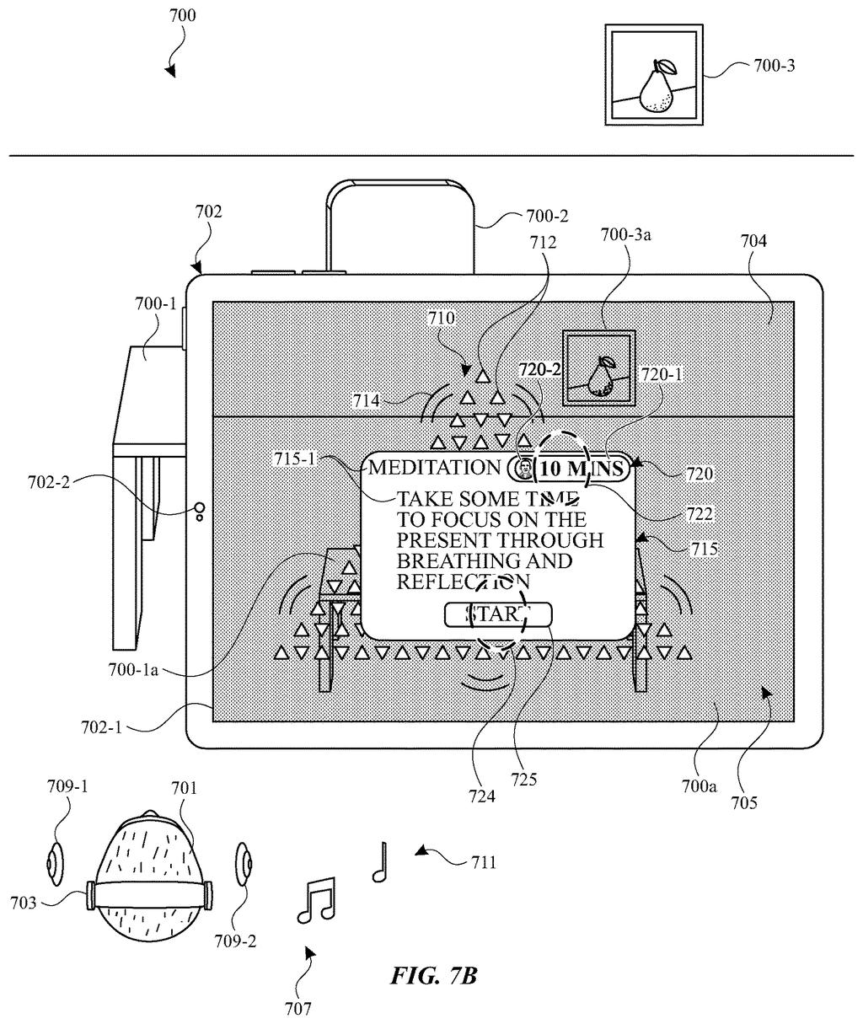
This patent describes a system Apple has been working on to fix that. Each time you start a wellness or meditation session inside the headset's extended reality environment, the system picks a fresh combination of audio pieces from a pre-approved library and stitches them together into a soundscape unique to that session. The visual display and audio play together, and the whole mix changes the next time you sit down.
The patent also mentions two other ideas in the same family: animated particles that move in sync with your breathing, and session options that adapt based on what your surroundings look like through the headset's cameras. Together, they sketch out a more personal, less repetitive approach to in-headset wellness.
… outputting the first audio soundscape with a first set of two or more audio components selected randomly or pseudorandomly from a set of available audio components; …
Translation: The system plays background sounds made from randomly picked audio parts during your first session.
How the system assembles a new soundscape each session
At the core of the patent is a randomized audio assembly system for extended reality (XR) wellness sessions. When you launch a session, the system pulls two or more audio components from a set of available, curated pieces and combines them into a soundscape. The key word is randomly: the specific combination is chosen pseudorandomly (meaning generated by an algorithm that produces unpredictable-feeling results without being truly random), so the mix you hear on Tuesday is statistically unlikely to match the one from Monday.
The claim is precise about this: a first session gets a "first set" of audio components, and a second session of the same type gets a "second set" drawn from the same pool. The system uses one or more sensors, a display component, and an audio output component, which in the Vision Pro context means the cameras, microphones, speakers, and the headset's displays all feeding into a coordinated experience.
The broader patent family covers two additional capabilities:
- Breathing-responsive particles: visual elements on screen that move or pulse based on the user's detected breathing rhythm, giving real-time visual feedback during breathwork exercises.
- Environment-aware session options: the headset reads characteristics of your physical surroundings (lighting, for example) and adjusts which session types or settings it surfaces to you.
All three capabilities are tied to the Vision Pro's ability to blend computer-generated content with the real world, which Apple calls an XR environment.
… a computer system provides a computer-generated user experience session with a soundscape having randomly selected curated sound components.
Translation: The headset creates virtual reality sessions that use randomized background music and sounds.
What this means for wellness features on Apple Vision Pro
For anyone who uses a wellness app daily, repetition is the enemy of effectiveness. The brain adapts to familiar stimuli fast, and a meditation soundscape that never changes becomes easy to ignore. Apple's approach, treating ambient audio as a modular set of pieces rather than a fixed track, is a low-cost way to keep sessions feeling fresh without requiring the company to produce an enormous library of fully unique recordings.
This sits squarely inside the pattern in Apple's Vision Pro wellness filings, which have consistently tried to push the headset toward health and mindfulness use cases. If these features ship, they would give Apple a concrete answer to the criticism that XR headsets are too isolating for daily wellness habits, since the system actively responds to your body and environment rather than just playing a static loop.
Apple's 73rd filing we've tracked since May on Apple AR glasses connects to the application about real objects around avatars and the one about a redesigned room overlay, adding yet another piece to the pile.
Anyone who has used a meditation app for more than a few weeks knows the moment a familiar opening note plays and the mind is already somewhere else. That recognition kills the session before it starts, and it shortens the useful life of an expensive piece of hardware meant to build a lasting habit.
Assembling ambient sound from a curated pool of smaller pieces, recombined differently each time, is a proportionate answer to that problem. The variety stays fresh without the user needing to understand how it works, and quality stays high without requiring an endless stream of new recordings.
The breath-responsive visuals and the feature that reads your physical surroundings address something quieter but equally real: the feeling that a wellness session is happening to you rather than with you. That gap between passive and participatory is a legitimate problem, and the size of the bet here reflects how seriously it is being taken.
There are more where this came from
We read every patent application Big Tech publishes and send you the ones worth knowing. Plain English, free, every week.
The drawings
22 drawing sheets from US 2026/0301338 A1 · click any drawing to enlarge


Want this weekly breakdown for a company we don't cover? Patentlyze Pro →
Be the first to weigh in