
Microsoft Patents a System That Assembles AI Agents From a Plain-English Request
Building a multi-step AI workflow today usually requires a developer. Microsoft has filed a patent for a system that does that job itself, turning a plain-language request into a working team of AI agents.
What Microsoft's self-building AI agent system actually does
You're a manager who wants an AI to research competitors, summarize findings, and email a report every Monday. Right now, setting that up means hiring someone who knows how to wire different AI tools together. Microsoft is working on a way to skip that step entirely.
The idea: you type what you want in plain English, and the system figures out which AI "agents" (mini-programs each focused on one job) and which tools (like web search or email) are needed, then assembles the whole thing for you. It draws on a library of pre-rated agents and tools, scoring them against your request to pick the best fit.
The result is a ready-to-run AI system built to your specification, without you ever touching a configuration screen or writing a line of code.
receive a request including natural language text input from an interaction interface; generate an agent design prompt including an agent task description, agent output instructions, and scored agents based on the request; …
Translation: The system takes your plain text request and builds a detailed prompt to create specialized AI agents.
How the system picks agents and tools in two separate passes
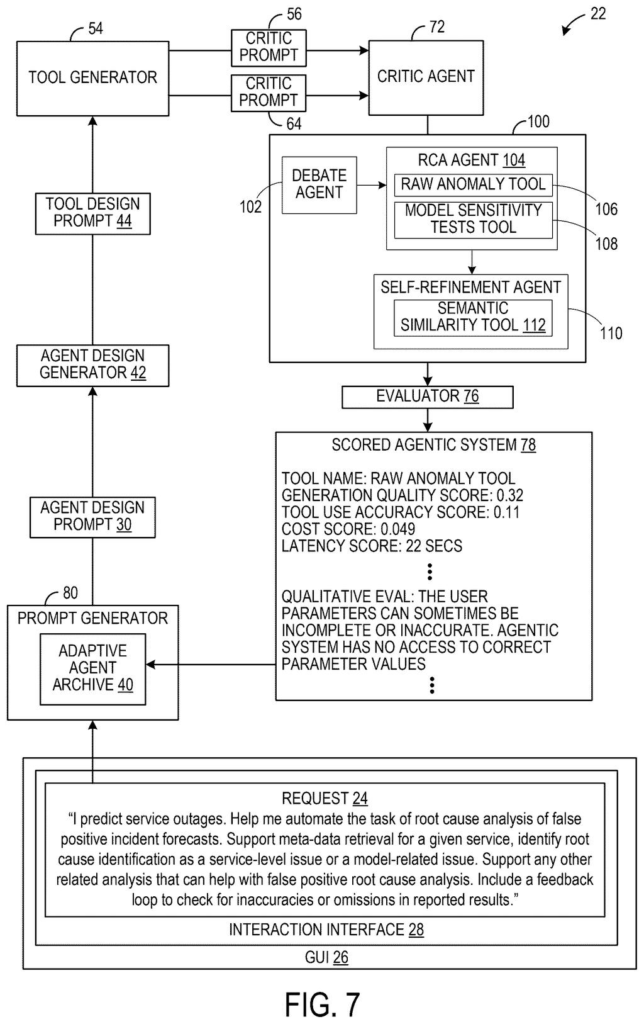
The patent describes a two-stage design pipeline. In the first stage, the system takes your natural-language request and builds an agent design prompt, a structured brief that includes a description of the task, output requirements, and a ranked list of candidate agents pulled from a library. That prompt goes into an agent design generator (an AI model) which selects or creates the agents your workflow needs.
In the second stage, the system takes those generated agents and builds a tool design prompt, adding a separate task description and a scored list of candidate tools (think: web browsers, calendars, APIs). A tool generator then picks or creates the tools each agent will use to do its work.
The key architectural choice is that agents and tools are designed in sequence, not simultaneously. Agents are specified first so the tool-selection step knows exactly what capabilities each agent needs. "Scored agents" and "scored tools" mean the library entries are pre-ranked by past performance or fit criteria, so the AI isn't starting from scratch every time.
The final output is a fully assembled agentic system: a coordinated set of AI agents with their assigned tools, ready to execute the task the user described.
What this means for people who want AI to do complex tasks
Right now, building a multi-agent AI workflow is a specialist job. This patent, if it makes it into a product, would let anyone describe what they want and receive a working AI pipeline in return. That could matter a lot inside enterprise software, where Microsoft products like Copilot and Azure AI are already positioned for business automation.
Microsoft has been filing around agentic AI systems since early 2024, and this filing fits a pattern of trying to lower the barrier between a human request and a deployed AI system. The practical payoff for you as a user: less time explaining your needs to a developer, and more time getting results from a system that assembled itself.
Microsoft's 16th filing we've tracked since July in our AI agents acting for you watchlist builds on earlier applications like no-code process automation and a self-patching three-AI setup.
Deciding what the AI workers do before choosing what tools they carry is a sensible ordering, and it gives the tool-selection step real context to work with. The cost is that the whole pipeline depends on a pre-scored library of candidate workers and tools, so if that library is stale or simply missing the right options for an unusual request, the system inherits those gaps with no obvious way to recover.
That dependency is a real constraint, and the patent says little about how the library stays current or who updates it when needs change.
For routine business tasks with well-established options, the trade reads as worth it. For anything novel or ambiguous, a human still needs to review the output before trusting it to run on its own, which limits how much of the promised automation actually lands in practice.
There are more where this came from
We read every patent application Big Tech publishes and send you the ones worth knowing. Plain English, free, every week.
The drawings
9 drawing sheets from US 2026/0300641 A1 · click any drawing to enlarge


Want this weekly breakdown for a company we don't cover? Patentlyze Pro →
Be the first to weigh in