
Sony Patents Faster Game Streaming by Sending Smaller Stand-Ins for Large Environments
Waiting for a massive game world to load is one of gaming's most persistent frustrations. Sony is patenting a cloud-server trick that sends a compact 3D stand-in for a large asset almost immediately, so something appears on screen while the full version catches up.
What Sony's 3D asset placeholder system does for players
Every time a cloud game needs to show you a huge building or detailed vehicle, it has to pull that asset across the internet to your console or device. The bigger the asset, the longer the wait, and in a streaming game that delay can mean a blank space or a sudden pop-in right in front of you.
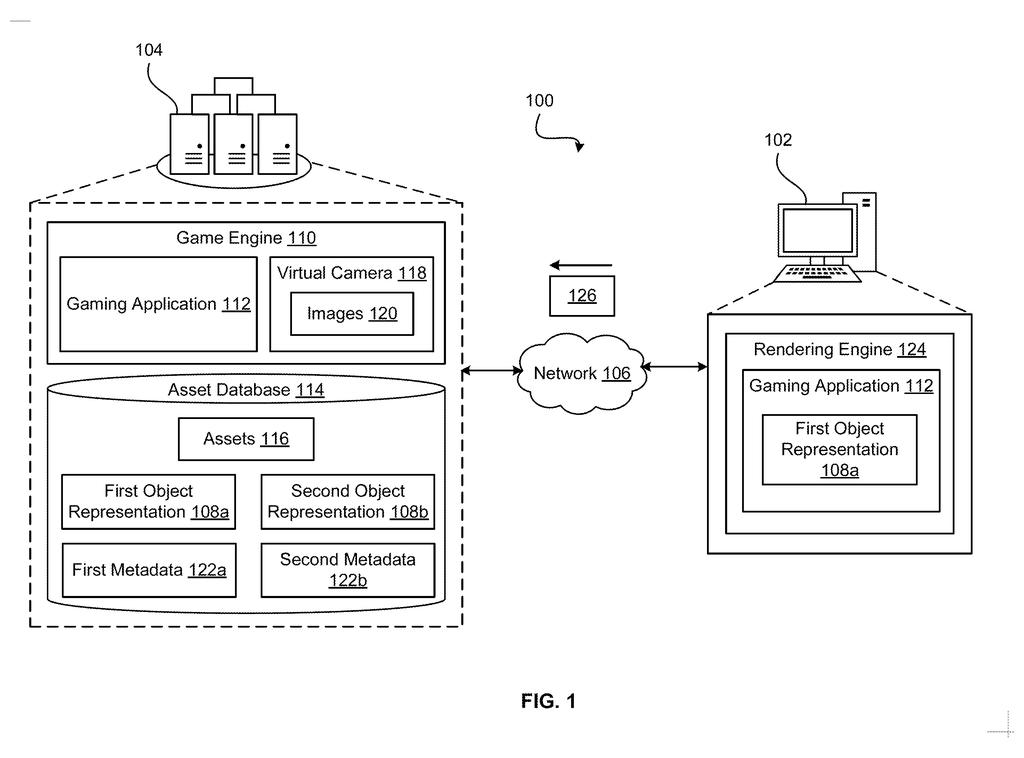
Sony's patent describes a system where a cloud server creates a smaller, simpler 3D version of that large asset by photographing it with a virtual camera and turning those images into a compact object. Think of it like a rough clay model standing in for an intricate sculpture. The server stores this lightweight stand-in alongside notes about its size and properties.
When your device asks for the full asset, the server sends the stand-in first so your screen shows something right away. Your device's rendering engine uses that lightweight version until the full-quality asset is ready. The goal is fewer blank spaces and a smoother experience on your end.
generating, for an asset of a gaming application, an object representation of the asset based at least in part on one or more images of the asset captured by a virtual camera, wherein a first data size of the asset is larger than a second data size of the object representation; …
Translation: The cloud creates a smaller stand-in asset using pictures taken by an in-game camera.
How the cloud server builds and delivers the stand-in object
The patent describes a cloud server pipeline with four main steps:
- Capture: A virtual camera inside the game engine photographs the full-size asset from one or more angles, creating image data that represents what the asset looks like.
- Generate a stand-in: The server converts those images into an object representation, a simplified 3D model that is measurably smaller in file size than the original asset.
- Tag it with metadata: The server records the stand-in's data size and its properties (things like its dimensions and rendering instructions) so downstream systems know exactly what they are working with.
- Serve on request: When a client device (your console, PC, or phone) asks for the full asset, the server responds by sending the stand-in to the device's local rendering engine instead, or as a first step before the full asset arrives.
The key technical idea is that the stand-in is generated from virtual-camera imagery rather than by manually authoring a lower-detail model. This makes the process automatic and scalable across a game's entire library of large assets.
The metadata layer is also notable: by tagging each stand-in with its size and properties, the server can make intelligent decisions about which version to send based on what the client device needs at any given moment.
… responsive to receiving a request for the asset from a client device, providing, based at least in part on the metadata, the object representation as input to a rendering engine executed by the client device.
Translation: When a player's device asks for the object, the server sends the lightweight version instead.
What this means for cloud gaming load times and streaming
For anyone who plays games through a streaming service, this addresses one of the most visible problems in cloud gaming: the moment when a large object just fails to appear, or appears as a blurry blob, because the data did not arrive fast enough. A 3D stand-in that looks roughly correct is a much better experience than an empty hole in the game world.
On the infrastructure side, this approach could let Sony's cloud servers handle more players without each one needing to wait for enormous asset files to fully transfer. Sony's run of cloud gaming infrastructure filings suggests the company is investing seriously in making PlayStation's streaming tier feel closer to running a game locally. Whether this technique makes it into a shipping product depends on factors the patent does not address, but the problem it targets is real and noticeable.
Sony's 585th filing in our Sony coverage since May adds to a run that includes an AI-matched graphics patent and a taste-reading game adjuster.
If you have ever watched a game world load and seen a blurry blob hovering where a building or vehicle should be, you already know what this patent is trying to fix. Sony is automating the creation of recognizable stand-in versions of large game objects, so that what appears in those loading moments at least looks like the real thing rather than a shapeless smear.
Most players will never consciously notice it working. The win is a negative one: the ugly, immersion-breaking placeholder simply stops appearing, or at least stops looking broken.
The part that matters for studios is that this happens automatically on the server side, which means artists and developers do not have to spend extra time hand-crafting lower-detail versions of every object in the game. Less manual work, fewer ugly gaps, and a slightly smoother experience for the person holding the controller.
There are more where this came from
We read every patent application Big Tech publishes and send you the ones worth knowing. Plain English, free, every week.
The drawings
6 drawing sheets from US 2026/0295400 A1 · click any drawing to enlarge


Want this weekly breakdown for a company we don't cover? Patentlyze Pro →
Be the first to weigh in