
Sony
Sony · AR / VR · Filed Jan 17, 2025 · USPTO published Oct 1, 2026 · Oct 1 release
Sony Patents a System That Lets Users Feel Three Stages of Grabbing in VR
Right now, most VR controllers either vibrate or they don't. Sony is patenting a system that gives your hands three distinct feelings depending on whether you're approaching, touching, or holding something in a virtual world.
- Publication number
- US 2026/0299690 A1(US20260299690A1)
- Applicant
- Sony Group Corporation
- Filed · Published
- Jan 17, 2025 · Oct 1, 2026
- Inventors
- Yuri ISHIKAWA, Hiroshi SUZUKI, Ryo YOKOYAMA, Yusuke NAKAGAWA
- Status when we published
- Examiner raised objections; the company can respond
- Document
- 24 claims
- US classification
- 345/156
- Examiner
- FIGUEROA-GIBSON, GLORYVID (Art Unit 2628)
- Parent application
- National Stage Entry of PCT/JP2023/021283 (filed Jun 8, 2023)(PCTJP2023021283)
What Sony's three-stage haptic grip system actually does
Ever tried to pick something up in VR and felt like the controller just buzzed randomly? Sony is working on a way to fix that by breaking the act of grabbing a virtual object into three clearly defined stages, each with its own distinct vibration pattern.
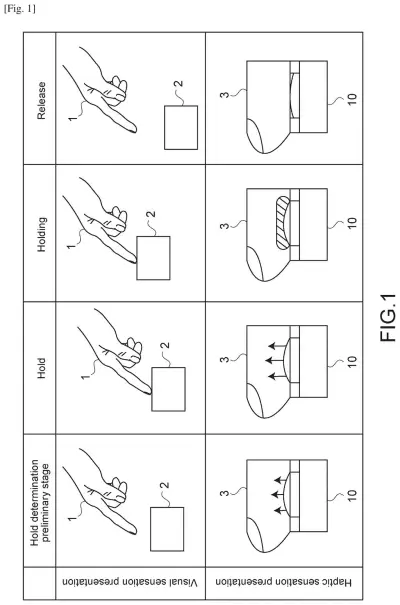
Here's how those stages work in plain terms: first, you're hovering near an object (the third state, in Sony's language). As your virtual hand gets closer, the vibration changes. When you actually make contact and grab it (the first state), you feel something different again. And once you're holding it steady (the second state), the feedback shifts one more time to reflect that continuous grip.
The goal is to make your hands feel like they're actually interacting with something real, rather than getting the same generic buzz for every action. Whether you're nudging a lever, picking up a cup, or pressing a button inside a virtual environment, each moment of contact could feel different.
… generating haptic sensation signals corresponding to each of the first, second, and third states.
Translation: Controllers produce physical feedback for every single phase of the grabbing action.
How the system maps distance and action to vibration signals
The patent describes a software method that monitors the relationship between two objects in a virtual space: an operation object (your virtual hand or tool) and a target object (whatever you're trying to interact with).
The system tracks three states:
- Third state: you're approaching but haven't touched yet. The system measures distance and starts adjusting haptic output as you get closer.
- First state: contact is made and an action begins (grabbing, pressing, activating).
- Second state: the action is sustained, meaning you're holding or maintaining that contact over time.
The transition from approaching to touching is triggered automatically when the measured distance drops below a specific threshold (the second distance in the claim). Once that threshold is crossed, the system locks into the first state and then advances to the second state as the interaction continues.
Haptic signals (vibrations sent to a controller or glove) are generated separately and distinctly for each of the three states. This means the hardware can be instructed to produce different intensities, rhythms, or waveforms depending on exactly where you are in the interaction timeline, rather than a single catch-all buzz.
What this means for feeling things inside VR headsets
For anyone using a VR headset with motion controllers, the practical payoff is a more believable sense of touch. Right now, the haptic feedback on most consumer controllers is blunt: you press something and it vibrates. Sony's approach could make the moment of almost touching feel different from the moment of actually gripping, which is how your real hands work.
This matters most in applications where precision counts: surgical training simulations, fine-motor rehabilitation tools, or VR games where picking up and manipulating objects is central to the experience. If your hands can feel the approach, the grab, and the hold as three separate events, the whole interaction becomes less like operating a remote control and more like touching something physical.
Sony's 571st filing in our Sony coverage since May adds to a run that includes a touchscreen that pushes back and gesture camera control from a headset.
Source: US 2026/0299690 A1 at the USPTO (PDF). Full patent text and figures are in the official publication.
Get our take in your Top Stories
Liked this breakdown? Add Patentlyze as a preferred source on Google, and our plain-English take shows up more often in your Top Stories the next time Sony patent news breaks.
Add Patentlyze on Google
One click.
There are more where this came from
We read the new patents from Big Tech, carmakers and more and send you the ones worth knowing. Plain English, free, every week.
The drawings · 12 sheets
12 drawing sheets from US 2026/0299690 A1 · click any drawing to enlarge


Show the other 4 sheets


More from Sony
All 722 Sony patents →
More in AR / VR
All 718 AR / VR patents →
Meta
Meta Patents Haptic Feedback System That Signals XR Event Urgency
Samsung
Samsung Patents a Segmented Grating Design for Clearer AR Waveguide Displays
Sony
Sony Patents a Vehicle Window That Doubles as a Per-Pixel Gaming Display
Google
No comments yet