
Salesforce Patents a Search Assistant That Rewrites Your Query When It Finds Nothing
Search for something a store doesn't carry and you usually get a blank page. Salesforce's patent has an AI helper step in with reworded searches and a one-line reason for each.
What Salesforce's search assistant does for you
Imagine typing "jitter" into a store's search bar, hoping to find a drink, and getting a blank page that says nothing was found. Most of us would shrug and leave the site. Salesforce's patent describes a chat-style helper that steps in at exactly that moment.
Instead of a dead end, the helper checks what the site actually sells and suggests new searches, like "energy drinks" or "coffee," each with a short explanation. If your search brings back a flood of results instead, it offers a short list of categories (Men, Women, Novelty) to narrow things down. You tap one, and the search runs again.
A third version skips the categories and gives you a short ranked list of the best matches, with notes on why each one made the cut.
… re-ranking, at the search assistant of the server, the one or more information categories based on grounding data that includes index metadata for a database of information products and at least one selected from a group consisting of: the received search query, and a distribution of the search results from the generated search request …
Translation: The system sorts the categories again using database details and the original search terms.
How the assistant narrows or rewrites a search
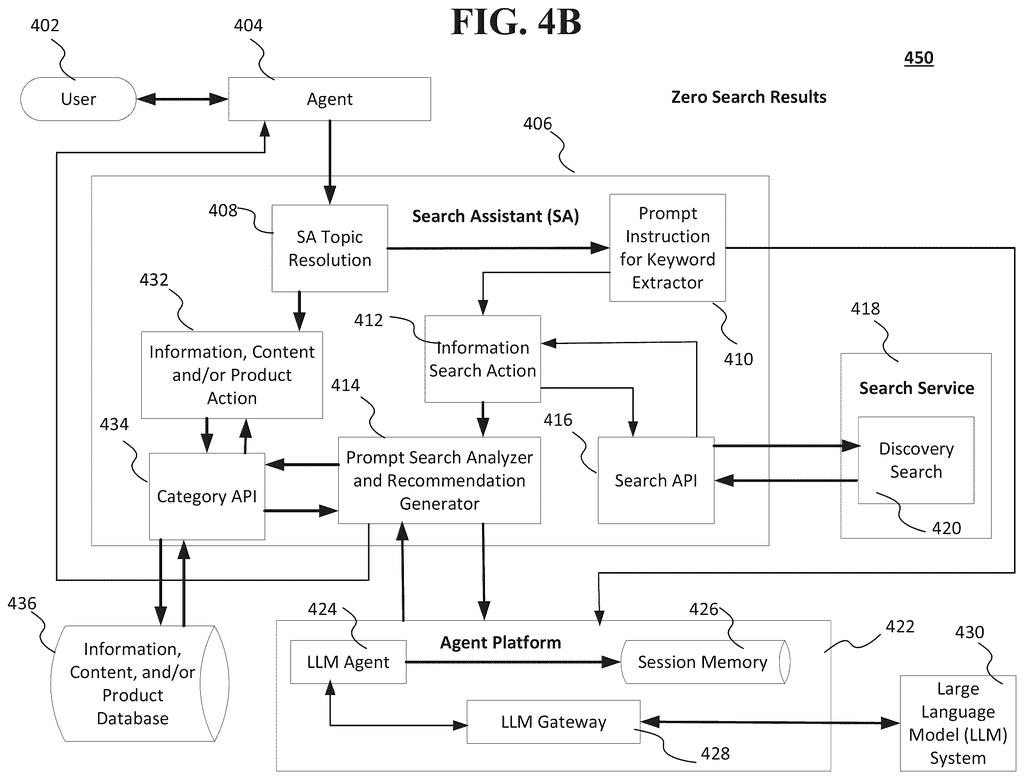
The filing describes an agent (a chat-style helper that could sit in a website's sidebar) backed by a search assistant running on the company's server. When you type a query, the assistant pulls out the keywords, throws away filler words, and sends a search request to the site's search service.
What happens next depends on how many results come back. The claims cover three paths:
- Too many results: the assistant builds a list of categories from the results, ranks them, then re-ranks them using the original query, how the results are spread out, and grounding data. Grounding data is the site's own category tree plus index metadata (descriptive labels such as color or product type that the search engine can filter on). The re-ranked categories go back to you to pick from.
- Zero results: a "search rescue." The grounding data tells a large language model (LLM, the kind of AI behind chatbots) what the site really carries, and it proposes reworded queries, optionally with a justification for each.
- Ranked picks: the same re-ranking applied to products or content directly, returning a set number of top matches along with reasons.
The description adds that the system can check a session memory for earlier results before calling the LLM again.
The one or more information categories may be re-ranked based on the received search query, a distribution of the search results from the generated search request, and/or grounding data.
Translation: The search categories are ordered again using the initial query and search results.
Why dead-end searches cost online stores
If you have ever searched a store's site, hit a wall of results or a blank "no results" page, and given up, this targets that moment. The filing says the goal is to get you to what you want quickly, without frustration and without you leaving the site. You would see a few clickable options instead of having to guess better search words on your own.
For the businesses running the site, a lost search can mean a lost sale. Because the assistant relies on the site's own category list and labels, its suggestions are meant to stay tied to what is actually available, which limits the risk of an AI pointing you to things that don't exist.
One more thing to know: the patent office has already approved this application, and Salesforce has paid the fee to have it issued, so it should become a granted patent soon. The final granted claims may read a little differently from the version described here.
Salesforce's 32nd filing we've tracked in AI assistant & agent coverage since May adds to a run that includes a task-timing warning system and a self-teaching conversation AI.
Everyone has hit a search box that returns either thousands of results or a flat "nothing found." Both outcomes hand the work back to you, and plenty of people respond by closing the tab. The cost per visit is small, but it adds up fast because search boxes sit on nearly every shop and help site.
The approach fits that problem well. It is a short list of tappable options built from the site's own categories and labels, with an AI doing the rewording. Nothing about it needs a new gadget or a change in your habits.
The core idea is simple: count the results, then offer narrower or reworded options. The details that carry the weight are the use of the site's own catalog data and the short reasons shown with each suggestion. Expect this to be useful and mostly invisible.
Get our take in your Top Stories
Liked this breakdown? Add Patentlyze as a preferred source on Google, and our plain-English take shows up more often in your Top Stories the next time Salesforce patent news breaks.
There are more where this came from
We read every patent application Big Tech publishes and send you the ones worth knowing. Plain English, free, every week.
The drawings
6 drawing sheets from US 2026/0310662 A1 · click any drawing to enlarge


Want this weekly breakdown for a company we don't cover? Patentlyze Pro →
Be the first to weigh in