
Google Patents an AI That Turns Hours-Long Livestreams Into Highlight Clips
Google's patent application has an AI watch your audience's chat, likes and gifts to find the best moment of a livestream. It then hands you a ready-made short, so you don't have to dig through hours of footage.
What Google's livestream highlight clipper does
A streamer ends a three-hour live broadcast and flops onto the couch. Somewhere in those hours is the short stretch worth posting, and finding it usually means scrubbing through the whole recording by hand.
A new Google patent application describes a system that does the hunting for you. It slices the stream into short windows (10, 20 or 30 seconds in the filing's examples), and for each window an AI proposes a clip. It doesn't only watch the video. It also reads what your audience is doing: chat messages, poll votes, likes and gifts.
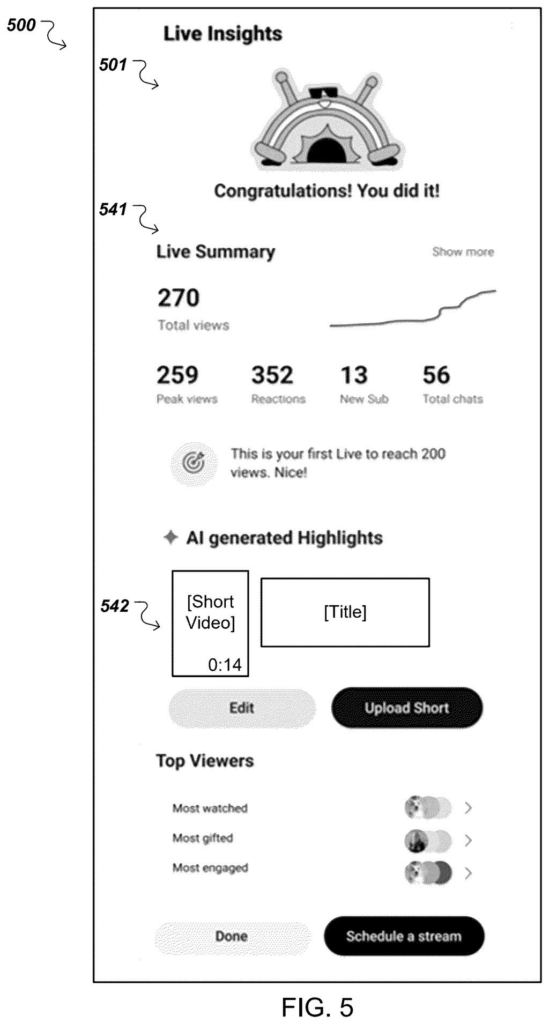
When the stream ends, the AI picks the best clips and shows them to you next to a summary of your viewer numbers. You can edit a clip or upload it as a short. In the filing's example screen, the clip runs 14 seconds.
… each viewer content stream comprises action data that characterizes actions performed by a content viewer while observing the visual data and audio data provided by the content creator …
Translation: It tracks what viewers are doing while watching the stream.
How the AI proposes and scores each clip
The patent covers a method that starts with a live stream made of two kinds of data. The creator stream is the streamer's video and audio. Each viewer stream holds action data, meaning what a viewer does while watching, such as posting in chat, voting in a poll, or sending a gift.
The system chops the stream into successive time windows, which can overlap. For each window, a multi-modal neural network (an AI that handles several kinds of data at once, like video, sound and text) builds a candidate short video. It picks a small subset of frames. The description says a window might hold tens of thousands of frames, while a candidate might use only twenty to a hundred.
The network has three parts:
- Live content data model: works out how the streamer and viewers interact, such as a streamer answering a chat question. The filing describes this as a graph that grows as new interactions arrive.
- Proposer: uses that interaction data and the footage to output a start and end timestamp for the clip.
- Selector: scores each candidate, either for overall importance or against criteria like how well it hooks viewers, tells a story, or shows the streamer's personality. The top scorers win.
The filing also mentions optional speech-to-text transcripts as extra input, and says the AI could be a Transformer model of the kind used in Google's Gemini family.
a candidate short video is generated based on using a multi-modal neural network system to process a multi-modal input …
Translation: An artificial intelligence system processes the video and viewer data together.
Why streamers could skip the editing marathon
If you stream, the pitch is simple: less time editing, more time posting. Short clips are how many people find a creator in the first place, and the filing lists several uses: an end-of-stream summary screen, a preview before someone joins, a spot on a creator's profile, or a recap shown mid-broadcast to draw in late arrivals.
For viewers, it could mean better previews of what a stream is actually like. For the platform, keeping a short clip instead of hours of video saves storage and network bandwidth, which the filing points out directly. The patent names no product, so how it would show up is open.
One more thing to know: the patent office has already approved this application. Once Google pays the final fee, it should be issued as a granted patent, and the final claims may read a little differently from the version described here.
Google files its 43rd patent in our Enterprise AI coverage we've tracked since May, building on earlier applications like one on smart home actions and one on privacy-safe grid AI.
Any tool that picks highlights gives something up. By leaning on chat, likes and gifts, the AI favors moments the crowd reacted to, so a quiet, well-made stretch could lose to a loud one.
The filing also says the raw stream may be discarded once it ends, which saves storage and means a missed moment is gone for good.
The safety net is that the streamer sees the picks first and can edit them. Since the system only suggests, the trade looks worth it for people who stream for hours and rarely have time to edit.
Get our take in your Top Stories
Liked this breakdown? Add Patentlyze as a preferred source on Google, and our plain-English take shows up more often in your Top Stories the next time Google patent news breaks.
There are more where this came from
We read every patent application Big Tech publishes and send you the ones worth knowing. Plain English, free, every week.
The drawings
6 drawing sheets from US 2026/0313209 A1 · click any drawing to enlarge


Want this weekly breakdown for a company we don't cover? Patentlyze Pro →
Be the first to weigh in