
Apple Files Patent for Avatars That Show Less Detail From Some Angles
Walk around a digital version of a person and Apple wants it to look different from each side. The filing describes an avatar that shows more detail from one angle, such as the front, and less from another, such as the back.
What Apple's angle-based avatar patent does
You're wearing a headset in a shared virtual room, and a friend's digital stand-in is standing across from you. You take a few steps to the side, then around behind them. Does the figure look just as crisp from back there as it did head-on?
Apple's patent application says it doesn't have to. The system checks which angle you're viewing the person from and changes how much detail it shows. The face and hands can be sharper from one angle and less defined from another. The figure can also turn more see-through, with softer edges around the face, from angles where less is known about the person.
The look can react to what's behind the figure, too. In one version, a brighter background makes the figure display dimmer. The filing describes all this for real-time calls and shared extended reality sessions, where real and virtual surroundings mix.
Techniques for displaying a representation of a person based on a background, viewing angle, and/or a mouth occlusion.
Translation: Methods for rendering digital avatars using factors like backgrounds, viewing angles, and mouth blockages.
How the avatar's detail shifts with your view
The core idea is a computer system that draws a digital version of a person (the filing calls it a representation) and picks how much detail to show based on the viewing angle, meaning where you are relative to that figure. From one angle it uses a first level of detail. From a different angle it uses a second, different level.
The claims list several ways the detail can change:
- Front view versus back view of the figure.
- More or less detail on the face or the hands.
- More or less translucency (how see-through it is) and a different amount of depth effect (how 3D it looks).
- A feathering effect (a soft fade) at the edge of the face, with a different amount, density or boundary position depending on angle.
Appearance can also depend on the background. The figure can pick up more of the background's visual properties from one angle than another, and a brighter background means the figure is shown at lower brightness. The angle can come from the orientation of the person's head or torso relative to your viewpoint, and different participants in a shared session can each see a different appearance.
The description also covers related ideas: lowering the face's fidelity when the person's mouth is blocked by an object, and a boundary that shifts gradually to change which parts of the figure are visible.
What this means for headset video calls
If you ever join a call in a headset, the person across from you is a digital stand-in built from what the device's cameras can capture. The filing says varying the detail by angle tells you how much is actually known about the part of the person you're looking at, instead of showing a sharp picture that may be partly guesswork.
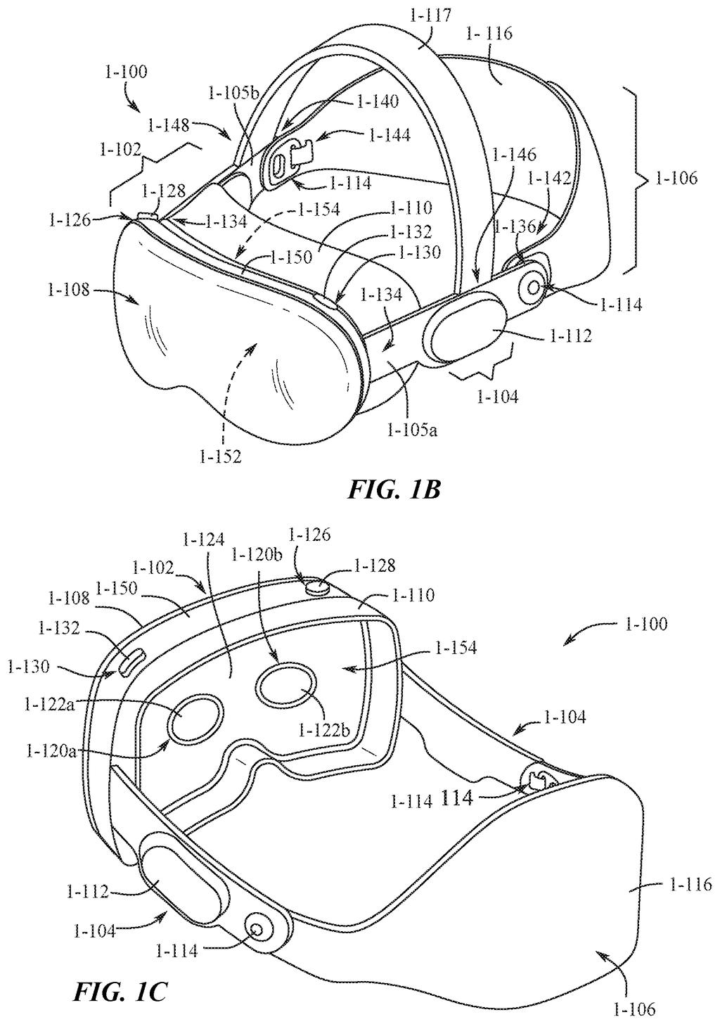
The filing describes headsets with cameras that track hands, eyes and the lower face, and it also covers phones, tablets and laptops. A patent is not a product, but the idea could fit avatar calls on Apple Vision Pro, where you and other people can share a space and move around each other.
Apple's 83rd filing we've tracked since May joins earlier applications like the 3D stadium view and arm-touch glasses in our Apple AR glasses watchlist.
Claim 1 is short and wide. It covers any computer system that shows a digital stand-in for a person, gives it one level of detail from one angle, and a different level from another. It never mentions faces, headsets, cameras or video calls.
Those specifics sit in the dependent claims: front versus back, face and hands, see-through versus solid, soft feathered edges on the face, and a dimmer figure in front of a brighter background. If granted, the broad claim could reach a lot of ground, while the narrower claims show how Apple actually pictures it working.
The idea makes sense for headset calls, because showing less than you know about someone's side or back keeps the figure honest. Whether the broad wording of claim 1 holds up through review is the open question.
Get our take in your Top Stories
Liked this breakdown? Add Patentlyze as a preferred source on Google, and our plain-English take shows up more often in your Top Stories the next time Apple patent news breaks.
There are more where this came from
We read every patent application Big Tech publishes and send you the ones worth knowing. Plain English, free, every week.
The drawings
53 drawing sheets from US 2026/0313075 A1 · click any drawing to enlarge


Show the other 45 sheets


Want this weekly breakdown for a company we don't cover? Patentlyze Pro →
Be the first to weigh in