
Apple Patents a Way to Overlay a Redesigned Room Onto Your Real Home
Before you knock down a wall or replace every cabinet, Apple thinks you should be able to see the finished version overlaid on your actual room, in real time. A newly published patent describes exactly how a device would pull that off without the virtual room sliding around or landing crooked.
What Apple's room-remodel AR preview actually does
Every time a home improvement show reveals a finished room, viewers spend thirty seconds wondering whether that would work in their own house. Apple's new patent tackles that exact moment, but for augmented reality headsets.
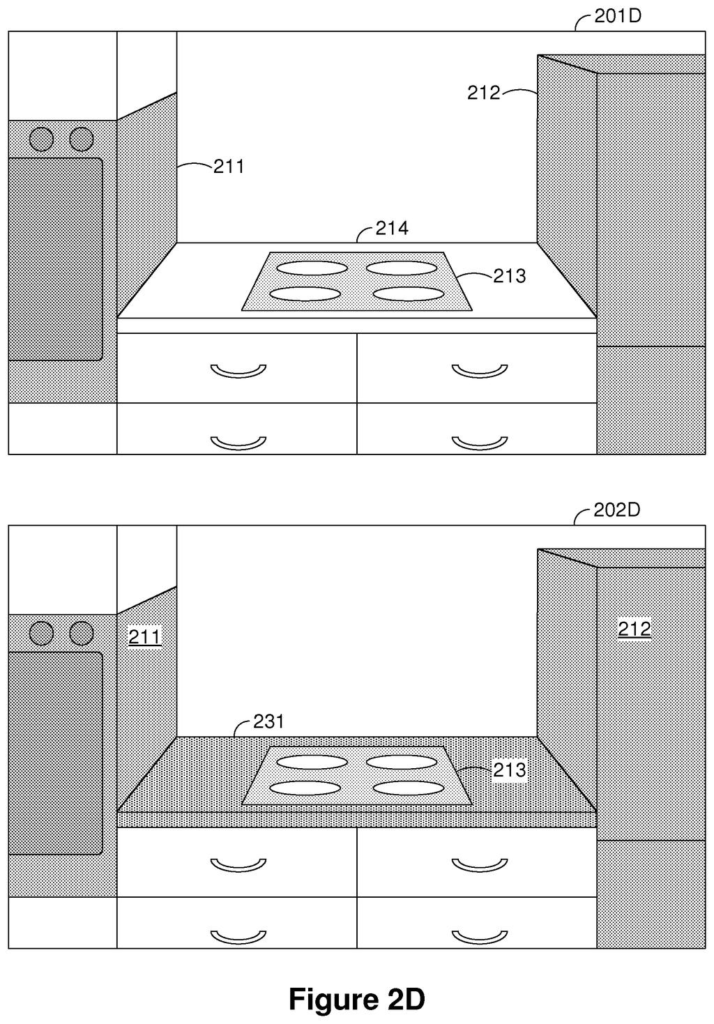
The idea: a device scans your real physical room and builds a 3D map of it. It then grabs a 3D model of a different room (a redesigned version, a showroom kitchen, a staged living room) and mathematically figures out how to rotate, scale, and position that virtual room so it lines up with your actual walls, floor, and ceiling. If the match is good enough, the device applies that adjustment and shows you the virtual room as though it physically exists in your space.
The key step is the alignment score: a quality check the system runs before committing to the display. If the virtual room doesn't line up well enough with your real one, it won't show you a misaligned mess. Only a confident match triggers the overlay. That score is what separates a convincing preview from a floating, tilted ghost of a room.
obtaining a three-dimensional (3D) model of at least a portion of the physical environment; obtaining a 3D model of a virtual environment; determining that a transform applied to the 3D model of the virtual environment aligns the 3D model of the virtual environment within a threshold of the 3D model of at least the portion of the physical environment …
Translation: The device scans your actual room and a digital room, then matches their shapes together.
How Apple matches a virtual room model to your real walls
The patent describes a three-stage pipeline running on a device that has a display and real-time awareness of its surroundings (think a headset or phone with depth sensors).
- Stage 1 - Scan the real room: The device builds a 3D model of the physical environment, capturing walls, floors, furniture edges, and room geometry.
- Stage 2 - Obtain a virtual room model: A second 3D model is pulled in, representing a redesigned or entirely different space. This could come from a retailer's catalog, an interior design app, or a contractor's blueprint converted into 3D geometry.
- Stage 3 - Compute a transform and score it: The system calculates a transform (a set of mathematical operations: rotation, translation, scale) that would move and reshape the virtual model until it fits inside the scanned real room. It then computes an alignment score, a number measuring how well the transformed virtual model matches the real-world geometry.
Only when that score clears a threshold does the device apply the transform and render the virtual room on screen. The threshold acts as a confidence gate: if the overlap between virtual and real geometry is below the bar, the system holds off rather than showing a badly positioned overlay.
The claim is device-agnostic, meaning it could run on a spatial computing headset, a phone held up to a room, or any display-equipped device with environmental awareness.
… determining an alignment score of a transform of the 3D model of the virtual environment. The method includes, in response to determining that the alignment score is greater than a threshold score, applying the transform to the 3D model of the virtual environment and displaying a portion of the virtual environment …
Translation: Once the virtual room fits your real space well enough, the system displays the redesigned interior over your view.
What this means for AR shopping and home design
For anyone who has ever ordered furniture only to find it looks completely wrong in person, or hired a contractor and regretted it three weeks later, this is a direct fix. The alignment-score gate is the part that makes it practical: it means the system only shows you the overlay when it's confident the virtual room actually fits your space, rather than dumping a floating, mismatched preview on screen.
Apple has been filing around spatial computing and real-world environment mapping for several years, and this patent adds a concrete consumer use case to that body of work: letting retailers, designers, and renovation apps show their finished rooms inside your actual home. That's a meaningful shift from today's AR furniture apps, which usually only let you place individual objects rather than preview a complete redesign.
Apple's 71st filing we've tracked on our AR glasses watchlist since May builds on work like simulated lighting in media apps and a dot-pattern surface projector.
The alignment-score mechanism is the real contribution here. Most AR room-preview demos fall apart because the virtual space slides off-axis or floats above the real floor. By building in a quality check before the overlay appears, Apple is trying to ensure that when you do see the preview, it's actually believable.
From a user standpoint, the moment this matters is the one right before a big purchase decision: standing in your kitchen, wearing a headset, deciding whether to commit to a full remodel. A convincing preview that locks onto your real walls could be the difference between confidence and regret.
That said, the patent describes the alignment and display logic, not the source of the virtual room models. The quality of any real-world experience would depend entirely on whether retailers and designers build out that catalog of 3D rooms, which is a business and logistics challenge the patent doesn't address.
There are more where this came from
We read every patent application Big Tech publishes and send you the ones worth knowing. Plain English, free, every week.
The drawings
22 drawing sheets from US 2026/0301345 A1 · click any drawing to enlarge


Want this weekly breakdown for a company we don't cover? Patentlyze Pro →
Be the first to weigh in