
Apple Patents a Floating Window That Makes AR Content Look Recessed in Space
Apple has patented a way to make content in a mixed-reality headset appear to sit physically behind a floating window cut into your space, creating a sense of genuine depth rather than a flat screen hovering in the air.
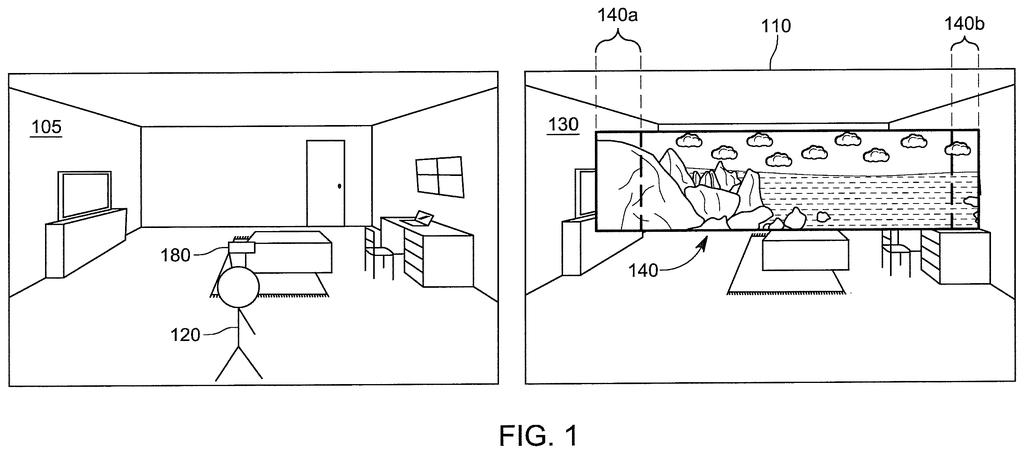
What Apple's XR viewing portal actually does
Every time you glance at an app floating in your living room through a Vision Pro, it sits right at the surface of where you placed it, like a picture hung on invisible air. Apple's new patent tries to change that by adding a sense of depth, making the content feel like it lives behind a window rather than on top of one.
The idea is a "viewing portal," a shaped opening positioned in your space. Content is placed at a coordinate that sits further back, behind that opening. As you move your head, the system recalculates exactly which part of the content you can see through the portal from your current angle, like peeking through a mail slot at something on the other side of a door.
The result is that apps and media could feel more embedded in physical space rather than painted onto it. On a device like Vision Pro, that distinction matters: depth cues are how your brain decides whether something feels real or simply projected.
… determining a second position for a content item within the 3D coordinate system, wherein the second position provides an appearance of depth between the content item and the viewing portal; …
Translation: The system places digital content further away to create the illusion of depth behind the window.
How the portal calculates what you can see through it
The patent describes a system with three moving parts: a viewing portal (an opening placed at one position in 3D space), a content item placed at a second, deeper position behind it, and the viewpoint of the headset itself, which changes as the wearer moves.
The device generates a flat surface object textured with the content, like wrapping an image onto a card, and places that card at the deeper coordinate. Then it runs geometry to determine which slice of that card is visible through the portal given where your head currently is. Only that slice gets rendered and shown. The rest is clipped away, invisible, as if truly blocked by the edges of the portal frame.
This is essentially a real-time occlusion and clipping calculation (figuring out what is hidden versus exposed) tied to head tracking. As you lean left or right, the visible portion of the content shifts, exactly as it would if you were looking through a real physical opening at something behind a wall.
- Portal position is set in a 3D coordinate system matching the real environment
- Content is placed at a separate, further coordinate to simulate recession
- Visible area is recalculated per frame based on the viewer's tracked position
- Only the geometrically exposed portion of the content surface is displayed
… a viewing portal for viewing an added content item that is positioned behind the viewing portal.
Translation: Users look through a virtual frame to see objects placed deeper in the space.
What this means for Vision Pro spatial app design
For Vision Pro and any future Apple headset, one of the hardest perceptual problems is making digital content feel like it belongs in physical space rather than floating on a screen strapped to your face. Depth cues, the subtle parallax shifts that happen as you move, are central to that illusion. This patent attacks that problem directly by encoding depth into where content lives relative to its frame, not just how it looks.
From a design perspective, this could give app developers a new tool for spatial layouts: a way to signal that one piece of content is "further away" without relying purely on scale or blur. For you as a user, it could make media viewing in a headset feel more like looking through a window and less like watching a monitor.
Apple's 48th filing we've tracked in our AR glasses research since May builds on ideas like which app owns your mixed-reality space and projecting your screen into the air.
The design trade here is legibility versus immersion. By clipping content to only what's geometrically visible through the portal, Apple accepts that users might see less of an app or image at any given moment, depending on their head position and the portal's shape. That's a real cost: if the portal is small or the content is information-dense, the framing could frustrate rather than delight.
The bet is that the depth illusion pays back more than the clipping costs. That's probably right for cinematic or ambient content, where the portal feels like a screen embedded in a wall. It's a harder argument for utility apps, where you need to see all the controls without craning your neck.
The engineering itself is not exotic. Real-time viewport clipping against a 3D position is standard graphics work. What's notable is the explicit decision to encode the portal and the content as separate positioned objects in the same coordinate system, which makes the depth relationship trackable and adjustable rather than baked into a texture. That architecture gives developers something to build with, which may be the point.
There are more where this came from
We read every patent application Big Tech publishes and send you the ones worth knowing. Plain English, free, every week.
The drawings
12 drawing sheets from US 2026/0278958 A1 · click any drawing to enlarge


Want this weekly breakdown for a company we don't cover? Patentlyze Pro →