
Nvidia Files Patent for AI That Invents New Camera Angles for Game Footage
Nvidia's filing describes an AI that redraws a scene from a camera angle nobody recorded. Before it draws anything, it checks whether it knows enough to get the picture right.
What Nvidia's view-switching AI actually does
You're watching a streamed match, and the camera sits behind one player's shoulder. You'd love to see what the other player sees, but that angle was never recorded.
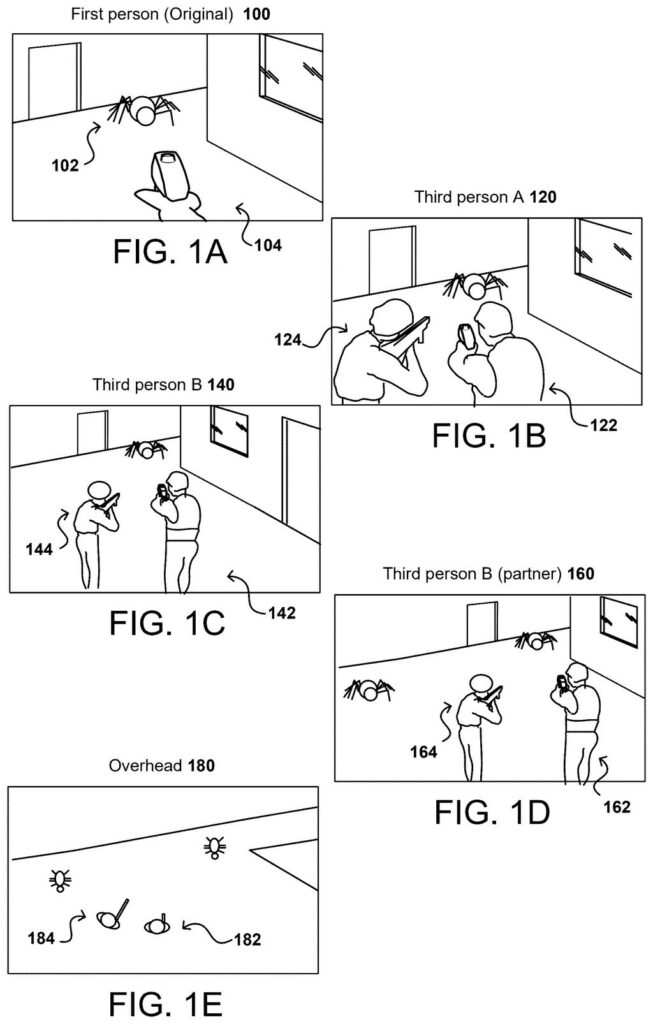
Nvidia's patent application describes a way for AI to fill that gap. It studies the objects in a frame, such as enemies, avatars and scenery, and builds a compact summary of what it knows about each one. Then it paints the scene again from a new camera position, drawing the sides of things the original shot never showed.
The twist is a built-in reality check. Before it generates anything, the system asks whether it knows enough to do a believable job. If the answer is no, or if the new angle is barely different from the old one, it skips the request instead of producing a mess.
… one or more neural networks are used to generate one or more images of one or more objects from a first point of view based at least in part upon one or more images of the one or more objects from a second point of view.
Translation: The system creates pictures from one camera angle using footage taken from a totally different angle.
How the AI decides it has enough to redraw
The system starts by finding the distinct objects in an image or video frame (an enemy, a player avatar, a rock) and turning each into a set of numbers that describe it. A variational autoencoder (a neural network that squeezes information into a compact internal summary, called a latent space) stores those details, plus extras such as object orientation, scene type and camera position.
Next comes the gate. The network works out a reconstruction probability, meaning how likely it is that a believable image from the new angle can be made, and compares it to a minimum threshold. Requests that fall short are dropped, and so are requested angles too close to the current one to be worth generating.
If the check passes, a generator paints the new view. The filing names a conditional generative adversarial network (a model trained to produce images that look real) and feeds it the original image plus the stored summary as constraints. Parts the camera never saw, like the back of a character, are extrapolated (educated guesses based on what is visible).
For video, the filing describes two passes. The first caches what was actually seen of each object across frames. The second fills in whatever is still missing from that stored data, so a character looks the same from shot to shot. The filing also describes splitting an image into regions with a separate model for each, and picking among several encoders that specialize in different object types.
Why replays and streams could use this
For you as a viewer, the clearest payoff is choice. The filing describes game streams where audiences switch between players' viewpoints even when those views were never offered, replays that show a highlight from a fresh angle, and movies shot from a single camera that could be seen from another character's position. Whether any of that ships is unknown, since this is a patent application describing an approach.
The built-in refusal is the part that matters for trust. Generated video that invents too much looks wrong fast, so a system that checks itself before drawing is easier to put in front of players. The claims also frame the whole thing as something other software can call through an API (a standard request one program makes of another), which points to a tool meant to plug into other apps.
Nvidia's 74th filing we've tracked in AI vision since May adds to work that includes one on guessing blocked objects and one on build-order adjustments.
Every new camera angle is a guess about parts of the world the camera never saw, and the description admits accuracy drops as the new view moves further from the original. The sufficiency check is Nvidia's cost control for that problem. The system will turn down some requests that a more reckless one would happily answer.
That refusal has a price. A viewer who clicks a new seat and gets nothing will be annoyed. The two-pass video method adds another cost, since it wants to see everything a clip shows before filling in the gaps, which could limit live use.
Still, the trade reads as worth it. A tool that occasionally says no is better than one that confidently draws a player with the wrong face. The cache that keeps characters consistent across frames also targets the flaw viewers would spot first.
Get our take in your Top Stories
Liked this breakdown? Add Patentlyze as a preferred source on Google, and our plain-English take shows up more often in your Top Stories the next time Nvidia patent news breaks.
There are more where this came from
We read every patent application Big Tech publishes and send you the ones worth knowing. Plain English, free, every week.
The drawings
47 drawing sheets from US 2026/0311378 A1 · click any drawing to enlarge


Want this weekly breakdown for a company we don't cover? Patentlyze Pro →
Be the first to weigh in