
Nvidia Patents an AI That Guesses the Hidden Part of Partly Blocked Objects
Nvidia's patent describes an AI that guesses the full shape of an object even when something is blocking part of it. It teaches itself using practice puzzles built from its own output.
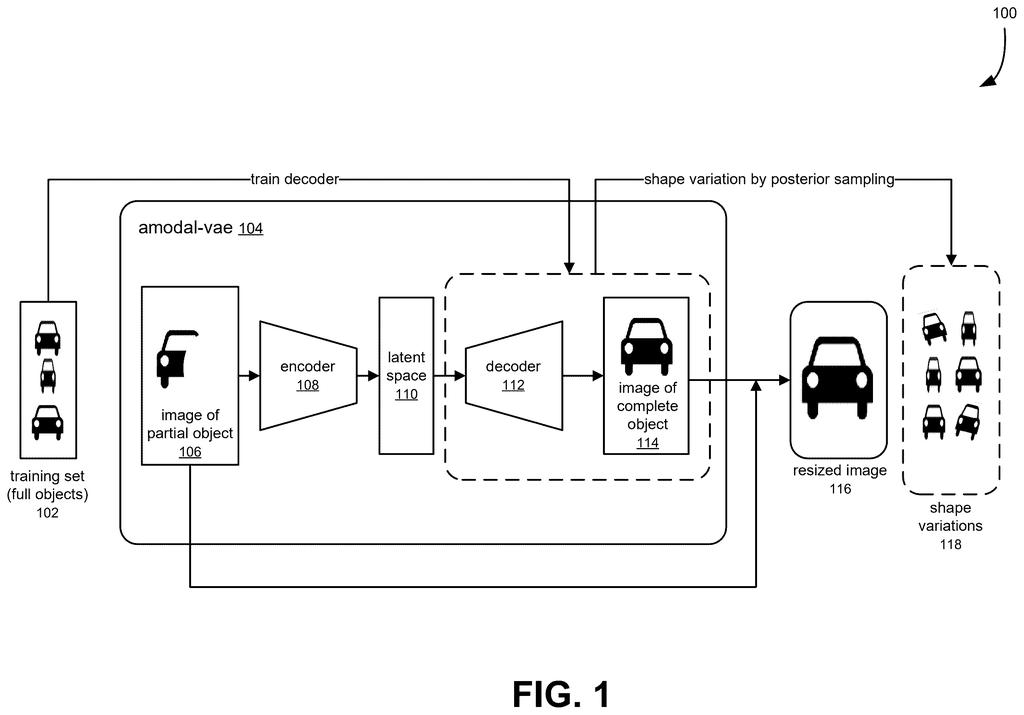
What Nvidia's hidden-object completion does
Teaching a computer what the hidden part of an object looks like is surprisingly hard. Today it usually means paying people to draw, by hand, the outline of the part nobody can see, and two people will often draw it differently. That makes the process slow, expensive and open to argument.
Nvidia's patent skips the hand-drawing. First, an AI studies lots of complete objects until it knows what realistic shapes look like. Then Nvidia locks that knowledge in place and uses it to make its own practice puzzles: it overlaps two shapes so one partly covers the other, then trains a second AI to look at the covered one and work out the full shape.
The payoff is that a program could look at, say, a person standing behind a parked car and sketch the whole person, often offering several plausible versions, each with a confidence score.
generate, by an encoder, an encoding of an occluded object depicted in an image; and generate, by a decoder and based at least in part on the encoding, an unoccluded representation of the object …
Translation: An AI system takes an image of a blocked object and creates a complete version of it.
How the frozen decoder trains the encoder
The patent describes a pair of neural networks (software that learns patterns from examples): an encoder and a decoder. The encoder looks at a partly blocked object and boils it down to a short list of numbers called a latent code (a compact summary of the object's shape). The decoder turns that code back into a full, unblocked shape. The work is done on object outlines, which the filing calls masks (a bitmap marking which pixels an object occupies).
The claims center on how the encoder is trained, in stages:
- Stage one: the decoder learns from complete, unblocked objects only, then is frozen (its settings are locked).
- Stage two: the frozen decoder's own output is used to build practice examples. Two complete shapes are overlapped at random so one hides part of the other, and a new encoder learns to turn the hidden version into a code the decoder can expand into the full shape.
- Stage three: the encoder is fine-tuned on real, partly visible shapes, so it copes with messier blockages than the simple overlaps.
Because the decoder only ever saw realistic complete shapes, even a slightly off code still produces a believable result. The system can output several candidate shapes, each with a probability that it is accurate. A spatial transformation (a resize and shift) then puts the completed shape back at the right scale and position in the original image.
Apparatuses, systems, and techniques to generate complete depictions of objects based on a partial depiction of the object.
Translation: The technology fills in the missing pieces of partially hidden objects in pictures.
What this means for photo editing and robots
The most direct use the filing describes is photo editing. If software can work out the whole of a partly hidden object, you could delete it, move it, resize it, swap which object sits in front, or change a person's pose without leaving a ragged hole behind.
The filing also says the same skill could help robots and other vision systems anticipate what is about to happen when part of a scene is blocked. And because training does not need hand-drawn outlines of hidden parts, the approach could cut the slow, expensive labeling work that usually holds this kind of AI back.
Nvidia's 73rd filing in the AI vision work we've tracked since May adds to a run that includes one adjusting parts by prior builds and one pre-loading graphics code.
If you have ever tried to move one person in a group photo and watched the person standing behind them get chopped in half, this patent is aimed at that kind of problem. The idea is that software could guess the missing piece of a partly hidden object, so you could move, resize or swap things without a ragged hole left behind.
Most of the invention is about how the AI is trained, which you would never see directly. What you would notice is the result: cleaner edits, and in the best case a few options to pick from instead of one confident guess. The confidence score the filing describes would matter most when a lot is hidden, because a nearly covered object has many plausible shapes.
The catch is that a guess is still a guess. Any app using this would be inventing detail you never photographed, so the benefit depends on how good those guesses are.
Get our take in your Top Stories
Liked this breakdown? Add Patentlyze as a preferred source on Google, and our plain-English take shows up more often in your Top Stories the next time Nvidia patent news breaks.
There are more where this came from
We read every patent application Big Tech publishes and send you the ones worth knowing. Plain English, free, every week.
The drawings
56 drawing sheets from US 2026/0311379 A1 · click any drawing to enlarge


Want this weekly breakdown for a company we don't cover? Patentlyze Pro →
Be the first to weigh in