
Nvidia
Nvidia · AI / ML · Filed Jun 2, 2026 · USPTO published Oct 1, 2026 · Oct 1 release
Nvidia Patents an AI System That Adjusts How Parts Are Built Based on What Came Before
Every manufactured object is only as good as the fit between its parts. Nvidia has filed a patent for an AI system that measures a finished component and uses that measurement to automatically tune how the next, related component gets made.
- Publication number
- US 2026/0299526 A1(US20260299526A1)
- Applicant
- NVIDIA CORPORATION
- Filed · Published
- Jun 2, 2026 · Oct 1, 2026
- Inventors
- Elad Mentovich, Siddha Ganju, Jeff Whitmer, Ryan Albright, Tahir Cader, Ron Chao
- Status when we published
- Waiting for an examiner
- Document
- 20 claims
- US classification
- 700/104
- Parent application
- Continuation of 18/237,233 (filed Aug 23, 2023)(18237233)
How Nvidia's AI links one part's measurements to the next
Every time a factory produces a complex object, dozens of parts have to fit together precisely. If one part comes out even slightly off, the parts that connect to it may not work correctly. Traditionally, workers or quality-control systems catch this after the fact, and fixes are expensive.
Nvidia's patent describes a system where an AI model checks the actual measured properties of a completed component and then adjusts the production settings for a related component before it gets made. Think of it as the factory "reading" what it just built and recalibrating on the fly, instead of waiting for something to go wrong.
For you as a consumer, this kind of system could mean products with fewer defects and tighter tolerances, because the manufacturing line is effectively self-correcting as it goes rather than after the fact.
determine a value of an attribute of a first component of the object; determine, using a machine learning model and based on the value, a manufacturing parameter for performing a manufacturing operation with respect to a second component …
Translation: The system measures a part and uses AI to figure out how to build the next related part.
How the model reads one component to set the next build step
The patent describes a two-step AI feedback loop inside a manufacturing system.
First, the system measures a specific attribute (a dimension, a thermal property, an electrical characteristic) of an already-produced component. That measurement becomes the input to a machine learning model (a software system trained on data to make predictions) rather than a lookup table or a fixed rule.
Second, the model outputs a manufacturing parameter for a second component that is "functionally interrelated" with the first. "Functionally interrelated" means the two parts are designed to work together, so a variance in one has a predictable downstream effect on the other. The parameter might be a temperature setting, a cutting depth, a material deposition rate, or any other controllable variable in the production process.
Finally, the system issues instructions to the manufacturing equipment to execute that adjusted operation and produce the second component to specification.
- Measure an attribute of Component A
- Feed that measurement into a trained ML model
- Receive a tuned parameter for manufacturing Component B
- Execute the operation and produce Component B
The claim is intentionally broad: it covers any two functionally linked components, any attribute, and any manufacturing operation.
What adaptive manufacturing could mean for Nvidia's hardware output
Manufacturing tolerances are one of the quietest cost drivers in hardware production. When parts don't fit perfectly, companies face scrap, rework, or lower yields, all of which add up fast at scale. A system that proactively adjusts downstream steps based on upstream measurements could cut those costs significantly.
Nvidia's run of AI-in-manufacturing filings fits a company that now designs its own chips and increasingly controls more of its supply chain. If Nvidia can apply this kind of adaptive control to its own production processes, or license the approach, the savings on complex multi-chip modules could be real. The catch is that the patent is broad enough to cover almost any two-component object, which may make it hard to enforce narrowly.
Nvidia's 72nd filing we've tracked in our AI vision coverage since May builds on earlier applications like one on pre-loading graphics code and one on training across image types.
Source: US 2026/0299526 A1 at the USPTO (PDF). Full patent text and figures are in the official publication.
Get our take in your Top Stories
Liked this breakdown? Add Patentlyze as a preferred source on Google, and our plain-English take shows up more often in your Top Stories the next time Nvidia patent news breaks.
Add Patentlyze on Google
One click.
There are more where this came from
We read the new patents from Big Tech, carmakers and more and send you the ones worth knowing. Plain English, free, every week.
The drawings · 12 sheets
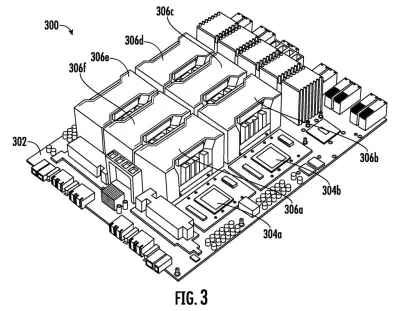
12 drawing sheets from US 2026/0299526 A1 · click any drawing to enlarge


Show the other 4 sheets


More from Nvidia
All 665 Nvidia patents →
More in AI vision
All 351 AI vision patents →
Samsung
Samsung Patents an AI Photo Eraser That Reshapes Its Own Selection Before Filling In the Background
Qualcomm
Qualcomm Patents a Way to Stop AI From Wasting Time on Still Video Frames
Samsung
Samsung Patents a Video Repair System That Uses Distance Sensing to Fill Missing Frames
Samsung
No comments yet