
Qualcomm Files Patent for a Headset Helper That Fetches 3D Objects Before You Need Them
Before your headset's web browser even asks for a 3D object, a hidden helper inside the device may already have it downloaded. A new Qualcomm patent application describes that helper and the traffic scheduling that goes with it.
What Qualcomm's headset helper actually does
You're wearing a headset and turn toward a virtual room on a web page. Furniture and plants pop in one piece at a time, and one big object holds up all the small ones. That lag is what Qualcomm's patent application tries to fix.
The filing describes a small helper program that sits between the browser and the internet. It reads a menu of the available 3D objects, then starts downloading the ones you're likely to need. It picks them using details about your headset that the browser can't see, like where your head is probably turning and how strong your connection is. When the browser finally asks for an object, it is already waiting.
The helper also spaces out its requests so they don't jam the connection, and it can hand over a rougher version of an object first while the sharp version is still on its way.
… prefetch a virtual object selected from the index file based on one or more hardware-specific properties of the extended reality device; …
Translation: The headset downloads 3D assets in advance by checking what its hardware can handle.
How the helper decides which 3D objects to fetch
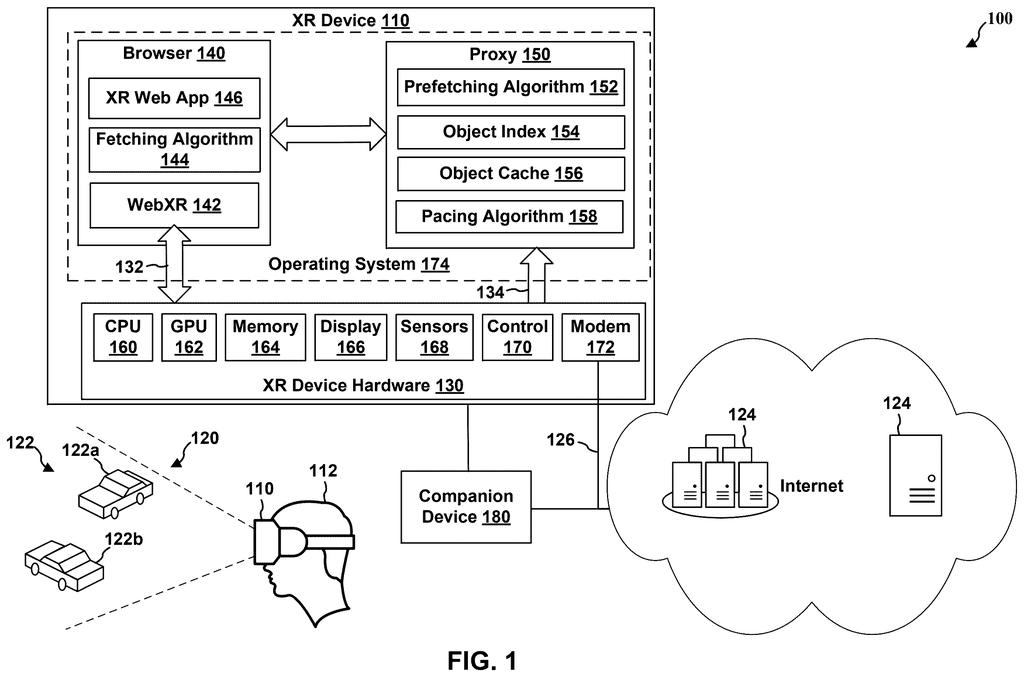
The patent covers an extended reality (XR) device, meaning a headset that shows virtual or augmented objects. It has a display, positioning sensors, and a proxy. A proxy is a middleman program that sits between the web browser and the web server, so every request passes through it.
When the browser asks for an index file (a menu listing the available 3D objects), the proxy fetches it and keeps a copy that both it and the browser can read. It then prefetches (downloads ahead of time) objects from that menu, choosing them using hardware-specific properties. The filing lists predictive positioning information (a guess at where you'll look next), the device's rendering capabilities, and communications parameters like link quality. These details are not available through WebXR, the standard interface browsers use to talk to headset hardware. When the browser asks for an object, the proxy hands over the stored copy.
The filing also describes optional pieces:
- Pacing: the proxy times its requests so each object starts arriving just as the last one finishes. It can use a congestion window (a cap on how many bytes can be requested but not yet received). The description gives 20 kB as an example.
- Level of detail: if the browser wants a high-detail object but a lower-detail copy is cached, the proxy hands over the lower one temporarily. It then prioritizes the better version, queues it last, or skips it.
- Notifications: the proxy can tell the browser when an object is ready.
The proxy receives a request for an index file of virtual objects from a web browser executing on the at least one processor and configured to render the virtual objects within the web browser.
Translation: An internal helper intercepts web browser requests for 3D content lists.
Why faster-loading 3D scenes matter for headsets
If you open a 3D scene from a web page in a headset, the biggest annoyance is waiting. Objects arrive late, in an awkward order, or as blurry placeholders. Qualcomm's filing aims to shorten that wait by letting a helper on the device use information the browser never sees, such as where your head is likely to turn and how good your connection is right now.
It also points to a practical split. Web-based experiences run in any browser, so developers don't have to build a separate app for each headset, but browsers stay generic by design. A helper at the operating-system level lets the device add its own hardware-specific smarts without every browser having to learn about every headset.
Qualcomm's 53rd filing we've tracked in our AR glasses race watchlist since July follows work on shrinking avatar movement data and object question answering.
If this works, you would notice it as an absence. Fewer moments where a virtual room shows up half-built, with a chair floating in empty space while a big table takes its time arriving.
The fix lives in a spot you never see, between the browser and the connection, and that is a sensible place for it. Web-based headset experiences have to load quickly to feel good, because nobody wants to download an app just to look at a 3D scene.
The benefit depends on good guesses. If the headset misjudges where you'll look, it spends bandwidth on objects you never see, and the description acknowledges that extra requests happen. It is routine engineering aimed at a frustration anyone in a headset would feel.
Get our take in your Top Stories
Liked this breakdown? Add Patentlyze as a preferred source on Google, and our plain-English take shows up more often in your Top Stories the next time Qualcomm patent news breaks.
There are more where this came from
We read every patent application Big Tech publishes and send you the ones worth knowing. Plain English, free, every week.
The drawings
7 drawing sheets from US 2026/0311414 A1 · click any drawing to enlarge


Want this weekly breakdown for a company we don't cover? Patentlyze Pro →
Be the first to weigh in