
Qualcomm Patents a Way to Shrink the Data Behind AR Avatar Movements
Every time your avatar waves in an AR call, a flood of numbers describing every joint in your body's skeleton has to travel across the network. Qualcomm has filed a patent for compressing that data dramatically, without making your virtual self look like a jittery marionette.
How Qualcomm shrinks your AR avatar's movement data
You're on an AR video call and your avatar is supposed to mirror your movements in real time, nodding when you nod, gesturing when you gesture. Behind the scenes, your device is constantly transmitting a stream of numbers that describe the position, angle, and scale of dozens of points on a virtual skeleton. That's a lot of data, and on a typical mobile connection it can become a bottleneck fast.
Qualcomm's patent describes a system for squeezing that stream down to a much more manageable size. Rather than sending the full position of every joint at every moment, the system sends only what changed since the last frame, predicts where child joints probably moved based on how the parent joint moved, and then rounds the numbers to a level of precision that still looks good but takes far fewer bits to transmit.
Think of it like video compression: instead of sending every pixel in every frame, a video codec sends only the differences between frames. Qualcomm is applying that same logic to your avatar's skeleton, keeping AR calls fluid without overwhelming your connection.
receiving encoded joint position data for a pre-defined skeleton for an avatar to be presented during an AR communication session; decoding the encoded joint position data to form joint position data; and animating the avatar according to the joint position data.
Translation: The system takes compressed data about how an avatar's joints move and translates it into actual onscreen motion.
How the skeleton compression and prediction pipeline works
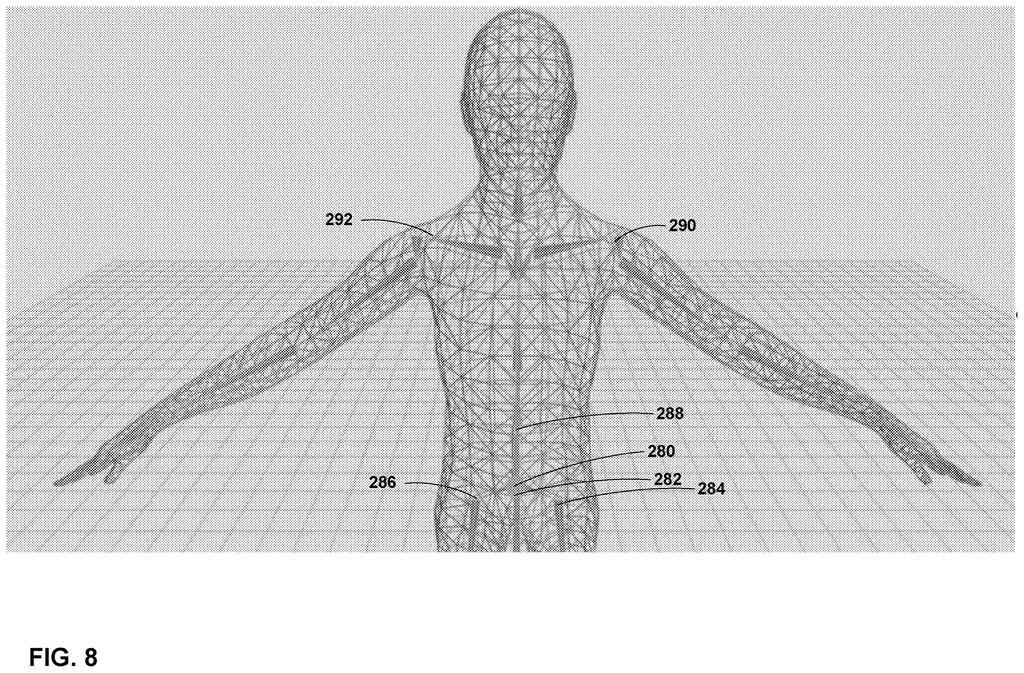
The patent covers a decoding and encoding pipeline for avatar animation data in AR communication sessions. Avatars are driven by a virtual skeleton, a hierarchy of joints and bones that mirrors the human body. The position of each joint is described by three kinds of transforms: translation (where it is), rotation (which way it faces), and scale (how big).
Rotations are expressed using quaternions (a compact four-number representation of 3D orientation, preferred over the more intuitive but messier Euler angles). The patent treats quaternions specially, extracting and compressing them separately from the other transform components rather than bundling everything together.
The compression strategy has four main pillars:
- Quaternion separation: rotation data is compressed on its own track, which avoids cross-contamination with translation and scale errors.
- Hierarchical prediction: because a wrist joint follows the elbow, which follows the shoulder, the system predicts child joint positions from parent joint data and only transmits the leftover error.
- Temporal prediction (delta coding): only the difference between one frame and the next is sent, rather than a full snapshot every time.
- Quantization: transform values are rounded to a precision that still looks natural on screen, cutting the bit count per number significantly.
On the receiving end, the decoder reconstructs the avatar's full joint positions from this compressed stream and drives the animation accordingly.
To compress the animation data, a device may perform extraction and compression of quaternions separately; a device may perform hierarchical prediction of joint transforms based on a skeleton hierarchy; a device may perform temporal prediction through coding of difference data (deltas); and/or a device may perform quantization of transform components.
Translation: It shrinks file sizes by processing math formulas, skeleton structures, frame by frame changes, and rounding data values.
What this means for AR video calls and headset hardware
AR headsets and phones already strain under the combined load of rendering, tracking, and networking. Sending high-fidelity avatar animation over a mobile connection adds yet another demand. A compression scheme that meaningfully reduces that data stream could make the difference between an avatar that moves fluidly and one that stutters or freezes when your signal dips.
Qualcomm's interest in AR communication infrastructure shows up in how broadly this filing is scoped. If you use a headset or phone powered by a Snapdragon chip for a future AR call, the encoding and decoding steps described here could sit inside the hardware itself, invisible to you but directly responsible for how natural your virtual presence looks to the person on the other end.
Qualcomm's 52nd filing we've tracked in our AR glasses race watchlist since July follows the object-question patent and the gaze-based hologram patent.
Claim 1, as written, is strikingly broad. It covers any method that receives encoded joint position data for a predefined avatar skeleton, decodes it, and animates an avatar from the result. That description could apply to a wide range of AR avatar systems, not just Qualcomm's specific compression tricks described in the abstract.
Broad claims are common at the application stage, and patent examiners routinely push back on them by citing prior art from existing video-game skeleton systems, video codec standards, or earlier AR research. Whether this survives in its current form is genuinely uncertain. If it does, though, it could give Qualcomm a meaningful position over any AR communication product that decodes skeleton-based avatar animation on a phone or headset chip.
The underlying engineering, hierarchical skeleton prediction combined with delta coding and quaternion-specific compression, is well-grounded in how game engines and motion-capture pipelines already work. This patent applies those ideas to the specific problem of live AR calls over mobile networks, which is a real and unsolved performance problem. The filing is technically credible even if the claim scope will likely face scrutiny.
There are more where this came from
We read every patent application Big Tech publishes and send you the ones worth knowing. Plain English, free, every week.
The drawings
15 drawing sheets from US 2026/0301233 A1 · click any drawing to enlarge


Want this weekly breakdown for a company we don't cover? Patentlyze Pro →
Be the first to weigh in