
Qualcomm Patents a Way to Render Two AR Headset Views From a Single Chip
Two people wearing AR headsets in the same room each need their own view of the virtual world, but running two full graphics pipelines is expensive. Qualcomm's new patent describes a single graphics chip that figures out both users' perspectives and renders frames for each, without doubling the workload.
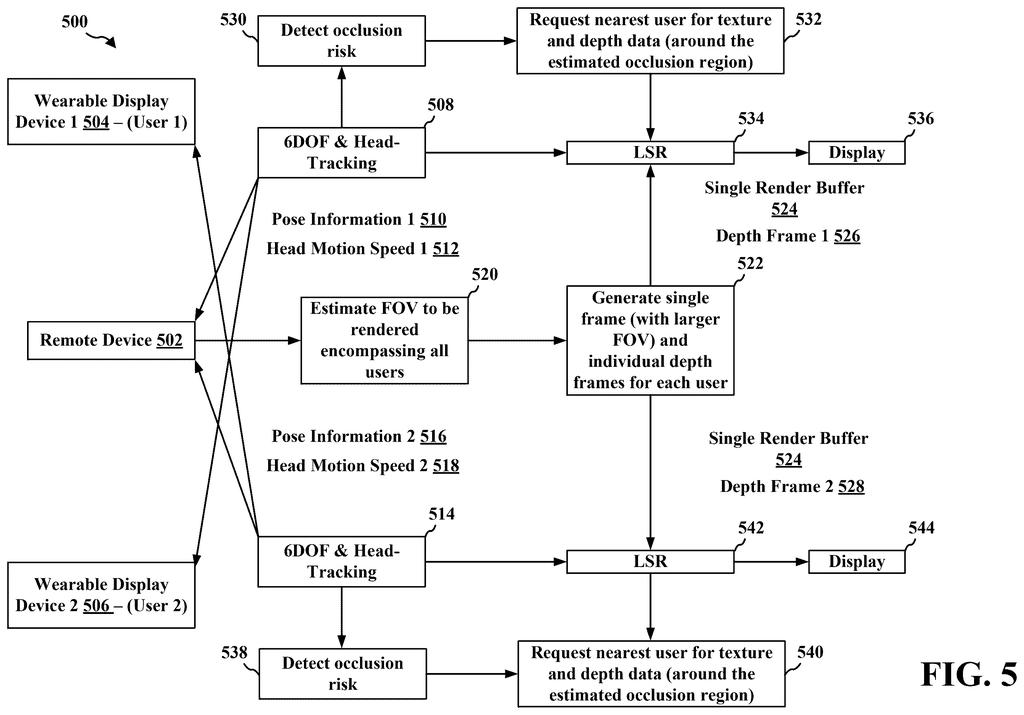
What Qualcomm's shared AR rendering actually does
Imagine you and a friend are both wearing AR glasses, looking at the same shared virtual scene from different angles. The system needs to show each of you a slightly different picture, your view, not theirs. Right now, doing that efficiently is a hard problem.
Qualcomm's patent describes a graphics processor that tracks where each headset is pointed (its pose, meaning position and direction), estimates what each person can actually see, and then generates the right frame for each headset. The key idea is that the chip isn't rendering two completely independent scenes from scratch; it's being smarter about what overlaps and what doesn't.
The result, if it works as described, is a shared AR experience for multiple users that doesn't require two separate, full-power graphics systems running in parallel. That matters a lot for things like lightweight wireless headsets that offload rendering to a nearby device.
obtain first pose information for a first wearable display device and second pose information for a second wearable display device; estimate a field of view (FOV) of the first wearable display device and the second wearable display device based on at least one of the first pose information or the second pose information; …
Translation: The chip tracks where both users are looking to figure out what each person needs to see.
How the GPU estimates each headset's view and builds the frame
The patent describes a graphics processor (GPU) designed for what Qualcomm calls a split XR system, an architecture where the heavy graphics work happens on a separate compute device (a phone, a hub, or a cloud box) rather than inside the headset itself. The headsets are "thin" displays; the brains live elsewhere.
The GPU's job, as described in claim 1, breaks into four steps:
- Obtain pose information for two wearable displays, essentially, where each headset is in space and which direction it's facing.
- Estimate the field of view (FOV) for each headset based on that pose data. The FOV is the portion of the virtual scene each user can actually see from their current angle.
- Generate a frame, a rendered image, for one or both headsets based on those FOV estimates.
- Transmit the finished frame back to the appropriate headset.
The efficiency angle comes from using a single GPU to handle both users together rather than treating them as fully separate rendering jobs. By estimating both FOVs at once, the chip can potentially share geometry calculations (the math that describes 3D objects) that appear in both views, reducing total processing load.
What this means for shared AR headset experiences
Shared AR experiences, think collaborative design reviews, multiplayer games in physical space, or workplace training, are a practical goal for headset makers, but the rendering cost has been a real obstacle. If one chip can serve two users efficiently, that changes what's possible with battery-powered, wireless hardware. Your headset stays light and cool because the heavy lifting happens off-device.
Qualcomm's bet on XR processing shows up consistently in its chip roadmap, and this patent fits that picture. The split-rendering approach also has implications for latency: the faster one GPU can produce personalized frames for multiple users, the more comfortable and convincing the shared experience feels, since AR falls apart the moment what you see lags behind where your head moved.
Qualcomm's 47th filing we've tracked since July in the AR glasses race adds to a run that includes a fix for remote processing blur and shielding 3D maps from bad photos.
Claim 1 is written broadly. It covers any apparatus that (a) collects pose data from two headsets, (b) estimates their fields of view, (c) renders a frame, and (d) sends it. That's a wide net, it doesn't specify how the FOV estimation works, what the rendering optimization looks like, or how much sharing actually happens between the two views.
In practice, broad claim language like this is exactly what patent offices push back on during examination, because the concept of "render a view based on where the camera is pointing" is pretty close to how all graphics work. The novelty, if any, likely lives in the specific efficiency techniques Qualcomm has in dependent claims or in the specification's detail, neither of which we see here.
For readers, the interesting question isn't whether this claim survives as written, but whether the underlying engineering is real and ready. Qualcomm builds the chips that go into most high-end Android phones and several AR/VR headsets, so a patent like this isn't idle theorizing. Whether claim 1's breadth survives USPTO scrutiny is a separate, genuinely open question.
There are more where this came from
We read every patent application Big Tech publishes and send you the ones worth knowing. Plain English, free, every week.
The drawings
10 drawing sheets from US 2026/0289917 A1 · click any drawing to enlarge


Want this weekly breakdown for a company we don't cover? Patentlyze Pro →
Be the first to weigh in