
Qualcomm Patents a Way to Keep AR Headsets Smooth When the Phone Does the Heavy Lifting
Qualcomm is working on a scheduling system that lets a phone acting as an AR headset's brain decide, moment to moment, whether to focus on the headset's needs or its own tasks and whether to crank up its processor speed to squeeze both in.
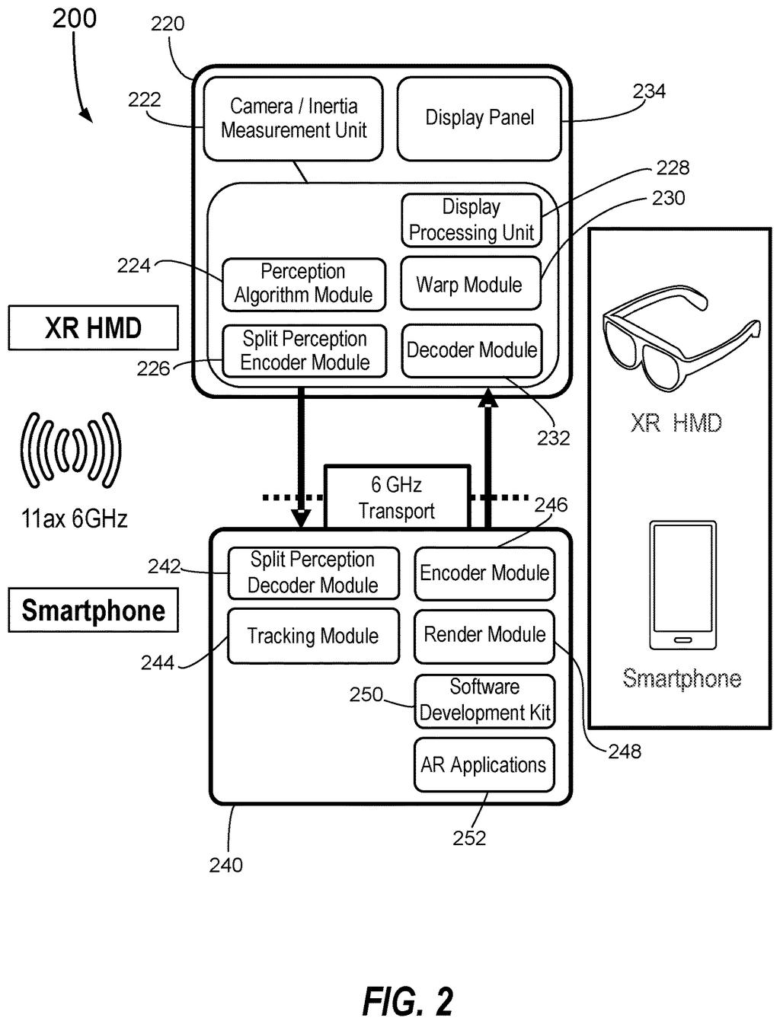
How Qualcomm splits AR work between phone and headset
You're wearing an AR headset that's wirelessly tethered to your phone, which is doing most of the real computing work. The headset needs a steady stream of processed frames to keep your view from stuttering, but your phone also has its own jobs to do.
This patent describes a system where the phone checks whether it's inside a scheduled communication window with the headset. If it is, headset tasks jump to the front of the line. If it isn't, the phone handles its own work first. And if the phone realizes it's running out of time to finish both, it can automatically push its processor to run faster or at higher voltage to get everything done before the next window opens.
The goal is that you never notice the juggling act. Frames stay smooth, your phone doesn't ignore its own processes, and neither side is left waiting.
… prioritizing processing of a first head mounted display (HMD) task in response to determining the host device is within a target wake time (TWT) window.
Translation: The phone prioritizes the headset's data during specific time slots to keep the experience smooth.
How TWT windows dictate task priority and clock-speed boosts
The patent centers on a split XR system, where a host device (a phone or similar) handles the bulk of the rendering and logic for a head-mounted display (HMD) connected over a wireless link.
The coordination mechanism relies on Target Wake Time (TWT) windows, a Wi-Fi scheduling feature that pre-negotiates fixed intervals during which the two devices talk to each other. Think of TWT as a set of regular scheduled calls between the phone and the headset: both sides know exactly when the next call is coming.
The scheduling logic works like this:
- If the host is inside a TWT window, HMD tasks get top priority so frames reach the headset on time.
- If the host is outside a TWT window, it processes its own tasks first, since the headset isn't expecting data right now.
- If the host calculates it won't finish its own task in time to also complete the next HMD task before the upcoming window closes, it evaluates whether raising the processor's clock speed or voltage would close that gap.
That last step is essentially the phone doing a quick cost-benefit check: spend more power now to meet the deadline, or risk a dropped frame.
… evaluating whether increasing processing core voltage and/or increasing processing core clock frequency would allow the host task to complete in time to allow enough time for a second head mounted display (HMD) task to finish processing before a next TWT window ends.
Translation: The phone decides if it should overclock its processor to finish background work before the headset needs more data.
What this means for untethered AR headset design
For the average person, this is about whether a wireless AR headset driven by a phone can actually feel as smooth as a fully self-contained headset. Dropped frames in AR are more disorienting than in ordinary video because your head movements need to match what you see in real time. Any scheduling hiccup the phone can't hide becomes something you feel physically.
The broader pattern here is that chipmakers like Qualcomm are betting that the phone-as-compute-engine model for AR will actually work at consumer quality levels, and that battery-efficient scheduling is as important as raw processing power. This filing sits alongside the stream of AR and chip-efficiency work tracked across the latest Big Tech patents, where the real competition in XR is increasingly happening at the firmware and scheduler level, not just the hardware spec sheet.
Claim 1 is surprisingly narrow: it covers prioritizing an HMD task when the host is inside a TWT window, and nothing else. The dependent claims add the clock-boost evaluation and the out-of-window host-task priority, but those aren't in the independent claim. That narrowness cuts both ways. A competitor could build the same general split-XR scheduler and stay clear of this patent by handling TWT windows differently or skipping TWT entirely. What Qualcomm does lock down, at least at this claim breadth, is the specific TWT-gated priority flip. That's a real and defensible piece of scheduling logic for Wi-Fi-linked AR systems, even if it's not a sweeping monopoly on the concept.
There are more where this came from
We read every patent application Big Tech publishes and send you the ones worth knowing. Plain English, free, every week.
The drawings
7 drawing sheets from US 2026/0236314 A1 · click any drawing to enlarge


Want this weekly breakdown for a company we don't cover? Patentlyze Pro →
Be the first to weigh in