
Samsung Files Patent for a Phone Screen That Reads Your Pulse in Both Hands
Samsung Display has described a phone screen that reads the pulse in both of your hands at once, then compares the two. The idea is that a gap between left and right could say something about your circulation that a single fingertip reading would miss.
What Samsung's two-hand pulse screen does
Ever wonder what your phone screen could tell you about your heart? In this patent application, Samsung Display describes a screen that reads your pulse when you rest a fingertip on it. The twist is that it asks for two hands: one finger from your left and one from your right.
The screen lights up the area under each finger and measures how much light bounces back. Your blood vessels widen and narrow with every heartbeat, so the reflected light shifts in a rhythm that matches your pulse. The device records this over many screen refreshes, finds the spot under each fingertip where the signal is clearest, and pulls out details about how each heartbeat rises and falls.
Then it compares left to right. The filing argues that differences between the two sides of your body can say more about your circulation than one fingertip reading can, and that this supports an assessment of your cardiovascular condition.
… detect an area where a finger of a user's left hand has been touched and an area where a finger of the user's right hand has been touched …
Translation: The device tracks exactly where fingers from both hands are placed on the screen.
How the screen compares left and right pulses
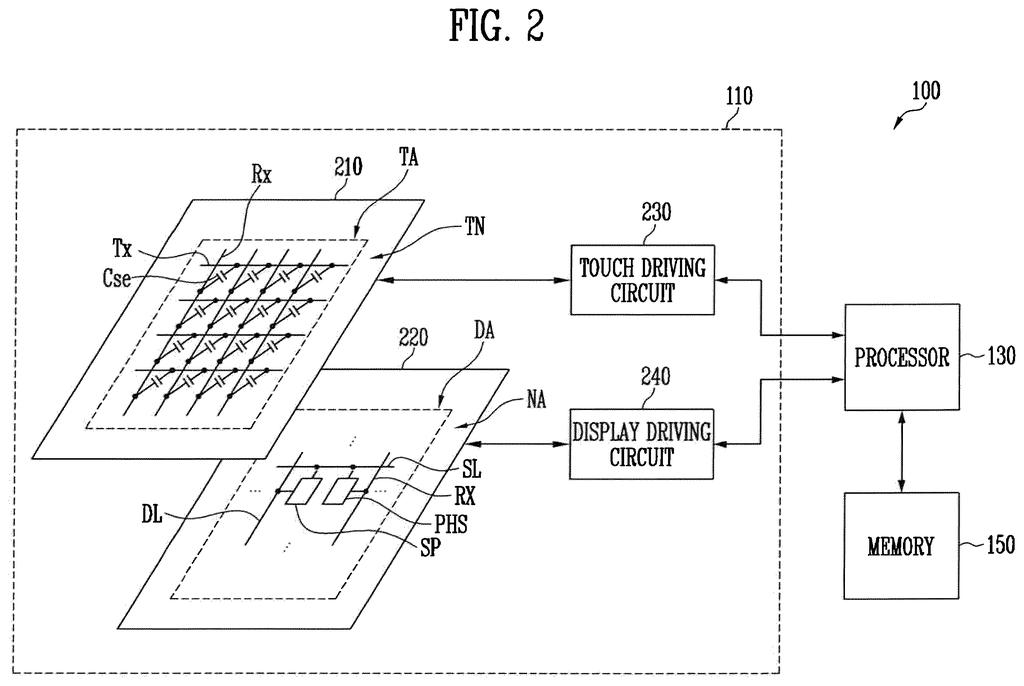
The display mixes ordinary red, green and blue sub-pixels (the tiny lights that make up the picture) with photo sensors, small light detectors tucked in between. A touch panel laid over the top works out where your left finger and your right finger are resting.
When a finger touches down, the display shines light from the pixels around it, and the sensors measure how much bounces back. Each heartbeat changes how much light your blood absorbs, so the reflected light pulses along with your pulse. In this mode the sensors use a short exposure of about 8.3 milliseconds, versus roughly 100 milliseconds for fingerprint scanning, and read several rows at once to catch fast changes.
Over many frames, the processor builds a stack of images for each hand. Then it:
- Finds the patch under each fingertip with the highest signal-to-noise ratio (where the pulse stands out most clearly from background fuzz)
- Pulls feature values from that patch, such as the systolic peak (the surge as blood is pushed out) and the diastolic peak, plus how long each takes to arrive
- Compares left against right, including where the strongest signal sits on each fingertip
A reading is flagged as unreliable if the finger contact shrinks below a set area or the pulse peaks fall under preset thresholds.
… extract physiological features, such as systolic and diastolic peaks, and assess the user's cardiovascular condition …
Translation: It reads blood pressure data and heart rhythms to evaluate how healthy your heart is.
Why a phone screen as a heart monitor matters
If this works, your phone could give you a quick pulse and circulation check with no extra gadget, just two fingers on the screen. The filing notes that the same built-in light sensors already handle fingerprint unlock and screen brightness, so heart readings would be one more job for hardware that is already there.
The two-hand angle is the interesting part. The filing says many existing methods look at a single fingertip at a single moment, which misses differences between the two sides of the body and changes over time. Samsung Display's pitch is that comparing both sides over a stretch of time gives a fuller picture. Whether that holds up in real use, the document does not say.
Samsung's 23rd filing we've tracked in wearables that read your body since June adds to a run that includes a self-tightening watch band and a workout plan that adapts mid-session.
The shortest route to a product here is software, but only on a screen that already has light sensors built in between its pixels. The filing describes those sensors doing double duty for fingerprint unlock and brightness control, so it treats that hardware as a starting point. What has to be added is an app that shows two touch targets and runs the comparison math.
The bigger gap is proof. The document gives no test results, no accuracy figures, and no medical thresholds for what counts as a worrying difference between your hands. Until someone shows that left-right gaps mean something a doctor can use, this stays a clever measurement idea.
My read: a plausible wellness feature for a future screen, and a long way from anything you would trust for a diagnosis.
Get our take in your Top Stories
Liked this breakdown? Add Patentlyze as a preferred source on Google, and our plain-English take shows up more often in your Top Stories the next time Samsung patent news breaks.
There are more where this came from
We read every patent application Big Tech publishes and send you the ones worth knowing. Plain English, free, every week.
The drawings
25 drawing sheets from US 2026/0305965 A1 · click any drawing to enlarge


Want this weekly breakdown for a company we don't cover? Patentlyze Pro →
Be the first to weigh in