
Samsung
Samsung · Display · Filed Jun 30, 2025 · USPTO published Oct 8, 2026 · Oct 8 release
Samsung Files Patent for a Phone Screen That Reads Your Pulse in Both Hands
Samsung Display has described a phone screen that reads the pulse in both of your hands at once, then compares the two. The idea is that a gap between left and right could say something about your circulation that a single fingertip reading would miss.
- Publication number
- US 2026/0305965 A1(US20260305965A1)
- Applicant
- SAMSUNG DISPLAY CO., LTD.
- Filed · Published
- Jun 30, 2025 · Oct 8, 2026
- Inventors
- Chul KIM
- Status when we published
- Examiner raised objections; the company can respond
- Document
- 20 claims
- US classification
- 600/480
- Examiner
- CHOI, YOUNHEE JEON (Art Unit 3797)
What Samsung's two-hand pulse screen does
Ever wonder what your phone screen could tell you about your heart? In this patent application, Samsung Display describes a screen that reads your pulse when you rest a fingertip on it. The twist is that it asks for two hands: one finger from your left and one from your right.
The screen lights up the area under each finger and measures how much light bounces back. Your blood vessels widen and narrow with every heartbeat, so the reflected light shifts in a rhythm that matches your pulse. The device records this over many screen refreshes, finds the spot under each fingertip where the signal is clearest, and pulls out details about how each heartbeat rises and falls.
Then it compares left to right. The filing argues that differences between the two sides of your body can say more about your circulation than one fingertip reading can, and that this supports an assessment of your cardiovascular condition.
… detect an area where a finger of a user's left hand has been touched and an area where a finger of the user's right hand has been touched …
Translation: The device tracks exactly where fingers from both hands are placed on the screen.
How the screen compares left and right pulses
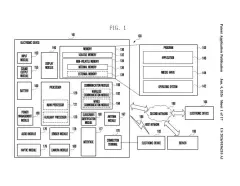
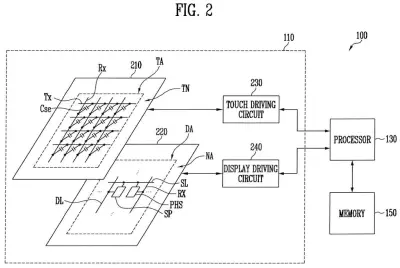
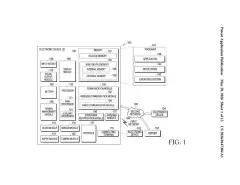
The display mixes ordinary red, green and blue sub-pixels (the tiny lights that make up the picture) with photo sensors, small light detectors tucked in between. A touch panel laid over the top works out where your left finger and your right finger are resting.
When a finger touches down, the display shines light from the pixels around it, and the sensors measure how much bounces back. Each heartbeat changes how much light your blood absorbs, so the reflected light pulses along with your pulse. In this mode the sensors use a short exposure of about 8.3 milliseconds, versus roughly 100 milliseconds for fingerprint scanning, and read several rows at once to catch fast changes.
Over many frames, the processor builds a stack of images for each hand. Then it:
- Finds the patch under each fingertip with the highest signal-to-noise ratio (where the pulse stands out most clearly from background fuzz)
- Pulls feature values from that patch, such as the systolic peak (the surge as blood is pushed out) and the diastolic peak, plus how long each takes to arrive
- Compares left against right, including where the strongest signal sits on each fingertip
A reading is flagged as unreliable if the finger contact shrinks below a set area or the pulse peaks fall under preset thresholds.
… extract physiological features, such as systolic and diastolic peaks, and assess the user's cardiovascular condition …
Translation: It reads blood pressure data and heart rhythms to evaluate how healthy your heart is.
Why a phone screen as a heart monitor matters
If this works, your phone could give you a quick pulse and circulation check with no extra gadget, just two fingers on the screen. The filing notes that the same built-in light sensors already handle fingerprint unlock and screen brightness, so heart readings would be one more job for hardware that is already there.
The two-hand angle is the interesting part. The filing says many existing methods look at a single fingertip at a single moment, which misses differences between the two sides of the body and changes over time. Samsung Display's pitch is that comparing both sides over a stretch of time gives a fuller picture. Whether that holds up in real use, the document does not say.
Samsung's 23rd filing we've tracked in wearables that read your body since June adds to a run that includes a self-tightening watch band and a workout plan that adapts mid-session.
Source: US 2026/0305965 A1 at the USPTO (PDF). Full patent text and figures are in the official publication.
Get our take in your Top Stories
Liked this breakdown? Add Patentlyze as a preferred source on Google, and our plain-English take shows up more often in your Top Stories the next time Samsung patent news breaks.
Add Patentlyze on Google
One click.
There are more where this came from
We read the new patents from Big Tech, carmakers and more and send you the ones worth knowing. Plain English, free, every week.
The drawings · 25 sheets
25 drawing sheets from US 2026/0305965 A1 · click any drawing to enlarge


Show the other 17 sheets


More from Samsung
All 1,662 Samsung patents →
More in Cell phone
All 496 Cell phone patents →
Qualcomm
Qualcomm Patents a Way to Track Your Workout Using Radio Signals Between Devices
Apple
Apple Patents a Way to Control Your Phone Using Tilt and Hand Position
Sony
Sony Patents a Split Game Controller That Squeezes Onto Your Phone
Qualcomm
No comments yet