
Samsung
Samsung · Wearable · Filed May 18, 2026 · USPTO published Oct 8, 2026 · Oct 8 release
Samsung Patents a Watch Band That Tightens Itself When You Start a Workout
Samsung's patent application describes a watch band that uses magnets to tighten itself around your wrist when you start a workout. After you finish, it loosens past its everyday setting so your skin can recover.
- Publication number
- US 2026/0310141 A1(US20260310141A1)
- Applicant
- SAMSUNG ELECTRONICS CO., LTD.
- Filed · Published
- May 18, 2026 · Oct 8, 2026
- Inventors
- Taesan KIM, Shinhun MOON, Yongjun CHOI
- Status when we published
- Waiting for an examiner
- Document
- 20 claims
- US classification
- 368/10
- Parent application
- Continuation of PCT/KR2024/013529 (filed Sep 6, 2024)(PCTKR2024013529)
What Samsung's self-tightening watch band does
Imagine you strap on your watch for a lunch-hour run. A loose fit is comfortable at your desk, but a loose watch gives less accurate sensor readings once you start moving. A tight fit helps the sensors, yet wearing it that way all day gets miserable.
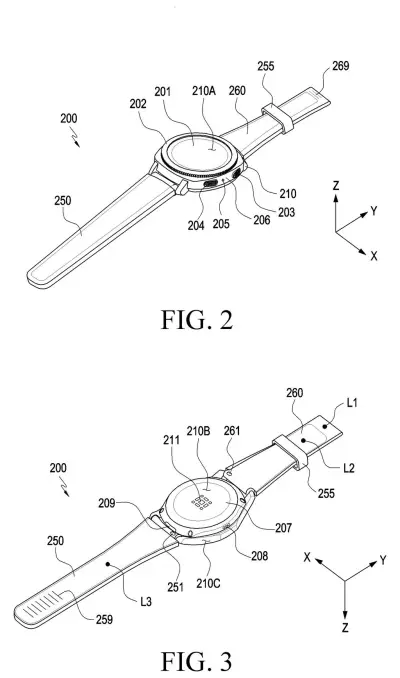
Samsung's patent application describes a watch band that adjusts itself. Small magnets in one strap and tiny electromagnets (magnets that only switch on when electricity flows through them) in the other push and pull the straps so one slides along the other.
When you start a workout, the band snugs up. When you finish, it goes looser than usual for a while so sweat can clear, then settles back to its normal fit.
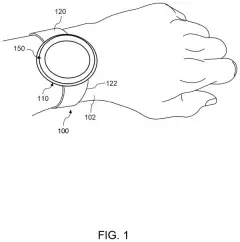
… the second wearing member configured to form a closed curve with the housing and the first wearing member by being coupled with the first wearing member while at least partially facing the first wearing member; …
Translation: The straps wrap around your wrist to form a closed loop.
How magnets slide one strap along the other
One strap holds permanent magnets laid out so their north and south poles alternate along the strap's length. The other strap holds at least one pair of electromagnets. When the watch sends an electrical signal, each electromagnet attracts or repels the nearby permanent magnets. That force slides the two straps against each other and shrinks or enlarges the loop around your wrist.
The filing describes three fits, which the claims call wearing states:
- First state: the everyday fit, with light pressure on the skin, used for things like calls and messages.
- Second state: when an exercise or health-measurement function starts, the band tightens so the sensors sit closer to your skin.
- Third state: when the workout ends, the band goes looser than the everyday fit to ease skin irritation and let sweat disperse. After a set time, it returns to the first state.
To know where it is, the band uses a pressure sensor built from two metal pads with an insulating layer between them (the watch reads pressure from changes in electrical capacitance, the ability to hold a charge). A geomagnetic sensor (a compass-style sensor) reads the polarity of the magnet next to it, which tells the watch which way the strap is moving. Ridges and grooves on the two straps interlock to hold the position, and the electrical signal can be cut off once the band is in place. For a health measurement, the band returns straight to the everyday fit afterward.
At least one pair of second magnetic bodies may be configured to receive electrical signals and generate attractive or repulsive force with respect to the first magnetic bodies.
Translation: Magnets inside the band push or pull each other when triggered by electricity.
What this means for your wrist after a run
If you wear a fitness watch, you know the trade-off: a snug band gives better readings, and a loose band is easier to live in. This filing describes a band that handles the switch for you, tightening when a workout or health measurement starts and easing off when you finish. Samsung's own description says the goal is comfort in normal wear with better accuracy during exercise.
The looser state afterward is the most interesting part. Samsung says it is meant to reduce skin irritation after tight contact and let sweat disperse, a problem anyone who has finished a run with a sweaty strap knows well. It is still a patent application, so there is no sign yet that it will become a product, and a design like this would depend on how well it holds up to real-world wear.
Samsung's 22nd filing we've tracked since June in our wearables that read your body watch list follows an adaptive workout plan application and earbuds that detect your activity.
Source: US 2026/0310141 A1 at the USPTO (PDF). Full patent text and figures are in the official publication.
Get our take in your Top Stories
Liked this breakdown? Add Patentlyze as a preferred source on Google, and our plain-English take shows up more often in your Top Stories the next time Samsung patent news breaks.
Add Patentlyze on Google
One click.
There are more where this came from
We read the new patents from Big Tech, carmakers and more and send you the ones worth knowing. Plain English, free, every week.
The drawings · 12 sheets
12 drawing sheets from US 2026/0310141 A1 · click any drawing to enlarge


Show the other 4 sheets


More from Samsung
All 1,662 Samsung patents →

More in Hardware
All 2,375 Hardware patents →
Qualcomm
Qualcomm Patents a Way to Track Your Workout Using Radio Signals Between Devices
Sony
Sony Patents Earbuds That Filter Out Noise from Your Health Readings
Google
Google Patents a Wearable That Flags Fall Risk After a Bad Night's Sleep
Google
No comments yet