
OpenAI Files Patent for AI Training That Fits Inside a Phone's Limited Memory
Teaching an AI model eats a lot of memory, and small devices run out fast. This OpenAI patent application has the system run a quick test first, then choose the training method that is fastest within the memory it actually has.
What OpenAI's low-memory AI training does
Imagine you're packing for a trip and the airline gives you a strict weight limit. You can bring everything and move fast, or leave some items behind and repack them later. Either way, you want the quickest option that still fits under the limit.
Teaching an AI model runs into the same problem. While it learns, it keeps piles of intermediate results in memory, and on a small device like a phone that memory can run out. OpenAI's patent application describes a system that runs a quick trial first. It measures how long each training method takes and how much memory it uses, then picks the fastest one that fits.
If memory is still short, the system can park temporary data in a bigger, slower storage area and pull it back when it's needed.
… select a training technique from a library of candidate training techniques associated with the learning network for training the model, the selection of the training technique being based on the profile of the model, a training iteration latency, and a capacity constraint of the local memory …
Translation: The system picks a specific training method that fits into tight phone memory without slowing down.
How the chip picks a training method
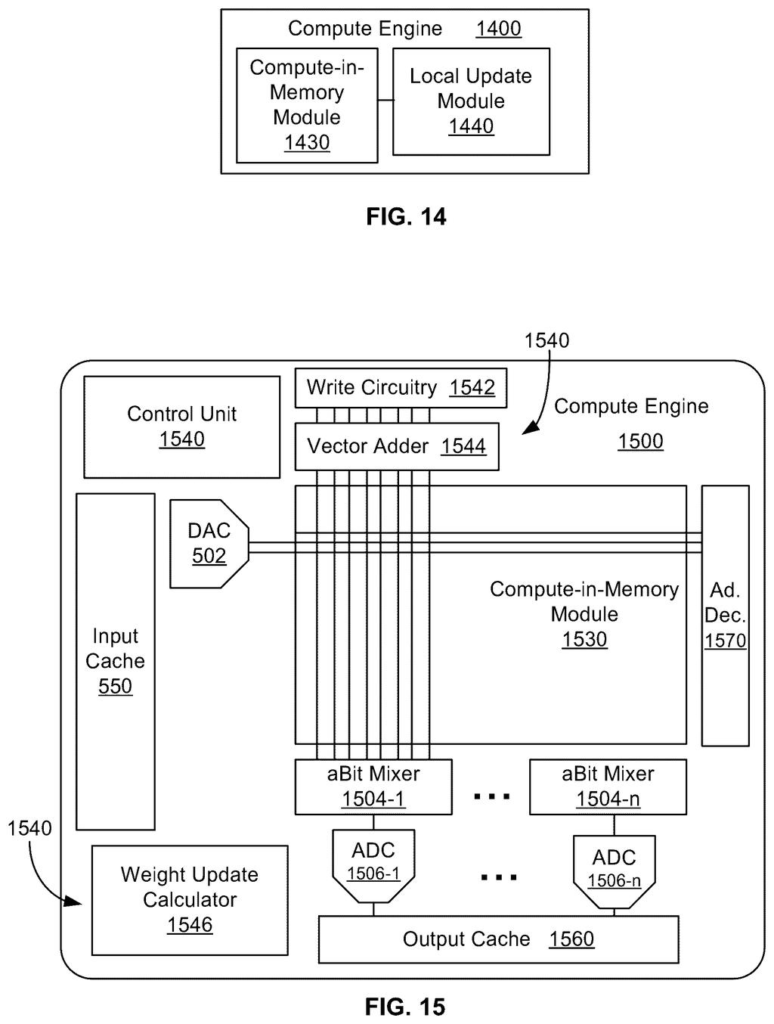
The patent covers a system with a small local memory and a processor that manages a learning network (the layered math structure behind modern AI) built from compute engines grouped into compute tiles. Step one is profiling. The system runs at least one training iteration (one round of guessing, checking the error, and adjusting the model's weights) and records descriptors of the model, such as batch size, image width and height, or kernel size (settings that describe the model's shape).
Step two is picking a method from a library of candidates, based on the profile, the time each round takes, and the memory limit. The filing lists:
- Backpropagation: the standard method. Fast, but memory-hungry.
- Activation recomputation: stores almost nothing and redoes work later. Light on memory, but slower.
- Partial recomputation: stores a few chosen intermediate results as a middle ground.
- Others, including feedback alignment and equilibrium propagation.
In the filing's four-layer example, a limit of twelve memory blocks picks plain backpropagation, eleven picks the partial version, and eight picks full recomputation. The claims also allow combining methods into a hybrid and holding back some memory for non-training uses.
The broadest hardware claim adds chips that do the multiplication right where the weights are stored (compute-in-memory). If memory would still overflow, the system loads data from a larger remote memory, runs the math, and writes the result back.
… optimizing a latency for at least one training iteration for a capacity of the associated memory …
Translation: It adjusts the training process to work as fast as possible within strict hardware limits.
What this means for AI that learns on-device
The practical problem here is that AI models are usually trained on big servers, while small devices like phones have far less memory to spare. The filing itself names smartphones as devices where training can use up all available memory or need more than exists. A system that automatically picks the right trade-off could make training on the device itself more realistic, with no engineer hand-tuning each model.
There is also a hardware angle. The description spends many pages on AI accelerator chips built from tiles and compute-in-memory engines, so this logic looks designed to sit on top of that specialized silicon. If you care about where AI training might happen next, the interesting part is the automatic choosing: measure first, then pick the fastest method that fits.
OpenAI's tenth filing in the AI assistant and agent space we've tracked since May follows earlier applications like the bot noting things about you and building and testing in one window.
The decision logic is the easy part to picture shipping. Measure a few training rounds, compare a short menu of methods, and pick the fastest one under the memory limit. That is ordinary software, and the filing even writes out the trade-off math in a few equations.
The catch is what the claims are built around: compute engines grouped into tiles and, in the broadest hardware claim, chips that do the multiplication where the numbers are stored. That hardware has to exist first. The filing describes the chip design in detail but says nothing about a product.
The shortest route to a real feature is a training tool built into the software for those specialized chips. Getting it onto an ordinary phone would take a different design. As written, this is a tidy piece of engineering for a narrow kind of hardware, and it sits a long way from your phone learning new tricks on its own.
Get our take in your Top Stories
Liked this breakdown? Add Patentlyze as a preferred source on Google, and our plain-English take shows up more often in your Top Stories the next time OpenAI patent news breaks.
There are more where this came from
We read every patent application Big Tech publishes and send you the ones worth knowing. Plain English, free, every week.
The drawings
11 drawing sheets from US 2026/0320395 A1 · click any drawing to enlarge


Show the other 3 sheets


Want this weekly breakdown for a company we don't cover? Patentlyze Pro →
Be the first to weigh in