
OpenAI Patents an AI That Writes Short Profiles of You for Apps to Use
Instead of storing your tastes as rows of numbers, OpenAI's patent has an AI write them down as plain sentences. Apps that want to personalize things for you can then use that description.
What OpenAI's written-profile patent does
Right now, when an app tries to learn what you like, it usually turns your habits into a long list of numbers. Those numbers are hard for a person to read, and they lose nuance. The list can't tell someone who likes any pasta from someone who hunts down unusual restaurants. OpenAI's patent describes plain-language profiles instead.
The idea is that an AI reads your past activity with a service (chats, clicks, purchases) and writes a short description of you, something like 'enjoys exploring new and innovative dining experiences.' It does this in the background, not while you wait, and keeps the description up to date. A music service could keep one version of you, and an ad service could keep another.
The profiles can also be combined. A request for a recipe to cook for a friend could draw on what one service knows about her and what another knows about your cooking.
… evaluating, by a generative response engine, past interaction data between a user account and a service provider, wherein the generative response engine is configured to determine what information should be synthesized into a natural language representation of the user account; …
Translation: An AI reviews your past activity to figure out what details belong in your personal profile summary.
How the AI builds and updates your profile
The filing describes a generative response engine (the kind of AI model behind chatbots) that reads a person's past activity with a service and writes a natural language representation, meaning a plain-text description of that person's interests. It runs as an asynchronous process (a background job on its own schedule, not tied to anything you are doing). The description says it can kick in once enough unreviewed conversations pile up.
The claims and description cover several pieces:
- Specialized copies of the model, each trained for one category such as music, ads or food, so one person can have several profiles.
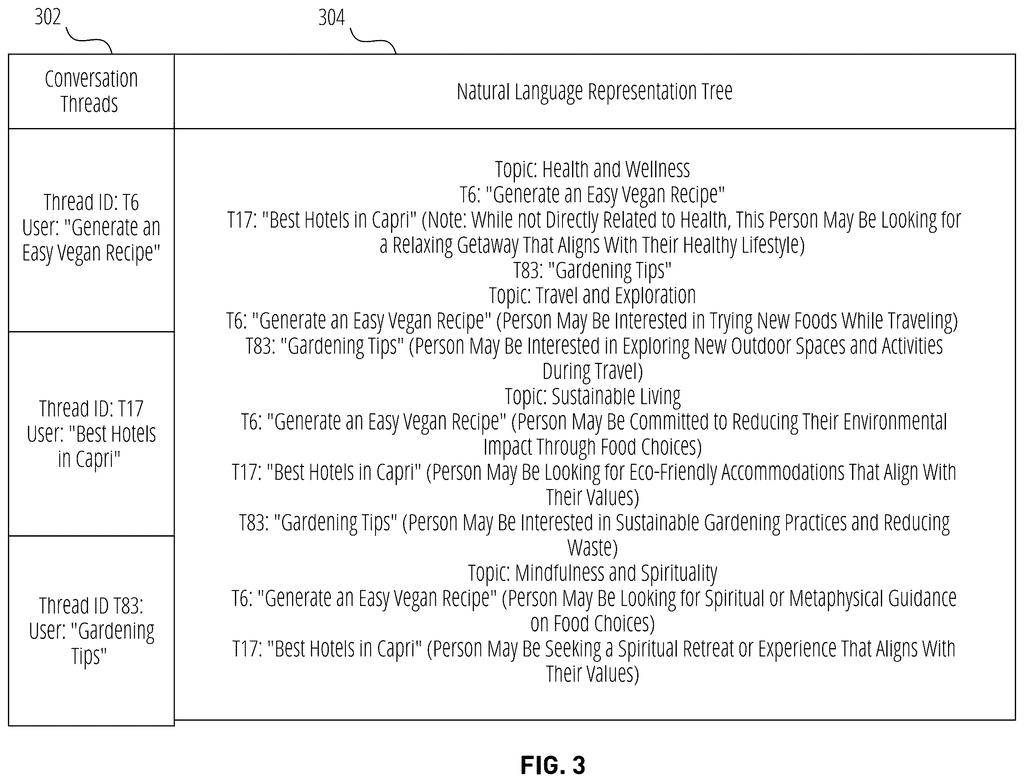
- Profiles stored as a paragraph or a topic tree, built from chats, clicks or logs of what you did on a site.
- Combining profiles from different categories, or from different service providers, into one recommendation.
- A service scheduling a prompt, such as a weekly sales notification, that carries your profile.
Profiles are kept current. The model can revise, add or remove parts when you bring up new topics, and older summaries can move into a searchable archive.
One example rewrites a news app's landing page. If your profile says you only read the Tech News section, the app enlarges it and tucks the unused sections into a menu.
The representations are continuously generated in an asynchronous process, allowing seamless updates without disrupting operational efficiency.
Translation: Your profile updates in the background so apps never slow down while gathering your data.
Why recommendations could read you better
If this reaches products, the practical change is that recommendations could draw on a written description of you instead of a pile of numbers. A music service, an ad network and a shopping app could each keep their own version, and the filing also describes combining them, for example when a recipe request for a friend draws on a profile of her from one service and your cooking history from another.
The filing pictures other companies calling the model through an API, or running their own copies. It includes opt-in and opt-out language and anonymous identifiers, but a profile that can feed ad targeting raises obvious questions about who reads it and what it says about you.
OpenAI files its third patent we've tracked on AI assistants that remember you since August, following applications on knowing when you change subjects and learning your company's code names.
You would notice this when a home screen drops the sections you never open, or when a music app builds playlists around a hobby you mentioned in a chat weeks ago. That is a real, everyday benefit, and plain sentences are a sensible way to store it because the AI that reads them is built to handle language.
The cost is just as concrete. A paragraph that calls you 'well-educated, confident' (the filing's own example) is a guess about you, and the same paragraph can feed ad targeting. The text gives little detail on whether you could read or correct what is written about you.
The claims are broad: any AI that writes a profile in the background and uses it to recommend things. Whether you come out ahead depends on the guardrails around that profile, and the filing leaves most of them open.
Get our take in your Top Stories
Liked this breakdown? Add Patentlyze as a preferred source on Google, and our plain-English take shows up more often in your Top Stories the next time OpenAI patent news breaks.
There are more where this came from
We read every patent application Big Tech publishes and send you the ones worth knowing. Plain English, free, every week.
The drawings
11 drawing sheets from US 2026/0310904 A1 · click any drawing to enlarge


Want this weekly breakdown for a company we don't cover? Patentlyze Pro →
Be the first to weigh in