
OpenAI
OpenAI · AI / ML · Filed Jun 17, 2025 · USPTO published Oct 8, 2026 · Oct 8 release
OpenAI Files Patent for Letting Customers Teach Its AI With Their Own Pictures
OpenAI's patent application describes a way for outside developers to hand its AI a stack of labeled pictures and get back a custom version. The filing says as few as 100 images can produce significant gains.
- Publication number
- US 2026/0311048 A1(US20260311048A1)
- Applicant
- OpenAI OpCo, LLC.
- Filed · Published
- Jun 17, 2025 · Oct 8, 2026
- Inventors
- John Allard, James Blomo, William Hang, Steven Heidel, Todd Hendry, Radu Kopetz, Ravi Teja Mullapudi, Damian Mrowca, Sherwin Wu
- Status when we published
- Examiner raised objections; the company can respond
- Document
- 23 claims
- US classification
- 706/12
- Examiner
- SMITH, PAULINHO E (Art Unit 2127)
- Parent application
- Continuation of 19/090,901 (filed Mar 26, 2025)(19090901)
What OpenAI's image-training patent actually does
Imagine you run a clinic and want an AI to look at your scans and flag anything worth a second look. A general-purpose chatbot has seen plenty of pictures, but it has never learned what your scans look like or what your doctors care about.
This filing describes how OpenAI could let you fix that. You upload a batch of images, each paired with the answer you want the AI to give. OpenAI's system then builds a customized copy of its model, and the filing says as few as 100 images can improve performance, with bigger batches helping more.
When training finishes, you get back a name for your custom model. Later, you send that name along with a new picture and a question, and your tuned version answers. The patent also describes safety checks on your images and ways to handle pictures that are too large.
receiving, via an application programming interface (API) call, a training set for fine-tuning an ML model, the training set comprising a plurality of images associated with respective text strings …
Translation: Customers can upload custom pictures and text to customize the artificial intelligence through software commands.
How small add-on layers teach the model new images
A developer sends an API call (a standard way for one program to make a request of another) containing a training set: a batch of images, each paired with a text answer the model should give. The call also names the model to start from, which can be a base model or one that was already customized.
The training method the first claim names is low-rank adaptation, or LoRA. The original model's weights (the numbers that encode what it learned) stay frozen. Two small matrices (grids of numbers) added to a layer are the only parts that get updated, so training is cheaper and the saved result is small. When training ends, the API returns an identifier, a name the developer uses later to call the custom model with a new image and a question.
The filing also describes extras:
- Screening the training set against safety rules (such as images of violence, nudity, people or minors) and halting the job if too many fail.
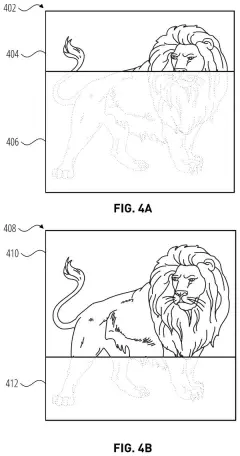
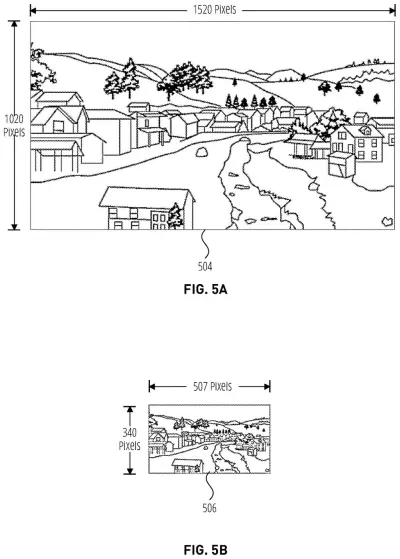
- Shrinking oversized images, or slicing them into tiles. In one example, a 1020x1520 image shrinks to 340x507 by averaging each 3x3 block of pixels.
- Progress readouts during training, such as an error score tracked over time.
- An image-reading layer based on CLIP (a model that links pictures to text descriptions), which lets a base model that cannot take images accept them.
To use the fine-tuned model to generate a response to a prompt, a subsequent API call includes the name and the prompt.
Translation: You can then use the custom model by sending prompts along with the new name given to your trained version.
Why custom image training matters for developers
If you have ever wished a chatbot could understand your own kind of pictures, this is the plumbing that would make it possible. Hospitals, retailers and city planners could, in principle, teach a general AI to handle their own images. The filing itself mentions medical image analysis, visual search and object detection for autonomous vehicles and smart cities, and says as few as 100 images can bring significant gains.
For OpenAI, the appeal looks practical. Because the add-on pieces are tiny, the filing's own math for a GPT-3-sized model says seven high-end GPUs (the chips that run big AI models) could hold weights for hundreds of customer versions at once, next to a single copy of the base model. That makes custom AI cheap to host, which is how one general model becomes something many businesses could each tune to themselves.
OpenAI's second AI training and infrastructure application we've tracked since September follows their watchdog model filing.
Source: US 2026/0311048 A1 at the USPTO (PDF). Full patent text and figures are in the official publication.
Get our take in your Top Stories
Liked this breakdown? Add Patentlyze as a preferred source on Google, and our plain-English take shows up more often in your Top Stories the next time OpenAI patent news breaks.
Add Patentlyze on Google
One click.
There are more where this came from
We read the new patents from Big Tech, carmakers and more and send you the ones worth knowing. Plain English, free, every week.
The drawings · 21 sheets
21 drawing sheets from US 2026/0311048 A1 · click any drawing to enlarge


Show the other 13 sheets


More from OpenAI
All 58 OpenAI patents →
More in AI training & infrastructure
All 324 AI training & infrastructure patents →
Nvidia
Nvidia Patents a Dual-AI System for Dynamic Cloud Resource Pool Sizing
Nvidia
Nvidia Patents a Multi-Teacher Knowledge Distillation System Using LoRA Towers
Nvidia
Nvidia Patents a Self-Routing AI Inference System That Skips the Traffic Cop
Google
No comments yet