

OpenAI
OpenAI · AI / ML · Filed Apr 23, 2025 · USPTO published Oct 8, 2026 · Oct 8 release
A New OpenAI Patent Puts Building and Testing a Custom Chatbot in One Window
OpenAI has filed a patent for a single screen where developers can build a custom chatbot, chat with it, tweak it, and chat again. It even includes a button that asks AI to write the chatbot's own instructions for you.
- Publication number
- US 2026/0310989 A1(US20260310989A1)
- Applicant
- OpenAI OpCo, LLC
- Filed · Published
- Apr 23, 2025 · Oct 8, 2026
- Inventors
- Jillian Khoo, Karolis Kosas, Scott Lessans, David Weedon
- Status when we published
- Waiting for an examiner
- Document
- 20 claims
- US classification
- 706/11
- Parent application
- Continuation of 19/170,539 (filed Apr 4, 2025)(19170539)
What OpenAI's chatbot test window actually does
Every time a company builds a custom AI assistant, someone has to change a setting, run a test question, read the answer, and wince. Then they do it all over again. That loop is the daily grind of building chatbots.
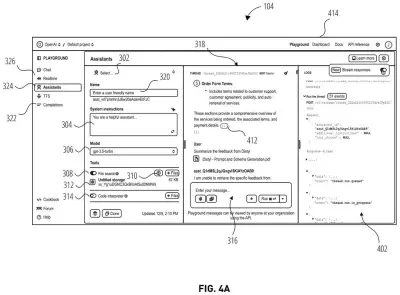
OpenAI's filing describes a single test window that folds the whole loop together. You pick the underlying AI model, write the standing instructions that shape its personality and limits, type a test question, and see the reply right there. If the answer is off, you change the settings and ask again without leaving the screen.
The filing also describes generate buttons scattered around the screen. Describe what you want in plain language, and another AI drafts the instructions or code for you to edit.
receiving a first configuration of the customized generative response engine by an interactive test interface, wherein the first configuration includes at least a system message, and a base generative response engine version, causing the customized generative response engine to be configured according to the first configuration …
Translation: You input your bot instructions and choose a base AI model inside a single testing window.
How the test window swaps settings and compares models
The claims cover a method for testing a customized generative response engine (a stock AI model, such as a GPT, shaped by your own settings). The settings include at least a system message (hidden standing instructions that set the AI's tone, detail level, format, length and limits) and a choice of base model. A test window takes those settings, sends your test question to the configured AI, and shows the reply for a person to judge.
From there, you can change the settings to make a second version and test it the same way. The claims also cover:
- AI-assisted buttons placed next to each setting. You describe what you want, and an AI assistant drafts the instructions, a function call, or a JSON schema (a template that forces answers into a fixed format).
- Tool switches for file search, a code interpreter, web browsing and custom functions, plus an option to force the AI to use a tool on every turn.
- An activity log showing the AI's reasoning, the files it opened, and the search results it used.
- A library of earlier setups you can import.
The description adds side-by-side panes for comparing two models on the same question, a tool that lines up their settings, and voice-chat controls such as a speech indicator and a mute button. Those extras are described but not the main claims.
The interface integrates the functions defining, modifying, and testing the CGRE to enable rapid iterations between testing and modifying the CGRE.
Translation: Combining setup and testing in one view lets developers tweak and test their bots much faster.
Why OpenAI wants testing and building in one place
If you have used an AI-powered support bot or writing helper from a smaller company, someone probably built it in a screen like this one. A faster loop between tweaking and testing means those products can be tuned more quickly, and a developer can see how a new model behaves before switching to it.
The filing also shows how much of the work OpenAI wants to handle for developers. The AI writes the instructions, and the same window tests them. OpenAI's interest in developer tooling suggests the company sees the building experience as part of its product, not an afterthought.
OpenAI's eighth filing in the AI assistant and agent space we've tracked since May adds to earlier work like one teaching AI company code names and one letting AI call outside tools on its own.
Source: US 2026/0310989 A1 at the USPTO (PDF). Full patent text and figures are in the official publication.
Get our take in your Top Stories
Liked this breakdown? Add Patentlyze as a preferred source on Google, and our plain-English take shows up more often in your Top Stories the next time OpenAI patent news breaks.
Add Patentlyze on Google
One click.
There are more where this came from
We read the new patents from Big Tech, carmakers and more and send you the ones worth knowing. Plain English, free, every week.
The drawings · 32 sheets
32 drawing sheets from US 2026/0310989 A1 · click any drawing to enlarge


Show the other 24 sheets





No comments yet