
Wing Files Patent for Drone Deliveries That Tell You in Words Where Your Package Landed
When a drone drops off your package, the proof of delivery is usually a photo, and that photo can show your neighbor's yard too. Wing's patent application has an AI look at the overhead picture and send you a written description instead.
What Wing's drone package descriptions do
Ever gotten a delivery photo and spotted your neighbor's car, or half their patio, in the background? A picture of a package captures everything the camera can see, and that includes other people's property.
Wing, the drone delivery company, has filed a patent application for a different approach. After the drone drops off your package, it takes an overhead photo and feeds it to an AI model. Instead of sending you the picture, the system writes a short message, such as where the package sits compared with your house and your trees, and what time it arrived.
The writing is built to stay inside your property line. Anything outside a boundary around your yard gets left out of the message, so the neighbors never come up. The text also doubles as proof that the delivery happened.
… generating, using the machine learning model and based on the aerial image, a textual description of a location of the object in the environment, wherein the textual description anonymizes visual information contained in the aerial image by omitting reference to objects located outside of a designated boundary within the environment …
Translation: An AI turns a drone photo into a text description of the landing spot while hiding surrounding areas for privacy.
How the model writes about only your yard
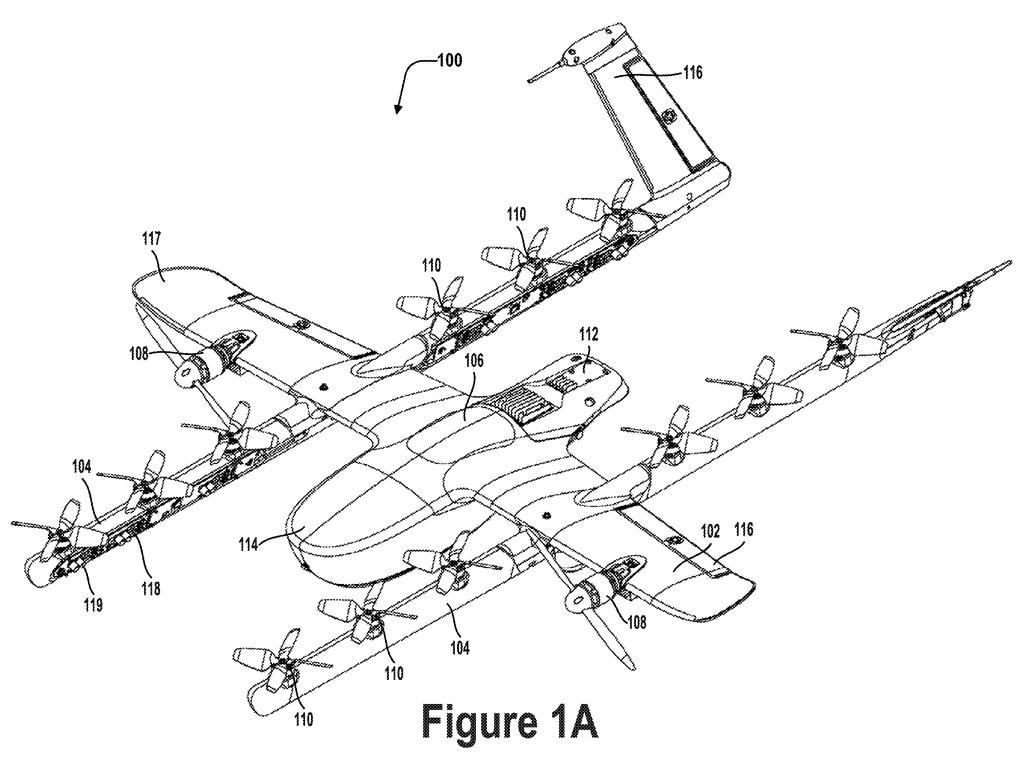
The patent describes a pipeline that starts with an aerial image, usually captured by the delivery drone itself after it releases a package. The image goes into a machine learning model (software trained on many examples until it can do a task on its own) that writes a sentence or two describing where the object is.
The key claim is how the text is written. The description must anonymize what the image shows by leaving out anything outside a designated boundary, such as the recipient's property line. The filing gives sample output like "The package was delivered at 2:30PM PST in the back drop zone of the property of the recipient, 5 m north of the house structure."
The filing describes several ways to help the model:
- A semantic map, a color-coded version of the photo where each region is labeled (house, tree, driveway, package, or whether it belongs to you or a neighbor).
- An intermediate image where parts of the scene are masked, blurred, or removed before the model sees them.
- A composite image stitched together from several shots taken from different angles.
- Extra inputs like capture time, altitude, and the gap between the planned drop spot and the real one.
The description can also leave out personal details, like a visible license plate number. If you reply with a question, the system can rewrite the description and send it again. The model is trained on pairs of aerial images and written descriptions of an object's location.
Why delivery photos may give way to text
The practical payoff is privacy. If your delivery confirmation is a few words of text instead of an overhead photo, there is no picture of your backyard sitting on a server or in a notification, and no picture of the neighbors' yard either. The filing also notes that text takes less storage and bandwidth than images, and it doesn't get blurry or degraded when files are compressed or sent.
It could also help you find the package. A message like "next to the stairs to the front door" or "the planned spot was blocked by a tree, so it landed 2 m away" tells you where to look and why. The patent describes the drone delivery setting, so the first place you would notice this is a delivery notification on your phone.
Google lands its 52nd filing we've tracked in voice and speech AI since May, building on earlier applications like blanking out audio slices and filling task gaps mid-chat.
If you have ever opened a delivery alert and winced at how much of your property it showed, this idea is for you. A short written note could give you everything you need to find your package, with none of the surrounding scenery.
You would notice it the first time a drone delivers during a day when the usual spot is blocked. A sentence explaining the change saves you a hunt around the yard, and it keeps your neighbors out of your notification history.
The weak point is trust. A written note only helps if the AI describes the scene correctly, and if it misplaces the package, you are the one standing on the porch with nothing there. The patent lets you reply with a question, which is a sensible safety valve. For something this routine to make daily life better, the sentence just has to be right.
Get our take in your Top Stories
Liked this breakdown? Add Patentlyze as a preferred source on Google, and our plain-English take shows up more often in your Top Stories the next time Google patent news breaks.
There are more where this came from
We read every patent application Big Tech publishes and send you the ones worth knowing. Plain English, free, every week.
The drawings
19 drawing sheets from US 2026/0321002 A1 · click any drawing to enlarge


Show the other 11 sheets


Want this weekly breakdown for a company we don't cover? Patentlyze Pro →
Be the first to weigh in