
Google Patents a Way for Its AI Assistant to Fill In Task Details Mid-Conversation
Asking a voice assistant to book a restaurant and then casually asking a follow-up question about it should not reset the whole conversation. Google has filed a patent for a system that holds the task open in the background while answering your questions, feeding what it learns directly back into completing the original request.
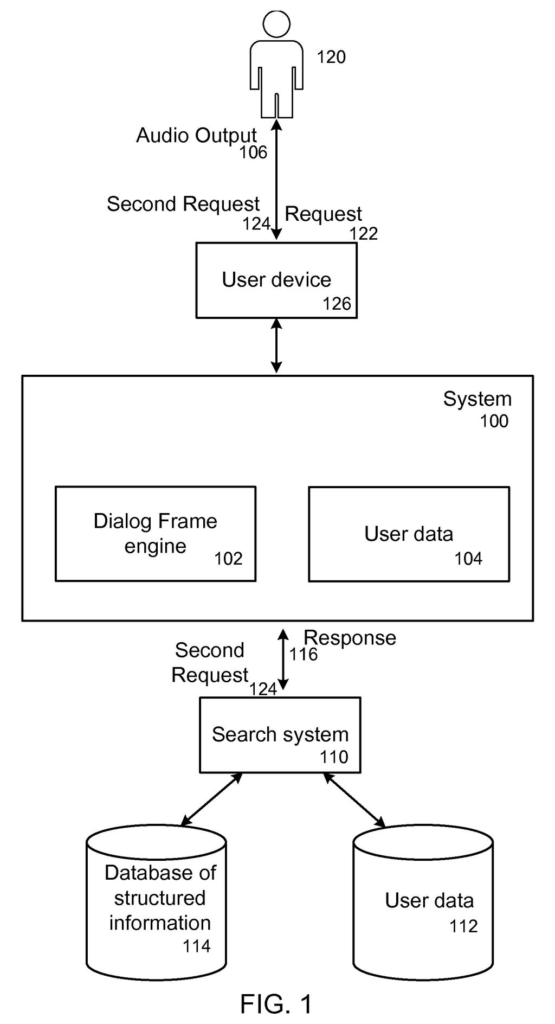
What Google's mid-conversation task-filling actually does
Imagine you ask a voice assistant to make a dinner reservation, then ask, "What are the hours for that place on Saturdays?" Right now, many assistants treat those as two separate conversations. The booking task gets dropped.
Google's patent describes a system that keeps the original task open in a kind of mental checklist called a frame. A frame is just a list of blank fields the assistant needs to fill in before it can finish your task, things like the restaurant name, the time, and the number of guests. When you ask a follow-up question, the assistant runs a search, gets the answer, and then checks whether that answer also happens to fill in one of those blank fields.
So the hours you asked about might tell the system you want an 8 p.m. slot, and it stores that automatically. You get your answer and the task moves forward, without you having to repeat yourself.
… causing output to be provided for presentation to the user, via the client device, that solicits the user for one or more of the values required to perform the task …
Translation: The assistant asks you for the missing details it needs to finish your request.
How the frame slots get filled from search results
The system works by breaking a task into a structured checklist the patent calls a frame. Think of a frame like a form with required fields: to book a table, you need a restaurant name, a date, a time, and a party size. Each of those is a "slot" the system needs to fill before it can act.
When the user asks a separate question mid-conversation, the system routes that question to a search engine and gets back a list of possible terms or values. It then runs a check: can any of those terms satisfy one of the open slots in the current frame? If yes, it stores that value automatically.
The key steps look like this:
- User makes a task request by voice.
- System builds a frame identifying everything it needs to complete the task.
- User asks a related question (also by voice).
- System passes the question to a search engine and collects results.
- System checks whether any result matches an open slot in the frame.
- Matching values are saved into the frame, advancing the task.
The patent covers both the task-management logic and the way search results are mapped back into those open slots, which is the part that makes the conversational hand-off feel automatic rather than clunky.
… determining that at least one term can satisfy a type of value necessary to perform the task; and storing the at least one term in the frame.
Translation: It figures out that an answer you searched for earlier actually fills in a blank for your current task.
What this means for everyday voice assistant use
For you as a user, the payoff is simple: you stop having to repeat yourself. Today, most voice assistants lose track of what you were doing the moment you ask a clarifying question. That friction is annoying enough that many people just give up and do the task manually. A system that holds your place and learns from your questions while it answers them removes one of the most common failure points in voice-assistant interactions.
Google's track record in conversational AI patents shows this is part of a longer push to make assistants feel less like search boxes and more like persistent helpers. Whether this specific approach makes it into a product is another question, but the underlying problem it targets, context dropping mid-task, is one that real users complain about constantly.
Google's 34th filing we've tracked since May in assistants that remember you adds to earlier work on searchable browser memory and chatbot image memory.
Anyone who has tried to book something through a voice assistant knows the moment it breaks: you ask a follow-up question, and the assistant forgets what you were doing. This patent addresses that failure directly by having the assistant hold onto an open task while you ask something related, then fold a useful answer back into that task automatically.
The concrete change for a user is that a side question stops being a dead end. If you are mid-booking and ask what the weather will be, a system built this way could recognize that the answer matters to your trip and use it, rather than wiping the slate and waiting for you to start over.
Whether this actually works well in daily life depends on how accurately the system matches an answer to an open question it is holding. The design is right, but the quality of that matching is what users will feel.
There are more where this came from
We read every patent application Big Tech publishes and send you the ones worth knowing. Plain English, free, every week.
The drawings
2 drawing sheets from US 2026/0300421 A1 · click any drawing to enlarge


Want this weekly breakdown for a company we don't cover? Patentlyze Pro →
Be the first to weigh in