
Google Patents a Speech Recognition System That Anticipates Your Words
Most speech recognition systems wait for you to finish talking before they figure out what you said. Google's new patent describes a system that starts narrowing down likely words and phrases while you're still speaking — before transcription even begins.
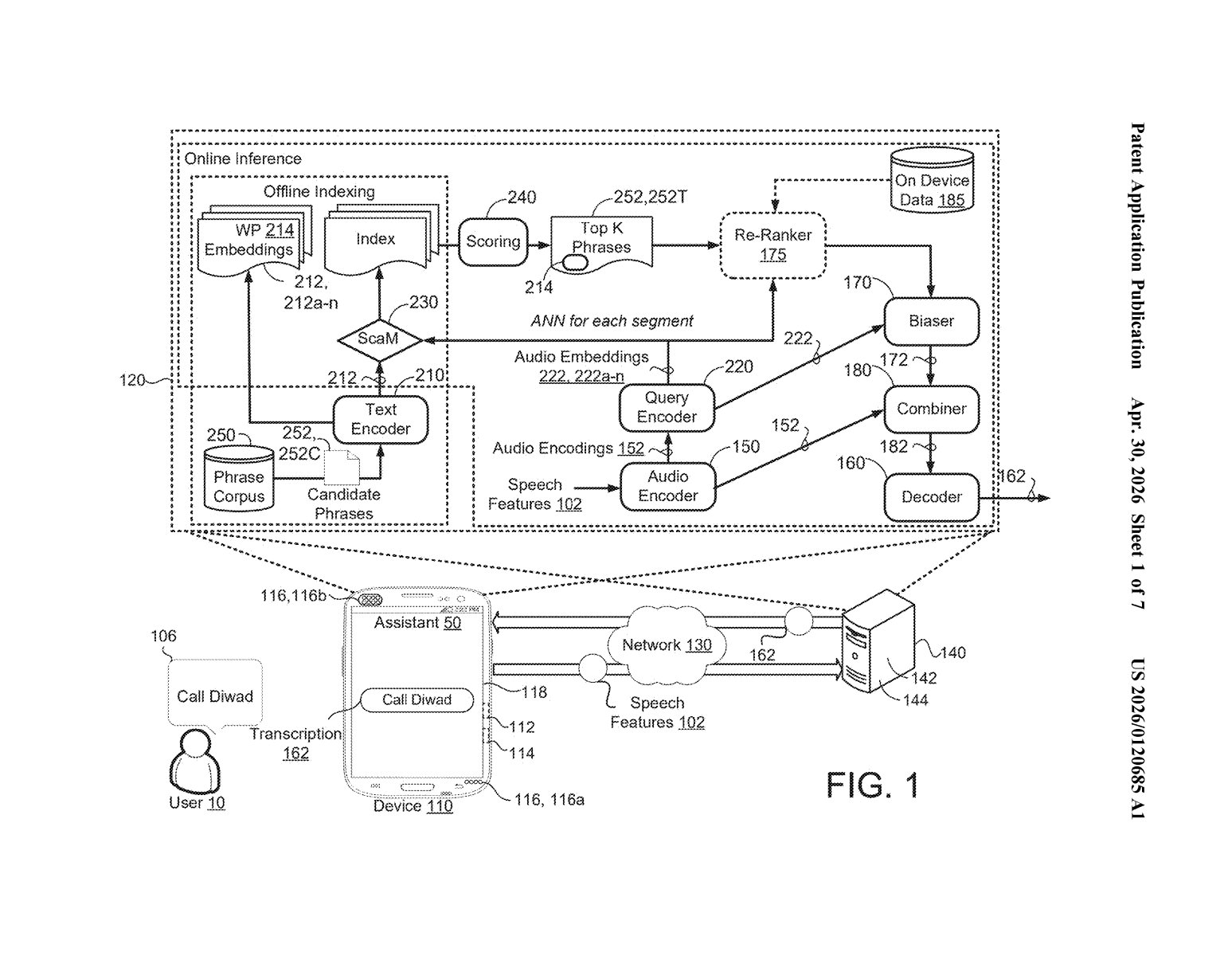
How Google's speech system predicts words mid-sentence
Imagine you're asking your phone about a restaurant: "Can you get me directions to Nobu Malibu?" A standard voice assistant has to hear the whole thing, then look up every possible word before deciding what you said. That's slow, and it struggles with unusual names, places, or brands.
What Google's patent describes is more like a well-read co-worker who's already thought of the five most likely things you might say next. While your voice is still coming in, the system is already scoring a big list of candidate phrases — things like proper nouns, contact names, or app titles — and picking the most relevant ones based on the audio so far.
Those top candidates then get fed into the transcription process as extra context, nudging the system toward the right answer. The result is a recognizer that's better at handling rare or custom vocabulary without having to slow down or search through millions of options at the last second.
How the neural retrieval module ranks and injects phrases
The system works in three linked stages, each handled by a different component.
First, an audio encoder converts incoming speech into a sequence of audio embeddings — dense numerical vectors that capture the meaning and sound of what's being said, frame by frame. Think of these as a compact mathematical fingerprint of your voice input.
Second, a neural retrieval module runs in parallel. It takes a large candidate phrase corpus — a library of words or phrases the system might need to recognize, like contacts, app names, or location names — and scores each one against the audio embeddings using a scoring function. Each phrase has been pre-encoded into its own phrase embedding and broken into wordpiece embeddings (sub-word tokens, the standard unit in modern language models). The top-K highest-scoring phrases are selected — the K most contextually relevant candidates.
Third, a biaser module combines the audio embeddings with the wordpiece sequences from those top-K phrases to produce a context vector — essentially a hint to the final recognizer about what vocabulary is most likely. The speech recognizer then uses both that context vector and the raw speech features to generate the final transcription.
- Audio encoder → speech embeddings
- Neural retrieval → top-K biasing phrases
- Biaser module → context vector
- Speech recognizer → final transcription
What this means for Google Assistant and Pixel voice
Voice assistants have always had a known weak spot: rare words. Proper nouns, brand names, niche medical terms, your contact list — these trip up generic models trained on broad text. The usual fix is brute-force: check every possible word after the fact. That's slow and doesn't scale.
Google's approach here — doing the vocabulary narrowing before transcription, using audio-based relevance scoring — could meaningfully improve accuracy for exactly the cases where voice recognition frustrates you most. If this lands in Pixel phones or Google Assistant, it would be most noticeable when you're asking for something specific: a person's name, a local business, or a niche command. That's also the category where getting it wrong is most annoying.
This is a genuinely smart systems patent, not a vague AI grab. The key insight — rank your vocabulary candidates against live audio before transcription, not after — is the kind of pipeline-level improvement that compounds over time. Google has been iterating on contextual biasing in speech recognition for years, and this looks like a meaningful architectural step forward, not incremental tuning.
There are more where this came from
We read every patent application Big Tech publishes and send you the ones worth knowing. Plain English, free, every week.
Want this weekly breakdown for a company we don't cover? Patentlyze Pro →