
Disney Files Patent for Grainy-Video Cleanup That Teaches a Faster Copy of Itself
Grainy video usually gets cleaned up at a cost: smeared details and faint ghosts of earlier frames. Disney's filing describes a cleanup model built to avoid both, then trains a smaller copy of itself to run about twice as fast.
What Disney's grainy-video cleanup tool does
Ever filmed something in a dim room and noticed the footage looks like it's crawling with specks? That grain is called noise, and cleaning it out of video is harder than it sounds. Many cleanup tools leave ghostly smears behind, like faint text from one frame hanging around in the next, or patches that flicker for no reason.
Disney's patent describes software that looks at a handful of neighboring frames at once instead of one at a time. Along the way it learns which details to pay attention to, so moving objects stay sharp and the picture doesn't shimmer. An artist can also dial the amount of cleanup and sharpening up or down in different parts of the image.
The filing also covers a shortcut. Once the big model is trained, it teaches a smaller copy to imitate it, and the filing says the smaller version can run about twice as fast.
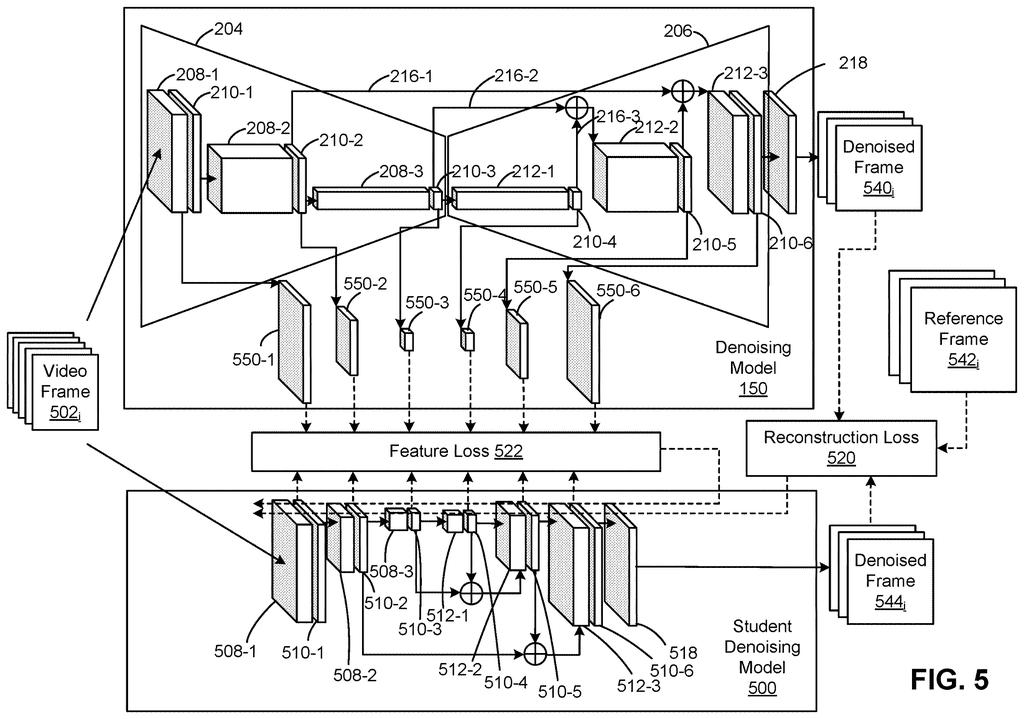
… inputting the one or more sets of noisy frames into (i) a first denoising model and (ii) a second denoising model that is smaller than the first denoising model …
Translation: The system feeds fuzzy footage into both a large cleaning model and a smaller copy at the same time.
How Disney's big model trains a faster one
The claims center on how you build the fast version. A large teacher model is trained first on pairs of noisy clips and clean reference clips. The noisy practice footage is made by adding different amounts of noise, and in some cases blur, to clean video.
A smaller student model then gets the same noisy frames. Training nudges the student to match the teacher in two ways:
- Feature loss: a score for how far the student's internal working notes (the patterns it pulls out of the frames) are from the teacher's.
- Reconstruction loss: a score for how far the student's cleaned frames are from the clean originals and from the teacher's own cleaned frames.
Both models share one layout: an encoder-decoder (it squeezes frames into a compact summary, then rebuilds them) made from 3D convolutions (filters that scan across width, height and time together). Attention modules (small components that learn which features deserve more weight) score each feature and each spot in the image, which the description says keeps fast-moving objects from leaving ghosts. A temporal fusion layer blends the results across frames. Training the teacher also penalizes frame-to-frame flicker. In one example, the student has about a quarter as many weights.
The denoising model can also be used to train a student denoising model that has a same architecture as, but is smaller and faster than, the denoising model.
Translation: The heavy-duty video cleaner teaches a smaller, speedier version of itself to do the same job.
Why faster video cleanup matters for Disney
If you've ever zoomed in on a phone video shot at night, you know the problem. Noise is the price of low light, and cleaning it up usually trades grain for smearing or flicker. This filing goes after both, and it says the cleanup needs no hand-entered noise settings or drawn masks, which the filing says older tools demand.
The speed gain matters just as much. A cleanup model that runs about twice as fast means shorter waits on long clips, and the description names camera footage and computer-rendered video as targets. It also lets an artist set cleanup and sharpening strength pixel by pixel. This is a patent application, so nothing here says where, or whether, it will ship.
Disney's fourth filing we've tracked in the AI photo editing race since September follows patents on turning flat scenes 3D and cutting actors from footage.
Grainy video is an everyday annoyance, and in film and TV production it is an expensive one. Footage shot in low light has to be cleaned up before anyone sees it, and the old fixes trade grain for smeared, flickering frames. That problem comes up constantly, and a model that watches several frames at once matches it well.
The shrinking step answers a cost problem too. A cleanup tool that runs slowly gets used sparingly, while one running about twice as fast can be used on far more footage. Training a small copy from a big one is a familiar move in AI, so the novelty here is modest.
The filing also offers little proof. It shows one comparison with fewer ghosts and gives a single speed figure, with no wider test results. Sensible work on a real problem, and a fairly routine way of solving it.
Get our take in your Top Stories
Liked this breakdown? Add Patentlyze as a preferred source on Google, and our plain-English take shows up more often in your Top Stories the next time Disney patent news breaks.
There are more where this came from
We read every patent application Big Tech publishes and send you the ones worth knowing. Plain English, free, every week.
The drawings
8 drawing sheets from US 2026/0320758 A1 · click any drawing to enlarge


Want this weekly breakdown for a company we don't cover? Patentlyze Pro →
Be the first to weigh in