
Samsung Files Patent for a Foldable Hinge That Mixes Two Kinds of Springs
Samsung's patent application splits the work inside a foldable's hinge between two kinds of springs: one built for a firm hold, one built for a crisp click.
What Samsung's two-spring foldable hinge does
The bigger a foldable gets, the harder its hinge has to work. A large screen is heavier, and a folded display pushes back, trying to spring flat again. Yet the hinge still has to hold the phone half-open on a table, then let you close it without a fight.
Samsung's patent application stops asking one kind of spring to do everything. Stacked disk springs (dished metal washers that pack a lot of force into a tiny space) handle the heavy holding. Ordinary coil springs handle the click you feel as the phone snaps fully open or shut.
Each spring presses on a notched part with its own slope, one gentle and one steep. Blended together, you get a firm hold at in-between angles and a crisp finish at the ends.
… a third elastic member coupled to the third shaft and configured to provide a second elastic force different from the first elastic force to the third cam; and a fourth elastic member coupled to the fourth shaft and configured to provide the second elastic force to the fourth cam …
Translation: It uses two different spring strengths inside the hinge to control how the phone folds.
How disk springs and coil springs split the job
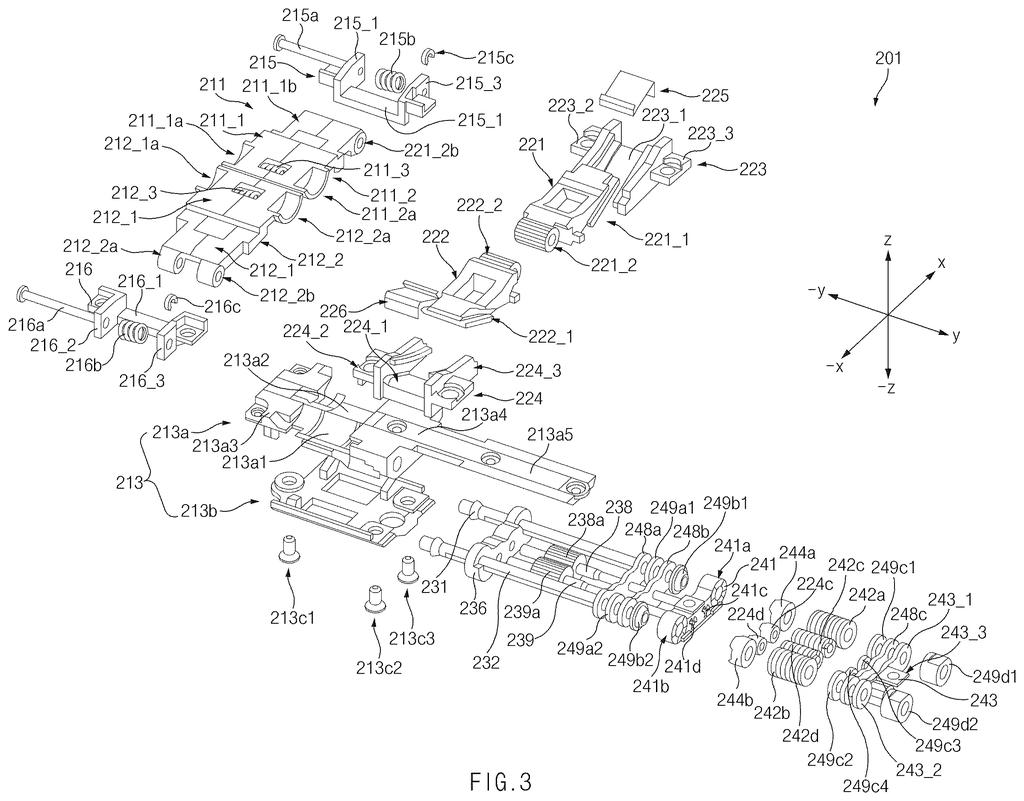
The hinge sits between the two halves of the phone, with four parallel shafts running through it. Two outer shafts connect to arms that move with each half, and two inner shafts carry linking gears so both halves swing in sync. Every shaft has a cam (a disc with ridges and valleys) that presses against a fixed, matching cam, and a spring pushes the pair together.
The claims turn on mismatching the springs and cams on purpose:
- Outer shafts: stacked disk springs push hard but move very little (about 0.05 mm per piece in the example), paired with a gentle cam. One claim puts its contact angle between 0 and 20 degrees.
- Inner shafts: coil springs push less but travel farther (about 2.0 mm in the example), paired with a steep cam of 35 degrees or more.
The gentle cam keeps a disk spring from losing much force when it shifts a hair, so the half-open hold stays firm and the last stretch of opening or closing takes less effort. The steep cam gives the coil springs a sharp detent (the little click that tells you the phone has locked into place). The example puts the disk-spring pair at 21.1 kgf (kilograms of force) and the coil pair at 6.5 kgf, and the filing says those numbers can change.
Alternating friction pads and support plates on the outer shafts turn spring pressure into the drag that holds the angle.
Disclosed are a hinge structure including elastic members that provide coupling of cam members and cams with different contact angles and elastic forces, and a foldable electronic device including the same.
Translation: Samsung filed a patent for a foldable phone hinge that combines different springs and cams.
Why a bigger foldable needs a stronger hinge
If you have ever held a big foldable half-open and felt it drift, or wrestled one shut against the screen's push, this is the problem the filing targets. Samsung says larger, heavier devices need more hinge torque to hold an angle, and it wants that strength without losing a clean click when the phone is fully open or closed.
Samsung's Galaxy Z Fold line is the closest match, though the filing names no product, and a patent application says nothing about what ships. Hinge parts are hidden from view, yet they decide how a foldable feels in your hand every day.
Samsung's 86th filing we've tracked on foldable phone patents since May, following work on reducing fold lines and a task-aware folder, adds another piece to the picture.
Every extra spring and shaft costs something. This hinge carries four spring packs, a stack of friction pads and support plates, and two spring types matched to cams cut at different angles, so more parts in a thin hinge mean more places for wear and cost to creep in.
Samsung's own numbers show why it takes on that burden. A stacked disk spring moves only about 0.05 mm per piece, and the filing says a shift of that size can cut its force by 20 percent or more when the cam is steep. So the gentle cam shields the disk springs, and the steep cam goes to the coil springs, which have room to move.
Splitting the job looks like a sensible trade for big screens. The weak point is time: a hinge that feels crisp on day one has to keep that feel after thousands of folds, and a patent application cannot show that. The filing offers no wear data, so the cost stays unmeasured.
Get our take in your Top Stories
Liked this breakdown? Add Patentlyze as a preferred source on Google, and our plain-English take shows up more often in your Top Stories the next time Samsung patent news breaks.
There are more where this came from
We read every patent application Big Tech publishes and send you the ones worth knowing. Plain English, free, every week.
The drawings
14 drawing sheets from US 2026/0323850 A1 · click any drawing to enlarge


Show the other 6 sheets


Want this weekly breakdown for a company we don't cover? Patentlyze Pro →
Be the first to weigh in