
Samsung · Filed Apr 23, 2026 · Published Oct 15, 2026

Samsung Files Patent for a Glass Layer Designed to Reduce Visible Folding Lines on Flexible Screens

Samsung's idea for a less visible crease starts before the screen ever folds: shape the cover glass in advance, right where the hinge will be.
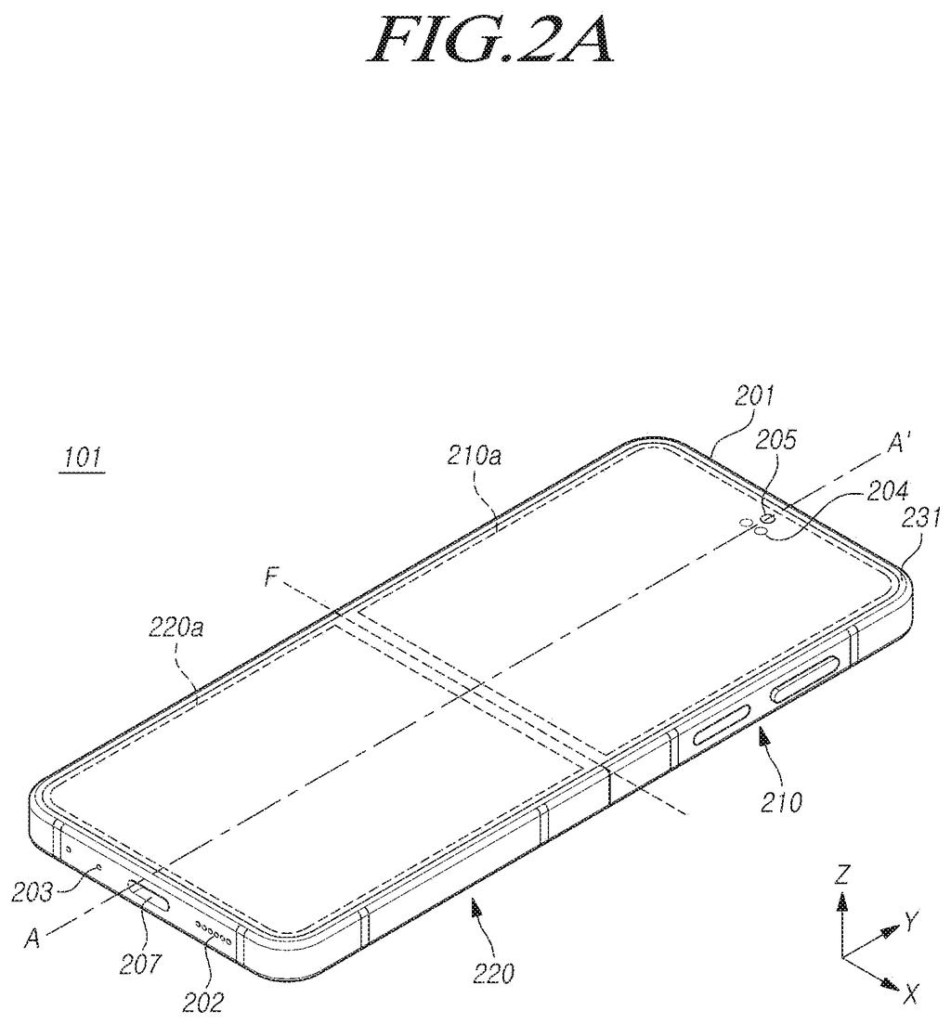
An unfolded smartphone with a flexible screen, marked along the central line where the display bends. Drawing from patent filing US 2026/0323852 A1.
An unfolded smartphone with a flexible screen, marked along the central line where the display bends.
See all 46 drawings from this filing ↓
Publication number US 2026/0323852 A1 US20260323852A1
Applicant Samsung Electronics Co., Ltd.
Filing date Apr 23, 2026
Publication date Oct 15, 2026
Inventors Sunghwan LIM, Hojung LEE, Hyunmoon CHO
US classification 361/807
Status when we published Waiting for an examiner (Jun 24, 2026)
Parent application is a Continuation of PCTKR2024014896 (filed 2024-09-30)
Document 20 claims

What Samsung's pre-bent foldable glass does

A foldable phone lies open on a kitchen counter, and a faint line runs down the middle of the screen. That line is the crease, and every time the phone closes, the screen pushes back a little against the hinge.

Samsung's patent application goes after both problems through the cover glass on top of the display. Instead of keeping that glass perfectly flat and forcing it to bend later, the strip over the hinge is shaped with a gentle dip ahead of time, so it has less distance to travel when you fold.

Soft, clear layers on the front and back fill in the dip, so the surface you touch still ends up flat. In the company's own computer simulations, the force pushing back dropped by about 47% compared with a similar cover that has no dip.

From the filing · CLAIM 1
… a flexible cover structure ( 400 ) disposed on the flexible display panel, the flexible cover structure comprising: a glass layer ( 410 ) including a first area (S 1 ) and a second area (S 2 ) extending from the first area and corresponding to a bending or rolling area of the flexible display panel …

Translation: The screen cover includes a special glass layer with flat and folding sections to handle the bend.

How the dented glass and two coatings stack up

The cover sits on top of a flexible display panel that spans two housings. Its glass layer has a flat first area over each housing and a second area over the part that folds or rolls. That second area is pre-formed into a shallow curve bending toward the rear coating, so the front face dips slightly and the back face bulges slightly.

Two clear polymer coatings wrap the glass. The front coating fills the dip so the top surface stays level, which makes it thickest right at the fold. The rear coating is far softer. The filing gives a modulus (a measure of stiffness) of about 600 MPa for the front and about 10 MPa for the back. Added up, the layers are the same total thickness over the fold as everywhere else.

The description also lists several variations:

  • Tiny holes or slits cut through the glass over the fold and filled with soft material, giving the glass room to stretch as it bends
  • Glass that gets thinner toward the center of the fold
  • A removable protective film, about 5 to 10 micrometers thick, on top
  • Front coating only in the fold zone, leaving bare glass elsewhere

The bent strip is narrower than the hinge, and the glass is roughly 30 to 200 micrometers thick depending on the version. The filing also covers rollable, outward-folding, sliding and multi-fold devices.

Why a softer crease matters on foldable screens

If this works the way the filing describes, a foldable would take less effort to close and show a less obvious crease. In the company's simulations, folding to a radius of about 1.5 mm produced roughly half the pushback force of a comparison cover (about 47% less), and the peak stress in the front coating fell by about 39%.

The design also moves where the stress builds up, away from the center of the fold and toward the edges of the bent strip. That shift is how the filing argues the crease gets shallower. It fits foldable phones like the ones Samsung already sells, though the filing names no product. Keep in mind that every result here comes from computer models, not a finished device.

Samsung's 85th filing we've tracked since May joins earlier work like one fixing camera blocks and one that adapts to your task in our foldable phone patents watch.

Editorial take

If you own a foldable, the crease is the thing you notice every time the screen lights up. A cover glass shaped to fold before you ever fold it aims at that exact spot, and the filing's own simulations show a big drop in the force needed to bend it.

You would feel the difference in how the hinge moves and see it as a fainter line across the middle. The catch is that the filing offers only computer models, with no real-world durability tests. Glass this thin has to survive keys, coins and thousands of folds, and a simulation can't promise that.

One version stands out for everyday use: the front glass is left bare outside the fold, so your fingertip meets glass directly. That makes this a modest-sounding hardware tweak that speaks to complaints foldable owners have today.

Get our take in your Top Stories

Liked this breakdown? Add Patentlyze as a preferred source on Google, and our plain-English take shows up more often in your Top Stories the next time Samsung patent news breaks.

There are more where this came from

We read every patent application Big Tech publishes and send you the ones worth knowing. Plain English, free, every week.

The drawings

46 drawing sheets from US 2026/0323852 A1 · click any drawing to enlarge

Smartphone internal parts and connections, drawing sheet 1 from US 2026/0323852 A1
Sheet 1 Smartphone internal parts and connections
Unfolded smartphone with flexible screen, drawing sheet 2 from US 2026/0323852 A1
Sheet 2 Unfolded smartphone with flexible screen
Folded smartphone showing outer cover, drawing sheet 3 from US 2026/0323852 A1
Sheet 3 Folded smartphone showing outer cover
Exploded view of foldable smartphone, drawing sheet 4 from US 2026/0323852 A1
Sheet 4 Exploded view of foldable smartphone
Cross section of screen hinge, drawing sheet 5 from US 2026/0323852 A1
Sheet 5 Cross section of screen hinge
Top view of display layers, drawing sheet 6 from US 2026/0323852 A1
Sheet 6 Top view of display layers
Side view of display layers, drawing sheet 7 from US 2026/0323852 A1
Sheet 7 Side view of display layers
Bending test of screen layers, drawing sheet 8 from US 2026/0323852 A1
Sheet 8 Bending test of screen layers
Show the other 38 sheets
Samsung Files Patent for a Glass Layer Designed to Reduce Visible Folding Lines on Flexible Screens patent drawing, sheet 9
Sheet 9
Samsung Files Patent for a Glass Layer Designed to Reduce Visible Folding Lines on Flexible Screens patent drawing, sheet 10
Sheet 10
Samsung Files Patent for a Glass Layer Designed to Reduce Visible Folding Lines on Flexible Screens patent drawing, sheet 11
Sheet 11
Samsung Files Patent for a Glass Layer Designed to Reduce Visible Folding Lines on Flexible Screens patent drawing, sheet 12
Sheet 12
Samsung Files Patent for a Glass Layer Designed to Reduce Visible Folding Lines on Flexible Screens patent drawing, sheet 13
Sheet 13
Samsung Files Patent for a Glass Layer Designed to Reduce Visible Folding Lines on Flexible Screens patent drawing, sheet 14
Sheet 14
Samsung Files Patent for a Glass Layer Designed to Reduce Visible Folding Lines on Flexible Screens patent drawing, sheet 15
Sheet 15
Samsung Files Patent for a Glass Layer Designed to Reduce Visible Folding Lines on Flexible Screens patent drawing, sheet 16
Sheet 16
Samsung Files Patent for a Glass Layer Designed to Reduce Visible Folding Lines on Flexible Screens patent drawing, sheet 17
Sheet 17
Samsung Files Patent for a Glass Layer Designed to Reduce Visible Folding Lines on Flexible Screens patent drawing, sheet 18
Sheet 18
Samsung Files Patent for a Glass Layer Designed to Reduce Visible Folding Lines on Flexible Screens patent drawing, sheet 19
Sheet 19
Samsung Files Patent for a Glass Layer Designed to Reduce Visible Folding Lines on Flexible Screens patent drawing, sheet 20
Sheet 20
Samsung Files Patent for a Glass Layer Designed to Reduce Visible Folding Lines on Flexible Screens patent drawing, sheet 21
Sheet 21
Samsung Files Patent for a Glass Layer Designed to Reduce Visible Folding Lines on Flexible Screens patent drawing, sheet 22
Sheet 22
Samsung Files Patent for a Glass Layer Designed to Reduce Visible Folding Lines on Flexible Screens patent drawing, sheet 23
Sheet 23
Samsung Files Patent for a Glass Layer Designed to Reduce Visible Folding Lines on Flexible Screens patent drawing, sheet 24
Sheet 24
Samsung Files Patent for a Glass Layer Designed to Reduce Visible Folding Lines on Flexible Screens patent drawing, sheet 25
Sheet 25
Samsung Files Patent for a Glass Layer Designed to Reduce Visible Folding Lines on Flexible Screens patent drawing, sheet 26
Sheet 26
Samsung Files Patent for a Glass Layer Designed to Reduce Visible Folding Lines on Flexible Screens patent drawing, sheet 27
Sheet 27
Samsung Files Patent for a Glass Layer Designed to Reduce Visible Folding Lines on Flexible Screens patent drawing, sheet 28
Sheet 28
Samsung Files Patent for a Glass Layer Designed to Reduce Visible Folding Lines on Flexible Screens patent drawing, sheet 29
Sheet 29
Samsung Files Patent for a Glass Layer Designed to Reduce Visible Folding Lines on Flexible Screens patent drawing, sheet 30
Sheet 30
Samsung Files Patent for a Glass Layer Designed to Reduce Visible Folding Lines on Flexible Screens patent drawing, sheet 31
Sheet 31
Samsung Files Patent for a Glass Layer Designed to Reduce Visible Folding Lines on Flexible Screens patent drawing, sheet 32
Sheet 32
Samsung Files Patent for a Glass Layer Designed to Reduce Visible Folding Lines on Flexible Screens patent drawing, sheet 33
Sheet 33
Samsung Files Patent for a Glass Layer Designed to Reduce Visible Folding Lines on Flexible Screens patent drawing, sheet 34
Sheet 34
Samsung Files Patent for a Glass Layer Designed to Reduce Visible Folding Lines on Flexible Screens patent drawing, sheet 35
Sheet 35
Samsung Files Patent for a Glass Layer Designed to Reduce Visible Folding Lines on Flexible Screens patent drawing, sheet 36
Sheet 36
Samsung Files Patent for a Glass Layer Designed to Reduce Visible Folding Lines on Flexible Screens patent drawing, sheet 37
Sheet 37
Samsung Files Patent for a Glass Layer Designed to Reduce Visible Folding Lines on Flexible Screens patent drawing, sheet 38
Sheet 38
Samsung Files Patent for a Glass Layer Designed to Reduce Visible Folding Lines on Flexible Screens patent drawing, sheet 39
Sheet 39
Samsung Files Patent for a Glass Layer Designed to Reduce Visible Folding Lines on Flexible Screens patent drawing, sheet 40
Sheet 40
Samsung Files Patent for a Glass Layer Designed to Reduce Visible Folding Lines on Flexible Screens patent drawing, sheet 41
Sheet 41
Samsung Files Patent for a Glass Layer Designed to Reduce Visible Folding Lines on Flexible Screens patent drawing, sheet 42
Sheet 42
Samsung Files Patent for a Glass Layer Designed to Reduce Visible Folding Lines on Flexible Screens patent drawing, sheet 43
Sheet 43
Samsung Files Patent for a Glass Layer Designed to Reduce Visible Folding Lines on Flexible Screens patent drawing, sheet 44
Sheet 44
Samsung Files Patent for a Glass Layer Designed to Reduce Visible Folding Lines on Flexible Screens patent drawing, sheet 45
Sheet 45
Samsung Files Patent for a Glass Layer Designed to Reduce Visible Folding Lines on Flexible Screens patent drawing, sheet 46
Sheet 46
Browse all the drawings 46 drawing sheets
Patent filing page

Source. Full patent text and figures from the official USPTO publication PDF.
Reader comments

Be the first to weigh in

Start the discussion

Real name or a handle, either is fine. Comments are read by a person before they appear, so allow a little time. Keep it about the filing.