
IBM Files Patent for Chatbots That Take Back Outdated or Off-Limits Answers
Ask a work chatbot a question today and the answer could be wrong tomorrow. IBM's patent application has the chatbot take back answers when the facts underneath them change, or when you lose permission to see them.
What IBM's expiring chatbot answers actually do
Ever asked a work chatbot a question on Monday, only to learn by Friday that the answer was out of date? Nobody told you, because the chatbot has no way of knowing the facts underneath it moved.
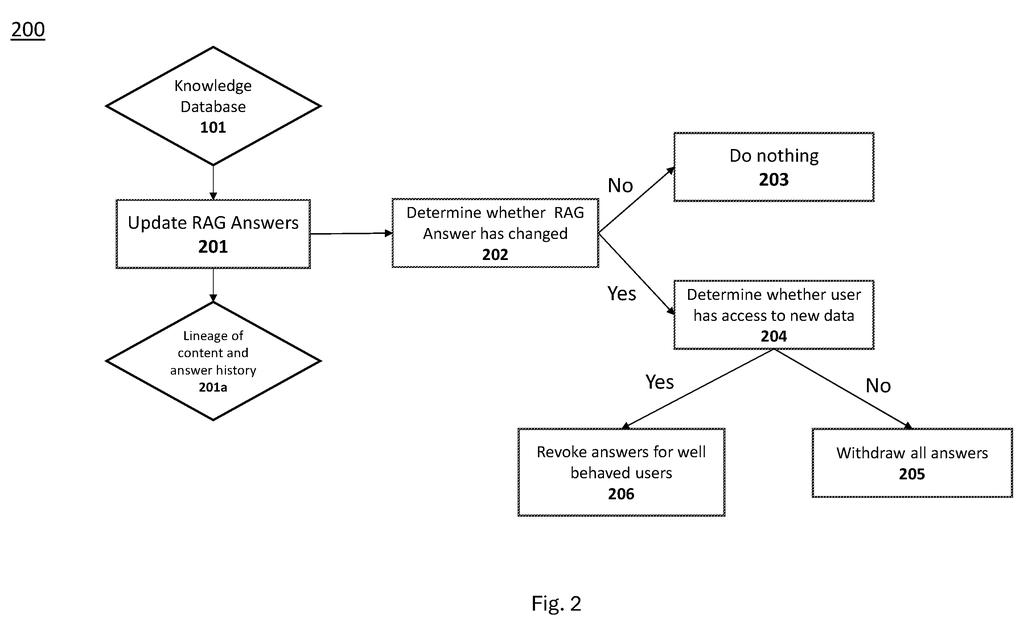
IBM's patent application tries to fix that. The chatbot's source library, which the filing calls a knowledge database, watches its own contents. When a document is edited, added or deleted, it alerts the answer system, which updates or revokes any answer that depended on it. You aren't left holding stale advice.
There's a second job too. In a company, marketing shouldn't be reading engineering's private project notes. If an answer touches data you aren't allowed to see, the system withdraws it. If you still have permission, you keep the answer, and you can see which documents it came from.
… updating one or more RAG answers based on the change in underlying data in the knowledge database …
Translation: The system automatically fixes previous chatbot responses when the source information changes.
How the database tells the chatbot to update
The setup has three parts. There's a knowledge database (the pile of documents, news, maps or company files the chatbot draws on), a RAG system (retrieval augmented generation, a layer that fetches relevant material and hands it to the chatbot so it answers from current sources instead of only its training), and the language model itself, the chatbot you type to.
The database watches itself for changes. The filing lists four ways to do that: Change Data Capture (a running log of every edit), polling (checking on a schedule), triggers (automatic alerts when a record changes) and webhooks (messages sent to other software when something happens). When the database reports a change, the RAG system updates the answers that relied on that data.
If a change affects an answer, the system then checks whether you are allowed to see the new data:
- No permission: the answer is withdrawn, and you may see an error or a message saying you lack access.
- Permission: answers based on outdated or incorrect information are revoked and replaced.
- No relevant change: the same answer stands, and the system keeps an answer as long as it can still reach the data behind it.
Permission checks can use company account details such as your title, department and access level, or established models like role-based access control (access decided by your job role). The filing even floats a chatbot guessing that a user is a child to block age-inappropriate material. The system also stores a lineage, a record of the documents behind each answer, and keeps old answers so it can compare them with new ones.
… controlling access to RAG answers by a user based on a permission of the user to the knowledge base …
Translation: It restricts what users can see based on their specific security clearance.
Why office chatbots need answers that expire
If your employer rolls out an AI assistant, two things can go wrong fast: it gives you an answer that stopped being true last week, or it hands you something from another team's private files. This filing goes after both with one mechanism, so answers track the data and the permissions behind them.
It also changes who does the checking. Today, the only way to know an answer is stale is to ask again, and the filing points out that thousands of people re-asking constantly would bog down the system. Pushing updates from the database avoids that. Keep in mind this is a patent application describing a method, not a product you can use.
IBM's 61st filing we've tracked since May in the AI guardrails race, this follows one on a tool-per-request AI and one on faster gene analysis.
Claim 1 is short: four steps. Watch a database for changes, get told when something changed, update the AI's answers, and control who sees those answers based on their permissions. It names no special algorithm and no particular kind of database, which makes it wide. If it were granted as written, any company building a chatbot on a monitored data source with permission checks would have to read that wording closely.
The breadth cuts both ways. Change monitoring and permission checks will be familiar to anyone who has used a shared drive, so a claim this general invites questions about what it adds beyond ordinary database habits. The dependent claims add detail, such as revoking answers, keeping them while access holds, and tracing which documents fed an answer, but none of those narrows the core idea much.
The problem is a good one, because stale and over-shared answers are what make office chatbots hard to trust. Whether this particular claim ends up protecting a solution to it is a different matter.
Get our take in your Top Stories
Liked this breakdown? Add Patentlyze as a preferred source on Google, and our plain-English take shows up more often in your Top Stories the next time IBM patent news breaks.
There are more where this came from
We read every patent application Big Tech publishes and send you the ones worth knowing. Plain English, free, every week.
The drawings
4 drawing sheets from US 2026/0320420 A1 · click any drawing to enlarge


Want this weekly breakdown for a company we don't cover? Patentlyze Pro →
Be the first to weigh in