
Apple Files Patent for a Headset Window That Shows You the Room Next Door
Apple has described a headset feature that makes your living room wall look like a window into the next room. Look at the right spot and you see what a camera on the other side sees, lined up with your own eyes.
What Apple's see-through-wall headset view does
Ever wondered what the kids are up to in the next room, but didn't want to get up and check? Apple has filed a patent for a headset feature that lets you look at your living room wall and see straight through it, as if someone had cut a window.
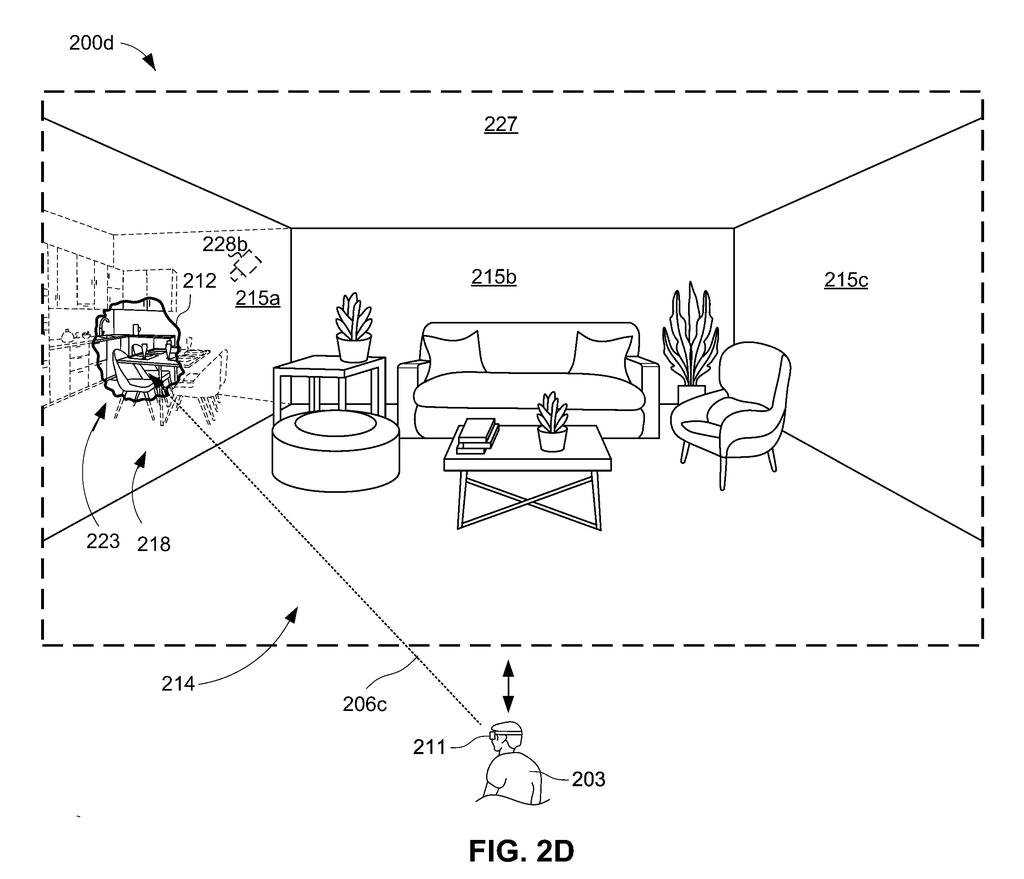
The trick is a camera in the other room. When you glance at a spot on the wall, or drag a virtual window onto it, your headset pulls in that camera's video and reshapes it so it matches what you'd see from where you're standing. Move your head, and the view shifts with you. The window can fade in slowly or pop open instantly.
Because the camera has to roughly face the same way you do, the patent also checks that the angles line up, and even describes a small motor that can turn the camera toward you.
presenting, via the one or more displays, a first view from a first viewpoint within a first location within an environment, wherein the first view includes an obstacle preventing the first view from including a portion of a second location within the environment …
Translation: The headset shows you your current room, but something is blocking your line of sight to the next one.
How the camera view gets matched to your eyes
Claim 1 covers a method run on a device with a display. It shows you a first view from where you are, in which an obstacle (a wall, say) blocks part of a different location. When the device detects a triggering condition, it shows a second view where the hidden part of that other location appears, built from image data from a sensor placed inside it.
The dependent claims fill in how the trigger works:
- Looking toward the hidden room.
- Dragging a virtual window (a portal) onto the wall.
- Making a gesture.
- Aiming your gaze at an invisible activation point on the wall. The description suggests holding your gaze for about a second, to avoid accidental openings.
The description says the camera's video is turned into a depth map (an estimate of how far away each thing is) and then a 3D point cloud, a cloud of dots standing in for the room. A chain of position calculations then re-renders those dots from your eye position instead of the camera's. A claimed alignment criterion checks that the camera and your device point in roughly the same direction, within a threshold angle, and a motor can turn the camera to line them up.
If the angle gets too steep, the picture can fade out, and a stored model of the room can fill gaps. The opening can appear instantly or over a set time, replacing part of the wall.
… present a second view of the environment generated based on image data captured from a second viewpoint within the second location …
Translation: It switches to a camera feed from the other room so you can see past the blockage.
Why the camera in the other room is the catch
If you have ever wanted to check on a child, a pet, or a computer in another room without getting up, this is the idea. Your headset would show that room right on your wall, from your angle. The filing names a TV, a table, a person such as a child, and a crib as things you might want to see.
The catch is the camera. The view only works if a camera is already sitting in the other room, and the patent wants it facing roughly your way, which is why it mentions a motor that can turn it toward you. That puts a camera in a space where someone else may be, so consent and privacy would matter in practice. For Apple, it fits a head-mounted display that tracks your eyes and mixes digital content into your real room, as this filing describes.
Apple's 88th filing we've tracked since May on Apple's AR glasses adds to earlier work like fixing room scans and a bigger headset keyboard.
Claim 1 is short and wide. It asks for a display, a view where something blocks part of another place, a trigger, and a second view built from a camera in that other place. Nothing in it says headset, wall, eye tracking, or even that the video gets reshaped to match your eyes.
Those details show up in the dependent claims: looking toward the hidden room, dragging a virtual window onto a wall, making a gesture, and checking that the camera and your device face roughly the same direction. So the broad claim covers the basic idea of peeking at a camera in another room on demand, and the narrower ones cover how Apple would do it well.
As written, the wording reaches any display that swaps an obstacle for a live view from a camera in another room, which is a lot of ground. Claims this wide often get narrowed during review, so the final scope could look quite different. Still, the idea is easy to grasp and easy to want.
Get our take in your Top Stories
Liked this breakdown? Add Patentlyze as a preferred source on Google, and our plain-English take shows up more often in your Top Stories the next time Apple patent news breaks.
There are more where this came from
We read every patent application Big Tech publishes and send you the ones worth knowing. Plain English, free, every week.
The drawings
8 drawing sheets from US 2026/0320932 A1 · click any drawing to enlarge


Want this weekly breakdown for a company we don't cover? Patentlyze Pro →
Be the first to weigh in