
Samsung Files Patent for a Camera Sensor That Keeps Autofocus Working in Bright Light
Phone cameras tend to struggle with focus in harsh light, because the tiny pixels that judge focus can fill up and spill over. Samsung's patent application describes a sensor layout built to read those pixels cleanly even when they overflow.
What Samsung's shared-lens focus sensor does
Every time you tap your screen to focus on something in bright sun, your camera has to work out which way to move its lens. It figures that out by comparing light arriving from the left and right sides of the scene, using tiny pixels on the sensor.
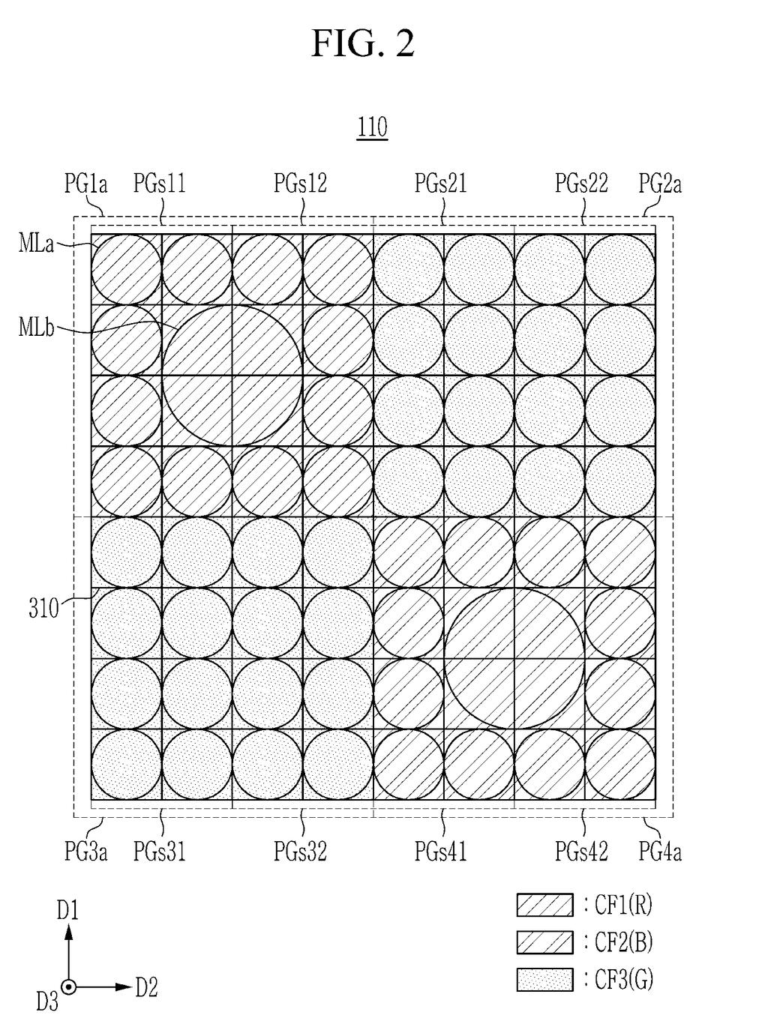
In harsh light, those pixels can fill up and spill over, which makes the comparison unreliable. Samsung's patent application describes a sensor layout where one small lens sits over pixels that feed two separate readout points, so the left and right signals come out together. Extra storage capacitors catch the spillover instead of letting it go to waste.
The goal is sharp focus in bright scenes without giving up photo detail.
a first sub-pixel group including a first plurality of photodiodes, the first plurality of photodiodes being arranged in a first plurality of rows and a first plurality of columns, and the first plurality of photodiodes sharing a first floating diffusion node …
Translation: A set of light-sensing pixels share a single electrical connection to process signals together.
How two readout paths feed one focus lens
The sensor is built from sub-pixel groups: clusters of light-sensing photodiodes (the tiny detectors that turn light into electrical charge). In the main example, each group is a 4x2 block of eight photodiodes. Every group shares a floating diffusion node, a small holding spot where the collected charge is turned into a voltage that can be read out.
The key claim puts two neighboring groups, each with its own separate node, under the same color filter. One shared lens then overlaps both groups. In the main example, that lens covers a 2x2 patch of four photodiodes that straddles the boundary, so the left pair feeds one node and the right pair feeds the other.
Because each side has its own node and its own column line (the wire carrying the signal to the read-out circuit), the chip can read left and right signals together. It compares them to produce phase data, which tells the camera how far out of focus the image is. The filing says this avoids a slower sequence of reading a reset level, then the left signal, then a combined signal.
The method claim adds conversion gain switching. That is how strongly charge becomes voltage: high for dim scenes, low for bright ones. The sensor reads in one mode, then connects
- Metal-insulator-metal capacitors (small charge-storage layers stacked over the pixels)
- That soak up overflowing charge in bright light
and reads again in the second mode. Phase data comes from that second read. The filing also describes 2x2 sub-pixel groups, three-level gain switching, and a lens spanning more groups.
… a first lens, at least a portion of which is overlapped planarly with the first sub-pixel group and the second sub-pixel group …
Translation: A single lens covers multiple pixel groups to help capture light more effectively.
Why bright-light focus matters for phone cameras
If you shoot in bright daylight, this is the situation where your phone's focus most needs to be reliable: a kid running across a sunny yard, a beach, a ski slope. Bright scenes are where the focus-sensing pixels can overflow, so fixing that could mean fewer soft, missed shots.
The filing also says its layout skips dedicated focus-only pixels, the kind that are partly masked with metal and contribute nothing to the picture. Using the same pixels for both photos and focus is how sensor makers try to chase higher resolution without losing focus speed. The patent also mentions vehicles as a place these sensors could be used, so the same idea could matter beyond phones.
Samsung's 149th filing we've tracked since May joins a growing set that includes one rating video frame detail and one slimming the lens stack in our camera sensor push watchlist.
Autofocus failures in bright sunlight are one of those quiet failures that photographers accept as permanent. They hit hardest at outdoor events, beaches, and anywhere people are moving fast in strong light, which is to say they hit hardest at the moments people most want to capture.
The design targets that specific failure rather than camera quality broadly, which is the right instinct. Separate readout paths, overflow storage, and a shared lens each address one reason bright-light focus breaks down, and together they add up to something proportionate to the actual problem.
Because this is a hardware layout buried inside the sensor, it will never appear as a feature in a spec sheet. If it works, you will simply notice that focus holds in sunlight when it used to slip.
Get our take in your Top Stories
Liked this breakdown? Add Patentlyze as a preferred source on Google, and our plain-English take shows up more often in your Top Stories the next time Samsung patent news breaks.
There are more where this came from
We read every patent application Big Tech publishes and send you the ones worth knowing. Plain English, free, every week.
The drawings
26 drawing sheets from US 2026/0323179 A1 · click any drawing to enlarge


Show the other 18 sheets


Want this weekly breakdown for a company we don't cover? Patentlyze Pro →
Be the first to weigh in