
Nvidia Files Patent to Keep AI-Altered Faces From Looking Pasted Onto Video
When an AI makes a still photo talk, the redrawn face often stops lining up with the shoulders under it. Nvidia's patent filing fixes that by using the body as an anchor.
What Nvidia's face-blending patch fix does
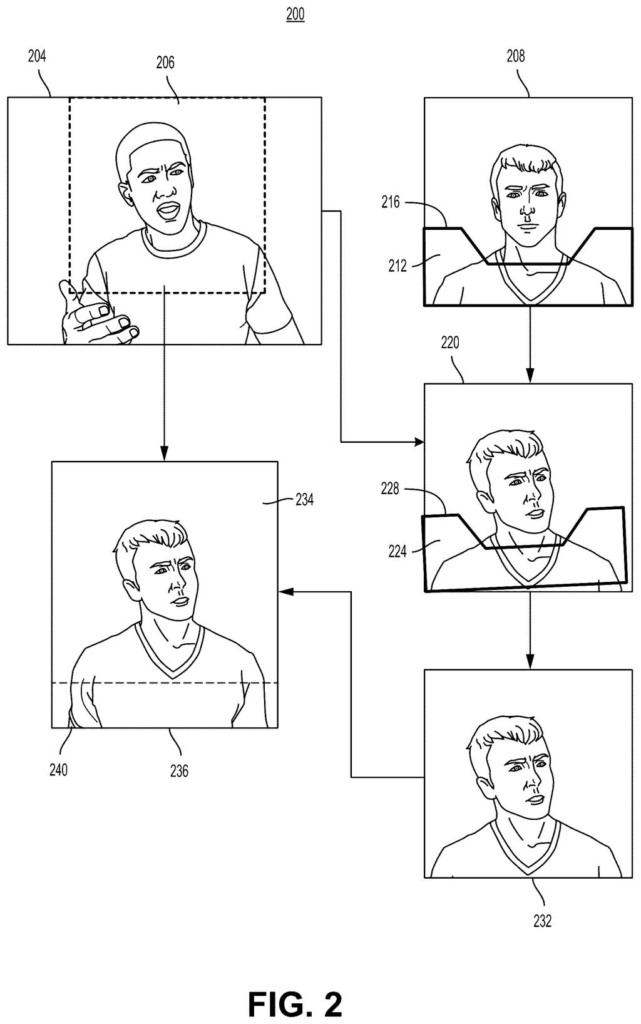
A still photo of a person sits on a screen. A recording of someone talking plays, and an AI makes the person in the photo tilt their head and move their mouth to match. The catch is that the AI only redraws a small square cut out of the photo, and that redrawn square rarely lines up perfectly with everything around it.
The result can look like a sticker slapped on the original, with shoulders that shift or a collar that jumps. Nvidia's patent filing describes a fix. The system looks at the part of the square that should barely move, like the shoulders and chest, and measures how far off it landed compared with the original photo. It then slides, turns or resizes the whole square to correct that, and blends the edges in.
The goal for you as a viewer: a stream where the talking person looks like one continuous picture, instead of a head floating over a photo.
identify a portion of a subimage comprising a subset of pixels modified from a reference image according to at least one of (i) a criterion for detection of a feature in the portion of the modified subimage or (ii) a criterion for expected movement of one or more pixels representing the feature in the portion of the modified subimage …
Translation: It pinpoints which parts of the picture were altered by AI and tracks how those pixels should move.
How shoulders anchor an AI-edited face
The patent covers three steps. First, a neural network (software trained on many examples) redraws a small cropped patch of a reference image, guided by a driving signal such as audio, text or another video. Second, the system picks a region of that redrawn patch to use for alignment, chosen because its features are easy to detect or because it is expected to move little. Third, it computes a correction and applies it to the whole patch.
The filing's example uses a band along the bottom of a head-and-shoulders patch, where the shoulders and upper chest sit. Alignment (called registration) means finding the settings that best match that band to the original photo. The main example uses a similarity transform, which has four settings:
- Horizontal shift
- Vertical shift
- Resize
- Rotation
The system searches for the settings that shrink the pixel differences between the two (a least squares measure, which adds up squared errors). For video, the answer from one frame becomes the starting guess for the next, and for big movements it can work coarse to fine across several resolution levels. It can also account for brightness and contrast mismatches. The claims also list other transform types, such as affine and projective.
Finally, the corrected patch is blended back into the original using a feathered blend (soft edges that fade into the surroundings) and output as a content stream.
… transform the modified portions to more realistically and precisely merge back into the reference images, such as for presentation as a content stream …
Translation: It adjusts the edited sections so they blend smoothly into the original video stream.
Why AI-edited video streams need this fix
If AI-altered video is going to look believable on your screen, the seams have to disappear. The filing describes talking-photo and video uses where speech, text or another person's movements drive a face, and it says the same approach could change the language a subject appears to speak. A visible glitch at the neck or shoulders is an easy giveaway, so fixing it matters for anyone building these tools.
The filing also describes running this in a game-streaming style setup, where servers do the heavy work and your device just shows the result. It names NVIDIA GeForce Now as one example of that kind of service. Nothing here says a product is coming, but it shows where Nvidia sees this editing step fitting.
Nvidia's 30th filing we've tracked since May, after their 360-degree scene application and their local camera fix, adds another piece to the AI photo editing race we follow.
The design bets that shoulders and chest sit still while the face moves. That bet buys speed: four adjustments (shift, shift, resize, turn) are cheap enough to recompute on every frame of a live stream. The cost shows up when the bet fails. If the person shrugs, leans toward the camera or waves a hand, the anchor region moves too, and the correction could drag the face along with it.
A simple correction also cannot repair a face the AI has stretched or bent unevenly. It can only slide, turn and resize the patch as a whole. The filing lists transforms with more freedom, which would handle more distortion.
For talking-head video, where the camera and body mostly hold still, the trade reads as a good one. It is a modest, practical fix for a visible flaw, and it does not depend on a bigger AI model.
Get our take in your Top Stories
Liked this breakdown? Add Patentlyze as a preferred source on Google, and our plain-English take shows up more often in your Top Stories the next time Nvidia patent news breaks.
There are more where this came from
We read every patent application Big Tech publishes and send you the ones worth knowing. Plain English, free, every week.
The drawings
6 drawing sheets from US 2026/0320808 A1 · click any drawing to enlarge


Want this weekly breakdown for a company we don't cover? Patentlyze Pro →
Be the first to weigh in